
AI Marketing in Travel: Shift from Traditional Tactics
Discover why travel brands are switching to AI marketing, which tactics drive the biggest ROI, where AI creates advantage, and how to start without overspending.
AI IN TRAVEL
Powerful Digital Marketing
6/10/20268 min read
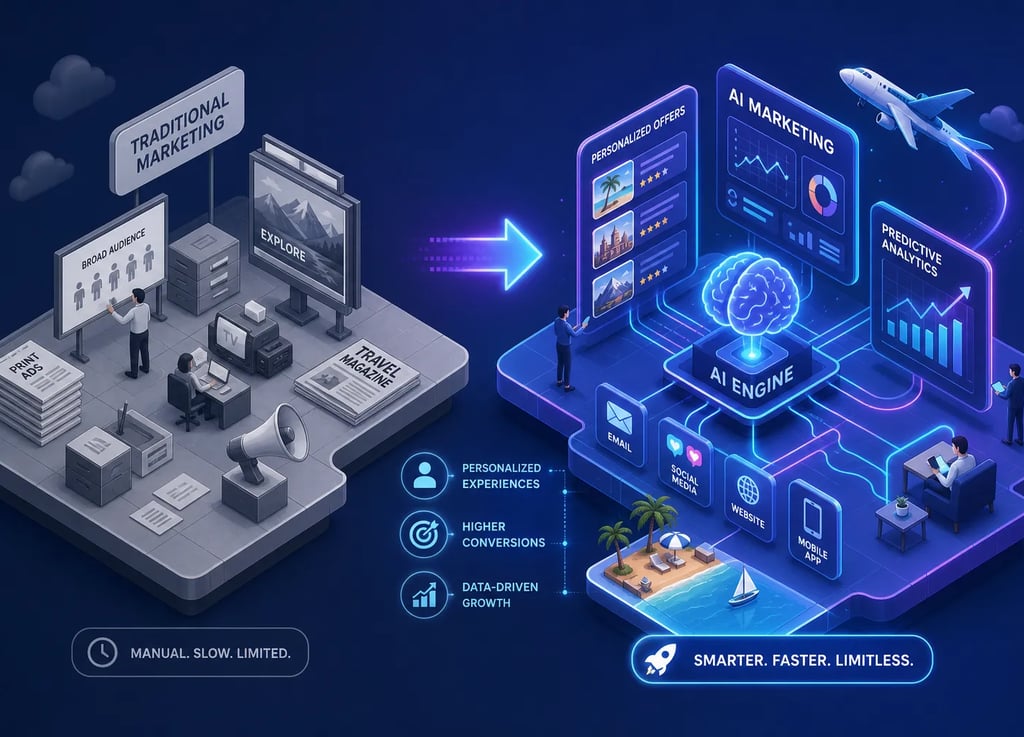
The Shift from Traditional to AI Marketing in the Travel Industry
Why travel brands are switching from traditional to AI marketing is now the central question for hotels, OTAs, tour operators, and destination management companies worldwide. Brands that built their businesses on brochures, trade shows, and broad display ads are watching AI-powered competitors win customers before a single click is registered. This is a structural change in how travellers discover, evaluate, and book travel, not a minor shift in channel preference. The core drivers are rooted in survival economics: rising acquisition costs, declining organic visibility, and the growing impossibility of competing manually against platforms deploying machine learning at billion-dollar scale.
Smaller operators are exposed to the same market forces. Boutique hotels, independent tour operators, regional cruise lines, and destination management companies all face the same pressures, even where internal AI adoption remains limited. Industry data indicates that marketing-tool AI adoption across smaller travel operators sat below 25% as of 2025, which means the competitive gap between early movers and those waiting is widening fast. A growing group of specialist agencies has built their entire model around this transition, helping travel brands navigate the shift with purpose-built tools rather than generic strategies borrowed from retail or SaaS. For most travel businesses, the question is no longer whether AI marketing is relevant, it is how far behind they can afford to fall before catching up becomes genuinely expensive.
This article covers what the data actually shows, where AI creates the clearest competitive advantage, how traveller discovery is changing, what barriers genuinely slow this transition down, and how to start moving without burning the budget.
Why Traditional Travel Marketing Is Losing Its Edge
OTAs like Expedia and Booking.com spent a combined $17.8 billion on sales and marketing in 2024, according to their respective annual financial disclosures. That spend is optimised by machine-learning algorithms that adjust bids, target audiences, and personalise creative in real time, using data pools that dwarf anything an independent hotel or mid-sized tour operator can match. When a boutique hotel runs a static Google Ads campaign with manual bidding, it is not competing on equal terms, it is competing against a system refined across millions of bookings. The outcome is predictable for smaller operators: cost-per-booking climbs, conversion rates stagnate, and margin erodes, though the severity varies by channel, market, and campaign structure.
The personalisation gap compounds the problem. Traditional email blasts, seasonal brochures, and untargeted social posts treat every potential traveller as roughly the same person. Research into travel-sector personalisation performance, including figures cited by Phocuswright and Simon-Kucher, indicates that personalised offers generate up to three times the ROI of generic campaigns. A travel brand spending the same budget as a competitor but running undifferentiated messaging is effectively getting a fraction of the return. AI-driven personalisation in travel changes this equation by deploying that same budget against micro-segmented audiences with dynamic creative built around actual booking intent, not demographic assumptions.
Why Travel Brands Are Switching from Traditional to AI Marketing: What the Data Shows
The quantified business case for AI travel marketing is no longer speculative. Travel brands using AI-driven targeting and intent data are reporting approximately 25% higher booking rates after implementation, according to findings from Master of Code's travel-sector analysis. AI-based next-best-action recommendations are lifting revenue by 5 to 15%, while AI-based customer lifetime value optimisation is increasing CLTV by 20 to 30%, based on Simon-Kucher's research into travel and hospitality AI deployment. Marketing ROI improvements of 20% are reported by travel marketers using generative AI for campaign content, with a significant portion of that group seeing gains well above that baseline.
Marriott cut time-to-market for campaign content by 70% through AI-driven content generation, a figure documented in SNS Insider's hospitality technology reporting. Hospitality brands using AI-powered guest engagement tools are reducing support ticket volumes by 60% while resolving queries in under 30 seconds, directly lifting satisfaction scores. These are cost-structure gains, not merely marketing ROI improvements. When a travel brand produces campaign content faster, responds to enquiries around the clock, and reduces manual overhead across the customer journey, those efficiency gains compound in ways that traditional marketing investment cannot replicate.
Where AI Creates the Clearest Competitive Advantage for Travel Brands
How AI Personalisation is Changing the Way Travel Brands Connect with Customers works by connecting booking history, browsing behaviour, and seasonality signals to serve each potential traveller content and offers that reflect their actual intent. Tools like HubSpot AI, Salesforce Einstein, and specialised travel CRM platforms now allow mid-sized operators to run micro-segmented campaigns that previously required enterprise-level teams and budgets. The contrast with traditional segmentation is significant: where traditional campaigns filtered by age and geography, AI filters by real-time behavioural signals, look-to-book window data, and previous booking patterns.
Conversational AI is another area where the advantage is measurable and immediate. Smart chatbots trained on travel inventory and FAQs now handle a substantial share of pre-booking enquiries, qualifying leads, answering destination questions, and moving browsers toward checkout without human involvement. Platforms like Tidio are used specifically by travel agencies and hospitality brands to capture lead data automatically, including travel dates, group size, and budget, feeding it directly into CRM for follow-up. Travel marketing automation delivers one of its clearest ROI signals here: more qualified enquiries, less manual overhead, and a shorter path from first contact to confirmed booking.
Generative AI for travel is also streamlining content production at a scale traditional content calendars cannot match. Ad copy, landing pages, email subject lines, and seasonal offer content are produced faster and A/B tested more rigorously using tools like Jasper, Brevo's AI layer, and Buffer's AI features. Production timelines that once took days have been compressed into hours, both for agencies and in-house teams that have embedded these tools into their workflows.
How AI Is Changing the Way Travellers Find and Choose Travel Brands
AI Overviews and chat-based travel planning tools are now answering a growing share of travel search queries directly, often before a user clicks through to a website. Data from SEO research tracking AI search features shows that zero-click behaviour rises from 34% on queries without an AI Overview to 43% when one is present, and to 93% in AI Mode. Organic click-through rates have dropped by roughly 30% since AI search features expanded, with DMOs reporting year-over-year traffic declines of 20 to 40%. For travel brands that built their acquisition model around traditional SEO, this represents serious structural exposure.
Traditional SEO was optimised for blue-link rankings. AI search visibility requires a brand's content to be structured, current, and authoritative enough for AI systems to cite it as a trusted source. Two travellers asking similar questions may now see entirely different brands recommended, not based on ranking position, but on which brand's content AI systems treat as the most reliable answer. Discovery is becoming personalised in a way that blue-link SEO never was, and that shift is accelerating.
Paid search still captures intent-driven demand, but AI-driven discovery is shortening the funnel. Travellers increasingly receive synthesised shortlists or itineraries rather than browsing multiple sites independently. The most effective approach now combines traditional SEO for discoverability, structured authoritative content for AI citation, and paid search for demand capture. Managing that stack requires AI tools and a clear understanding of where each channel sits in the modern booking journey.
Why Travel Brands Are Switching from Traditional to AI Marketing: The Real Barriers
Most travel brands hold more first-party data than they realise, booking records, loyalty data, website behaviour, email engagement. The problem is that this data typically sits across disconnected systems that do not communicate with each other. AI travel marketing depends on connected, clean, real-time data. Without it, personalisation engines make poor decisions, attribution stays broken, and the ROI case never materialises. A full platform overhaul is not always necessary; consolidating key data streams into a single CRM layer is often the practical first step that unlocks everything downstream.
Skills gaps and governance concerns create a separate set of friction points. Teams built for traditional marketing do not automatically know how to manage AI tools, interpret outputs critically, or build test-and-learn frameworks for campaign optimisation. There are also legitimate concerns around GDPR compliance, data consent, and the risk of AI-generated content that drifts from brand voice or contains inaccuracies. UK and European travel brands must navigate these carefully, particularly where behavioural profiling, location data, and payment-related information are involved in personalisation workflows.
The technology itself is rarely the sticking point. Having the right people and processes around it is what determines whether an AI implementation delivers or stalls. This is why travel brands are increasingly looking for specialist partners rather than trying to build AI capability entirely in-house, where the learning curve is steep and the cost of getting it wrong falls entirely on the business.
Starting the Transition: A Practical Roadmap for Travel Brands
The highest-return entry points for AI adoption in travel marketing are the ones closest to the booking decision: paid search optimisation, CRM personalisation, and chatbot-led lead capture on the website. Attempting to transform every channel simultaneously is how budgets get wasted. Starting where travellers are actively in the look-to-book window delivers faster, measurable ROI and builds the internal confidence needed to expand from there.
Before launching any AI tool, establish clear KPIs: cost-per-booking, direct booking rate, email engagement lift, and chatbot-to-qualified-lead conversion are the metrics that matter most for travel brands. For example, a mid-sized tour operator might benchmark its current chatbot enquiry volume and conversion rate over 30 days before deploying an AI-trained assistant, creating a clean before-and-after comparison that makes the ROI case internally. Without these baselines in place before implementation, attributing improvements accurately, or justifying continued investment, becomes significantly harder.
For boutique hotels, tour operators, and DMCs, the biggest risk is not investing in AI. It is investing in the wrong tools, or applying AI marketing strategies borrowed from unrelated industries. This is where working with a specialist makes a material difference. Powerful Digital Marketing is an AI-powered digital marketing agency built specifically for the travel industry, combining travel sector expertise across hospitality, cruise, tour operations, and holiday packages with purpose-built tools for AI travel marketing, SEO, PPC, competitor intelligence, and smart chatbot implementation. Travel brands working with a partner of this kind get strategies calibrated to real traveller psychology, seasonality, and booking behaviour, not recycled templates from an agency that worked on retail last quarter.
To dive deeper into targeted ad strategy, see Why AI PPC Travel Industry Campaigns Are Changing the Travel Advertising Game, which explores optimisation tactics for paid search and programmatic campaigns specific to travel inventory and seasonal demand.
The Shift Is Already Here
The travel marketing transformation from traditional to AI-driven approaches is not a future trend to monitor. It is a present commercial reality, supported by data across booking rates, revenue lifts, operational efficiency, and search visibility, and driven by traveller behaviour that traditional channels were never built to handle. The revenue improvements and booking rate gains documented across the industry are not projections; they are reported outcomes from brands that made the switch and built their marketing around AI-driven personalisation, automation, and search visibility.
Understanding why travel brands are switching from traditional to AI marketing becomes clearer when the numbers are laid out side by side: higher booking rates, stronger CLTV, lower cost-per-acquisition, and content produced at a fraction of the time. Starting that process today, even with a single channel, puts any travel brand ahead of where it will be if it waits another year. The brands gaining ground now are those that moved early, chose partners with genuine travel expertise, and focused their AI investment on the moments that matter most, when a traveller is ready to book. If your business is ready to begin that transition, How AI in Travel Marketing Is Transforming the Cruise and Travel Industry and Powerful Digital Marketing are resources that can help plan the first practical steps.
ADDRESS
The Powerful Group Limited
124 City Road
London
United Kingdom
EC1V 2NX
WORKING HOURS
Monday - Friday 9:00 AM - 6:00 PM
Saturday - Sunday 8:00 AM - 12:00 PM
Want to Call? Ask our Powerful Bot for the Number