

AI Marketing ROI vs Traditional: Travel Industry Guide
AI marketing ROI vs traditional for hotels & tour operators. Find channel benchmarks, OTA cost impact, and a framework to test ROI with booking data.
AI IN TRAVEL
Powerful Digital Marketing
6/11/20268 min read
How AI Marketing ROI Compares to Traditional for the Travel Industry
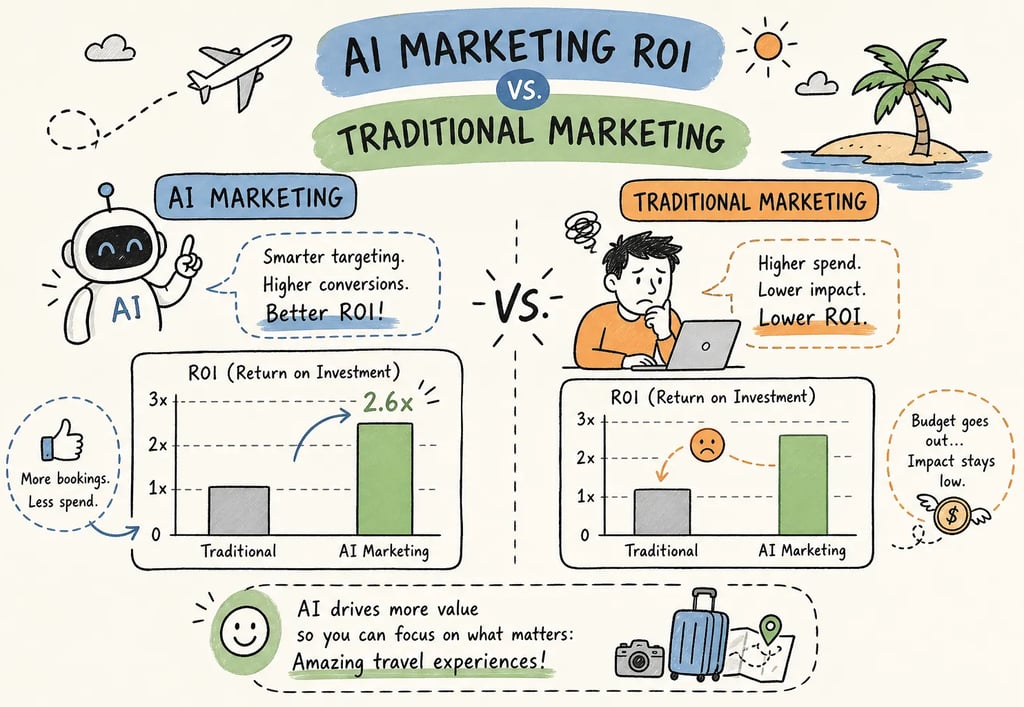
When comparing AI vs traditional marketing ROI for hotels and tour operators, the data tells a more nuanced story than either camp tends to admit. Every hotel owner and tour operator knows the feeling: traditional marketing feels manageable and the channels are familiar. But many operators report rising acquisition costs, growing pressure on margins from OTA commissions, and conversion rates that have trended downward over recent years. At some point, the question stops being "should we try AI marketing?" and starts being "can we actually afford not to?" This article answers that question with data, not opinion. You'll find channel-by-channel ROI benchmarks for traditional marketing, real case study numbers from AI deployments, and a measurement framework built around the booking cycles of hotels and tour operators.
The comparison is more nuanced than a simple "AI wins" headline. Timing, data readiness, and measurement discipline all shape the outcome. A hotel with three years of clean CRM records and a well-integrated PMS will see faster returns than one whose guest data lives across five disconnected spreadsheets. What follows gives you the benchmarks to build a credible business case and the framework to test it properly.
What traditional hotel and tour operator marketing actually returns
Channel benchmarks: email, SEO, and paid search
Traditional digital marketing has well-documented returns across three core channels. Email marketing benchmarks in hospitality run at roughly £36 to £40 revenue per £1 spent, making it the highest-returning channel when past-guest lists are properly managed and segmentation is applied to transactional messages. The economics make sense: you're communicating with people who have already stayed, already trust you, and are far cheaper to convert than a cold prospect arriving through a paid ad.
SEO typically delivers in the 5:1 to 10:1 range for well-optimised hotel programmes, with the compounding nature of organic search meaning returns improve over time rather than resetting each month. PPC and paid search comes in lower, usually 2:1 to 5:1, and is more cost-sensitive than organic or email because every click competes directly with OTA bids on branded and destination keywords. A well-managed hotel marketing programme combining all three averages roughly 6:1 to 12:1 in aggregate ROI.
The OTA commission problem that distorts every calculation
Those benchmarks look reasonable until you factor in the full booking mix. Industry estimates suggest OTA share varies significantly by segment and property type; figures commonly cited range from 30 to 40% of reservations at 15 to 25% commission, though the actual split at your property will depend on your distribution strategy and market. When OTA dependency is high, the blended acquisition cost across your entire booking portfolio looks considerably worse than any single channel suggests. The real figure can climb above 30% of booking value once hidden costs are included. Contrast that with direct digital acquisition, where the blended cost sits closer to 4 to 5% of booking value.
Tour operators face a structurally similar problem through intermediary channels. The key lens to apply is true CPA: what it actually costs, all in, to acquire a confirmed guest through each route. Data from BookingWhizz illustrates the lifetime value gap clearly: OTA-acquired guests in their example showed approximately US$162 in lifetime value against direct-booking guests at 7.3x higher, roughly US$1,183, though the sample size and property type were not disclosed in detail. The principle holds across the broader literature: direct-booking guests deliver materially higher long-term value, which reframes every marketing investment decision you make. Marketing attribution for hotels becomes a lifetime value argument, not merely a channel cost comparison.
AI vs traditional marketing ROI for hotels: how the numbers shift
AI-driven personalisation and what it does to CPA
Industry analysis reports 8 to 15% conversion rate increases from AI personalisation, alongside 10 to 20% ROAS improvements on media spend. Where AI earns its keep on CPA is in targeting precision: reaching travellers with confirmed booking intent rather than general awareness, which reduces wasted spend and lowers the cost per confirmed reservation. The mechanism is straightforward. AI models identify which audience segments, messages, and timing combinations convert, then reallocate budget away from underperformers automatically, without waiting for a monthly review.
BCG's analysis of AI-first hotels adds another dimension: organisations using AI in personalisation and commercial growth report up to 20% incremental ROI improvement, alongside a 10 percentage point faster annual revenue growth rate compared with those not using AI-driven personalisation. That gap compounds. The longer a property delays building AI-driven targeting capability, the wider the performance differential becomes against competitors who started earlier.
RevPAR and revenue uplift: what the data actually shows
BCG's research cites hotels using AI-driven pricing optimisers achieving upward of 15% RevPAR growth, though the report does not disclose the underlying hotel sample size or full methodology. Broader hospitality industry analysis, including figures cited in agency and vendor summaries such as NATIVE, reports 10 to 30% revenue increases from AI personalisation programmes, with one New York City hotel example showing a 15% RevPAR rise within six months; attribution methodology and sample size were not disclosed in the source. Treat these as directional benchmarks rather than guarantees, which is actually the more useful framing when building a business case.
The consistent signal across sources is that AI-driven pricing and personalisation, when properly deployed, outperforms static, manually managed marketing in both conversion rate and revenue per booking. The variability is in how quickly you reach those outcomes, which depends almost entirely on data readiness and integration quality.
What real case studies report before and after AI
Concierge AI and the service-to-booking link
According to a Master of Code vendor case study, one luxury hotel chain that implemented a multilingual AI concierge recorded 31% shorter guest wait times, 87% higher satisfaction scores, and a 42% reduction in front-desk burden. As with all vendor case studies, baseline details and sample size were not independently verified. Even so, the broader principle is well-supported: service experience connects directly to booking economics. Repeat-stay rates and direct referral bookings improve when guest satisfaction improves, making it a genuine revenue metric rather than a soft one. AI in Travel Improves Customer Experience Through Tech, AI-driven guest engagement starts showing up in customer lifetime value, not just campaign ROAS, once the service-to-satisfaction-to-rebooking chain is measured properly.
Chatbot and AI concierge adoption across the hospitality sector has risen 53% year-on-year, with 70% of guests finding AI assistants helpful, according to BCG's analysis. The relevance for direct bookings is clear: a guest who resolves a pre-stay query through your AI assistant rather than an OTA's customer service channel stays within your direct relationship, protecting both data capture and future re-acquisition costs.
Dynamic pricing, personalisation, and the ROI gap for tour operators
AI-optimised pricing models in airline and hotel settings report 36% conversion increases and roughly 10% revenue-per-offer uplift. Marketing personalisation programmes show a 20 to 21% marketing ROI lift in reported travel brand deployments. Keep the attribution caveats in mind: these figures come from operator-reported outcomes and show consistent directional trends even when individual baselines differ. Compared with the traditional benchmarks from the previous section, the pattern is clear. AI-driven marketing can materially improve on traditional channel returns, particularly in shifting the economics of direct versus OTA acquisition, something traditional PPC and email alone find difficult to achieve, especially where data readiness and measurement are strong. When assessing AI vs traditional marketing ROI for tour operators, this direct-booking advantage is often the single largest driver of commercial difference.
Why measuring AI marketing ROI in hospitality is harder than it looks
Attribution methods that actually work in hospitality
Last-touch attribution misleads hotel and tour operator marketers consistently. It overstates lower-funnel channels such as PPC retargeting and booking-engine prompts while missing the upstream AI personalisation that generated the intent in the first place. Best practice combines randomised holdout tests at the geo or property level with multi-touch attribution to allocate credit across the full customer journey. Audience holdouts work well for CRM and email personalisation; geo holdouts are better suited for paid media where individual randomisation breaks down due to cross-device behaviour.
The principle matters because the ROI case for AI marketing often lives in upstream and mid-funnel stages that last-touch models ignore entirely. If you're judging AI personalisation by last-click conversion data alone, you'll consistently undervalue it and make budget decisions that favour short-term retargeting over the intent-building activity that makes retargeting work. Measuring AI Marketing ROI Cruise Industry: What Cruise Companies Need to Know discusses practical holdout and incrementality approaches that map cleanly to hotel and tour operator use cases. Incrementality testing in hospitality marketing addresses this gap directly, isolating the genuine lift an AI programme contributes rather than simply crediting the last touchpoint before booking.
Measurement windows, KPIs, and the booking-lag problem
Hotel and tour operator booking cycles don't fit a seven-day digital attribution window. A campaign targeting leisure summer stays may drive confirmed reservations six to ten weeks after first exposure, particularly for premium properties and group travel. Report every test across at least two windows: an immediate conversion window and a full booking-lag window that captures delayed reservations, cross-device journeys, and rebook patterns. Prioritise incremental bookings and incremental revenue as your primary KPIs, with cost per incremental booking as the efficiency metric. Impressions and click-through rates sit at diagnostic level only; they explain what happened but don't measure commercial value.
A phased roadmap to reach positive ROI on AI marketing
Realistic costs and timelines for hotels and tour operators
A focused AI marketing pilot covering personalisation, chatbot, or AI-assisted PPC typically costs US$5,000 to US$20,000 per year in software, with additional integration and internal time. Mid-scale deployments run US$20,000 to US$80,000 annually. Most standard implementations reach initial configuration in 60 to 90 days, followed by a 30-day shadow period before going live. The main cost variable is data readiness: clean guest history, CRM records, and campaign data shorten integration considerably and reduce the risk of a slow start. Tour operators with fragmented booking systems should budget explicitly for a data-cleanup phase before software costs, because that groundwork determines how quickly the AI model learns to perform.
Internal staffing time is a real line item that often gets underestimated. PwC's hospitality analysis found that 60% of respondents dedicate 10 to 25% of their AI budget to up skilling employees, and the sources consistently flag over-reliance on vendors as a common failure mode. Plan for knowledge transfer from day one, not as an afterthought after go-live.
The measurement checklist before you commit budget
The steps that separate successful AI marketing projects from expensive ones are straightforward in principle but frequently skipped in practice. Audit your existing data quality across PMS, CRM, and ad platforms. Establish baseline CPA, conversion rate, and RevPAR for each current channel before any AI tool goes live. Define the incremental KPIs you'll test against, and set the measurement window to match your booking cycle, not a generic digital standard. Without that baseline, even a well-configured AI tool produces results you cannot defend to ownership or a board, because you have nothing to compare them against.
This structured data and ROI audit is central to how Powerful Digital Marketing approaches new hotel and tour operator engagements before recommending any AI strategy. The audit ensures that when AI tools go live, the baseline exists to demonstrate what they've actually moved, and that the strategy reflects real traveller booking behaviour rather than generic digital marketing assumptions. It's the difference between an AI project that builds a genuine business case and one that generates impressive-looking dashboards with no clear commercial outcome.
The ROI case in plain terms
Traditional marketing channels deliver solid, well-documented returns. Email, SEO, and paid search all have legitimate roles in a hotel or tour operator marketing programme. But across a growing body of industry and analyst evidence, AI marketing frequently shifts conversion rates, lowers CPA, and improves RevPAR for properties that deploy it with clean data and proper measurement. The ROI gap between the two approaches widens further when OTA dependency is factored in: AI-driven direct booking strategies reduce commission drag in ways that traditional paid search and email alone find difficult to replicate, and the lifetime value difference between direct-booking guests and OTA-acquired guests makes that gap commercially significant.
The practical implication is straightforward. Start with a baseline audit, run a controlled pilot, and measure against incremental bookings rather than last-touch attribution. The comparison of AI vs traditional marketing ROI for hotels and tour operators frequently favours AI when measurement is done correctly, but only when the data foundation is in place first. If you want to understand what that baseline looks like for your property or operation, that's exactly the conversation Powerful Digital Marketing is built to have.
ADDRESS
The Powerful Group Limited
124 City Road
London
United Kingdom
EC1V 2NX
WORKING HOURS
Monday - Friday 9:00 AM - 6:00 PM
Saturday - Sunday 8:00 AM - 12:00 PM
Want to Call? Ask our Powerful Bot for the Number