
AI Marketing Strategy for Tour Operators on a Budget
Learn low-cost AI marketing tactics for tour operators: tools, prompts, chatbots, and a practical 30/60-day roadmap to boost bookings on a limited budget.
AI IN TRAVELTRAVEL MARKETING
Powerful Digital Marketing
6/3/20268 min read
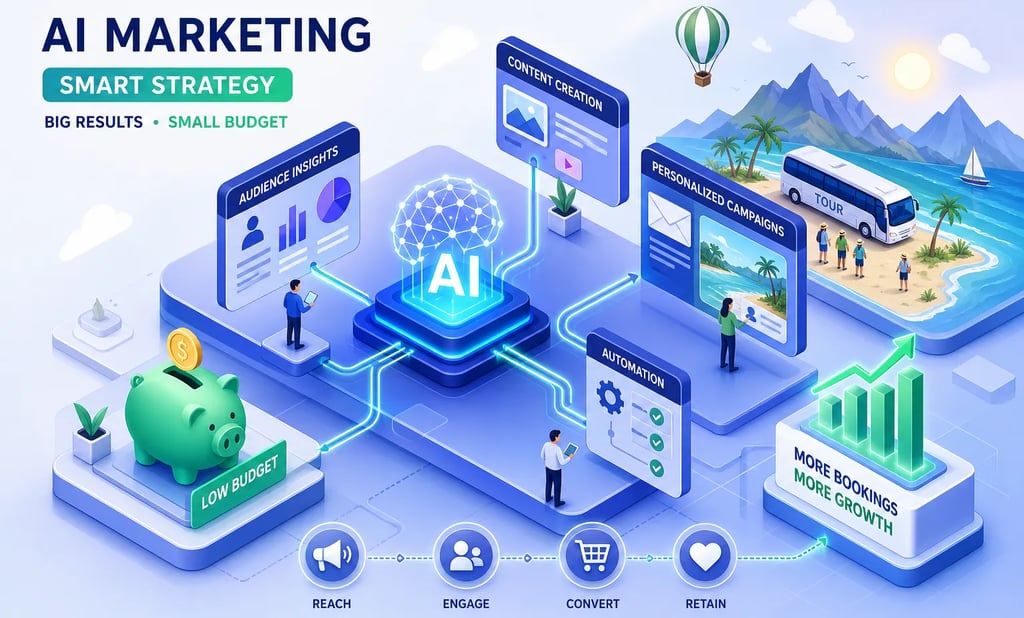
Best AI Marketing Strategy for Tour Operators on a Limited Budget
What is the best AI marketing strategy for a tour operator with a limited budget? It's not about spending more, it's about replacing expensive, slow, manual work with affordable AI tools that run faster and cost less. Small tour operators are losing bookings to OTAs that outspend them on paid channels by an enormous margin, and the problem isn't effort. It's strategy. Low-cost AI marketing has fundamentally changed what a lean team can accomplish, and this article gives you the exact tactics, tools, and a realistic 30, 60 day roadmap to act on today.
Why AI changes the economics of tour operator marketing
The biggest budget drain for small operators isn't overspending on one channel. It's spreading thin effort across every channel manually: writing trip descriptions by hand, answering the same enquiry questions after hours, scheduling emails one at a time, and guessing which ad creative will perform. AI replaces each of those functions at a fraction of the cost of agency retainers or additional headcount.
Itinerary drafts that once took 45 minutes now take about 30 seconds with the right prompts, an illustrative example of the time compression AI delivers across content, email, and ad production. That saving compounds fast when you're producing dozens of assets per month.
The key distinction worth making: AI handles autonomous, repetitive tasks well. That includes 24/7 chatbot responses, email send-time optimisation, and ad creative variation testing. Strategy, brand voice calibration, and relationship-building still require human judgment. Understanding that line helps you deploy AI where it delivers real leverage, rather than treating it as a substitute for genuine expertise.
Competing on ad spend against the OTAs is a losing game. OTAs spend substantially on marketing, making it effectively impossible for independent operators to outspend them on paid channels. For independents, the only winning path is competing on relevance, not volume. AI-powered targeting and personalisation let you reach the right traveler at the right moment with the right offer, and that's a fight you can win at any budget level.
What is the best AI marketing strategy for a tour operator with a limited budget? Start with these four tactics
This is where limited budgets generate the most return. Each tactic below is tied to a specific booking outcome, a realistic cost estimate, and a clear timeline. These are also the same core tactics that Powerful Digital Marketing deploys for travel clients, scaled with deeper data and ongoing optimization.
AI content creation for trip pages, social ads, and itinerary emails
Free tools like Copy.ai (2,000 words per month on the free plan) and ChatGPT can produce first drafts for trip descriptions, Meta ad copy, and email subject lines in minutes. The key is a structured prompt framework: define the role (senior travel copywriter), the business context (destination, audience, price point, differentiators), the output format, and a refinement instruction. That structure separates converting copy from generic travel clichés.
AI drafts still need a human travel expert's review, especially for premium offerings, but they cut production time dramatically and eliminate the blank-page problem entirely. Note that free-tier word limits are suited to testing and low-volume output; as content needs grow, a paid plan becomes worth evaluating. For an organised list of recommended solutions and how they map to marketing tasks, see the WeTravel AI marketing tools guide.
Chatbots for 24/7 lead capture and inquiry qualification
A significant share of lost enquiries results from after-hours response delays, an inquiry arrives, goes cold, and the traveler books elsewhere before anyone follows up. A chatbot prevents that without adding payroll. Tidio's free plan handles 50 Lyro AI conversations per month, which is well suited to testing the workflow and capturing leads in lower-traffic scenarios. The chatbot handles FAQ responses, asks qualification questions, and guides prospects toward booking initiation. It does all of this while you're offline.
Once you've validated the setup and confirmed it's handling enquiries effectively, the paid tier starts at around $29 per month (pricing current as of mid-2026; check Tidio's site for the latest). That's a fraction of what a single lost booking costs in revenue.
Email automation workflows that recover and convert leads
Three specific email workflows drive the most return for tour operators: a welcome series (2, 4 emails), an abandoned enquiry follow-up sequence, and a post-trip upsell flow. The abandoned enquiry sequence has the highest ROI of the three because it targets people who already showed booking intent.
Trigger-based, segmented flows consistently outperform static newsletters. Industry benchmarks suggest travel email programs average open rates in the 30, 33% range and click-through rates around 1.68, 2.52% (figures vary by platform and list quality; automated, personalised flows typically perform above these baselines). Mailchimp's free plan covers up to 500 contacts. Brevo starts at $9 per month for more advanced automation and segmentation, both pricing tiers reflect plans available as of mid-2026. For a practical walkthrough of setting up automated workflows specific to travel CRMs, consult this CRM automation workflows guide for travel.
Low-cost personalization through behavioral segmentation
Personalisation doesn't require expensive software. Segmenting your audience by destination interest, trip type, or inquiry source creates meaningfully different email flows and ad audiences that feel relevant rather than generic. The AI tools built into platforms like Mailchimp and Brevo handle the segmentation logic automatically once you define the segments.
A traveler who enquired about a family safari gets a different follow-up than someone who asked about a solo adventure tour. That difference in relevance directly impacts your conversion rate, and it costs nothing extra once the segments are defined.
Building a lean AI marketing stack for under $50/month
The decision framework here is simple: what to start for free, what to pay for first, and when to add the next layer. Every tool in this stack is chosen for a specific booking outcome, not just its software features.
The free-tier starter stack that covers the essentials
Start with three tools, each mapped to a distinct core function. Copy.ai handles content creation with 2,000 words per month free, enough for one or two trip page rewrites and a handful of email subject lines each month. Mailchimp takes care of email with up to 500 contacts on the free plan, which is sufficient to run all three core automation workflows for a growing enquiry list. Tidio covers chat with 50 Lyro AI conversations per month, suitable for handling after-hours leads at lower traffic volumes. Add Canva's free plan for ad creative, and you have a functional AI marketing operation at zero monthly cost, though free tiers are best treated as a testing phase rather than a permanent setup as lead volume grows. If you want travel-specific tool recommendations tailored to advisors and operators, this overview of AI tools for travel advisors is a helpful reference.
When and what to upgrade first as bookings grow
The upgrade trigger is straightforward: when free-tier limits start constraining active leads or content output, invest first in email automation. Brevo at $9 per month gives you more contacts, advanced segmentation, and the workflow depth that scales your highest-converting touchpoint. Frame that monthly cost against what a single lost booking costs in revenue, and the upgrade decision makes itself.
Making every ad dollar work harder with AI targeting
For operators with a small paid media budget, the core principle is concentration over coverage. Spend where booking intent already exists rather than chasing broad awareness audiences. Two tactics consistently deliver the best cost-per-booking for small operators competing against larger platforms.
High-intent search and retargeting as the best starting point
Transactional search queries like "book guided hiking tour in [destination]" convert far better than general awareness terms. Travel ads average around $1.92 cost per click on Google Search, though CPCs and conversion rates vary by market, keyword, and seasonality. At a 15% conversion rate, that puts estimated cost per booking in the $12, 13 range. Retargeting warm site visitors with Meta campaigns using social proof, user-generated content, and limited availability messaging adds a second layer that converts people who browsed but didn't book. These two tactics combined outperform most broad prospecting campaigns on a fraction of the budget.
AI segmentation and automated bidding to reduce wasted spend
Segment your retargeting audiences by intent level: checkout abandoners and pricing-page visitors first, then broader tour-page viewers. Use conversion-based automated bidding rather than click-based bidding so the platform optimises toward actual bookings.
Before spending a single dollar on ads, set up conversion tracking. Without it, automated bidding has nothing meaningful to optimise toward, and your budget works on guesswork instead of data.
Why a specialist travel marketing partner often costs less than going it alone
Building an in-house AI marketing capability requires tool subscriptions, hours learning platforms, failed campaigns during the ramp-up period, and content that doesn't convert because it lacks travel-specific copywriting depth. A full-time digital marketing manager at a small US travel company typically costs between $90,000 and $120,000 all-in per year once you account for salary, benefits, and overhead (estimates vary by region, seniority, and benefits load). That's before factoring in the ramp-up period and the cost of campaigns that underperform while that person learns the industry.
The hidden cost of the solo approach shows up in the details. Using AI for a 30-second itinerary draft only saves time if the prompts are calibrated for conversion, not just speed. Generic prompts produce generic copy. That's where sector-specific expertise matters more than the tool itself. For a deeper discussion on how generative AI is reshaping travel and tourism, see this industry piece on generative AI in travel.
If you're looking for that combination ready-made, Powerful Digital Marketing is a London-based AI-powered agency built exclusively for travel brands. The team combines hands-on experience in tour operations, hospitality, and cruising with AI tools purpose-built for travel marketing. Unlike generalist agencies applying broad strategies across industries, Powerful Digital Marketing focuses specifically on traveler psychology, booking windows, seasonal demand patterns, and OTA competitive dynamics, which means strategies are grounded in real booking behaviour rather than recycled frameworks.
Your 30, 60 day AI marketing launch plan, and what the best AI marketing strategy for a tour operator with a limited budget actually looks like in practice
The first week is setup and stack decisions. Choose your tools from the free-tier starter stack, create accounts, and connect your existing contact list to your email platform. A working, imperfect stack beats a perfect plan that never launches.
Weeks two through four are execution. Use Copy.ai or ChatGPT to rewrite your two or three highest-traffic trip pages using the structured prompt framework. Activate your chatbot and build the three core email workflows: welcome series, abandoned enquiry follow-up, and post-trip re-engagement. By day 30, those workflows are running automatically and capturing leads you were previously losing to slow or absent responses.
Days 30 to 60 shift focus to paid media and measurement. Launch a focused Google Search campaign targeting transactional keywords for your best-selling tour. Set up a Meta retargeting audience from recent site visitors. Review email performance against the 30, 33% open rate benchmark and identify which traffic sources generate the highest-quality enquiries.
By day 60, assuming baseline traffic and conversion tracking are already in place, the goal is one proven acquisition channel, one functioning email automation stack, and a clear picture of actual cost-per-booking. Results will vary based on traffic volume and testing cadence, but that's the measurable foundation this plan is designed to build. That's a real, data-backed answer to what the best AI marketing strategy for a tour operator with a limited budget looks like, not theory, but an executable system.
For operators who want to skip the trial-and-error phase entirely, Powerful Digital Marketing delivers this kind of specialist travel AI marketing strategy from day one, with the expertise and AI infrastructure already in place. Get in touch to start building your strategy today.
ADDRESS
The Powerful Group Limited
124 City Road
London
United Kingdom
EC1V 2NX
WORKING HOURS
Monday - Friday 9:00 AM - 6:00 PM
Saturday - Sunday 8:00 AM - 12:00 PM
Want to Call? Ask our Powerful Bot for the Number