
AI-Powered Travel Marketing: Why Brands Are Switching
AI-powered travel marketing is replacing traditional tactics. Learn why brands switch, measurable outcomes early adopters see, and practical transition steps.
TRAVEL MARKETING
Powerful Digital Marketing
6/4/20269 min read
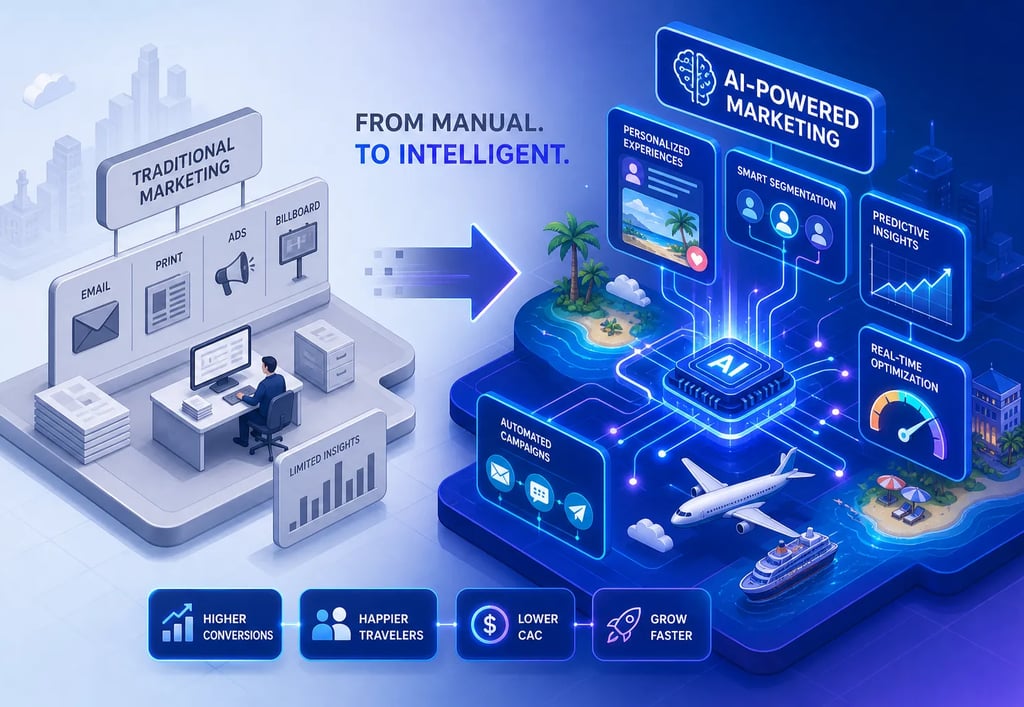
Why Travel Brands Are Switching From Traditional to AI-Powered Marketing
Why travel brands are switching from traditional to AI-powered marketing comes down to three compounding pressures: rising ad costs, OTA data dominance, and personalisation expectations that static campaigns structurally cannot meet. The seasonal campaign, the broad audience buy, the batch-and-blast email, these tactics built travel marketing for decades. Now they're producing worse results at higher cost, and the travel brands still anchored to them are paying for it two ways: inflated acquisition spend and direct bookings slowly surrendered to OTAs. Google travel CPCs have climbed from around $1.15 in 2024 to roughly $2.12 in recent benchmarks, a jump that compresses margins for independent hotels and tour operators who lack the volume to absorb it. Meanwhile, platforms like Expedia and Booking.com run machine learning optimisation across millions of booking signals at a scale most travel brands simply can't match manually. And the traveler on the other side of that ad? Many now expect highly personalised, itinerary-level experiences from brands they've never booked with before.
This article covers the business drivers behind why travel brands are switching from traditional to AI-powered marketing, the measurable outcomes early adopters are seeing, the practical transition steps that work, and the measurement mistakes that catch most brands off guard. At Powerful Digital Marketing , we work exclusively with travel brands navigating exactly this transition, and the patterns are consistent. The brands moving fastest aren't chasing technology for its own sake. They're responding to a competitive environment that left them little choice.
Why the traditional travel marketing playbook is running out of road
The structural problem isn't one thing, it's two pressures compounding simultaneously. Digital advertising costs in the travel vertical have climbed sharply while campaign performance from broad, seasonal approaches has declined. When your CPC climbs significantly year over year, your existing campaign structure doesn't just get more expensive. It gets less efficient, because the volume thresholds that justified certain bid strategies and audience sizes no longer work the same way.
The ad cost reality travel brands can't ignore
For smaller tour operators and independent hotels, CPC inflation in travel is not an abstract trend. It directly compresses the margin between what it costs to acquire a booking and what that booking is worth. At a $1.15 CPC, a modest conversion rate on a broad-match seasonal campaign could still produce acceptable returns. At $2.12, that same campaign structure can lose money before a single booking is confirmed, particularly for operators with lower average booking values. To illustrate: at a 2% conversion rate and a $200 average booking value, a $2.12 CPC produces a cost-per-booking of $106, leaving thin margin before overhead. The brands absorbing rising CPCs most easily are those with the highest booking volumes, which means OTAs, not the independent operators trying to compete with them.
How OTA dominance changed the rules of the game
OTAs aren't just competitors with bigger budgets. They're platforms built on aggregated behavioural data and machine learning running real-time optimisation across millions of search and booking signals. They know which traveler is in the research phase, which is ready to book, and which responds to price anchoring versus experience messaging. Independent travel brands competing with static audience segments and manual campaign adjustments aren't fighting a bigger version of the same battle. They're fighting a structurally different one. AI-powered marketing, including programmatic travel advertising capabilities that match OTA-level targeting precision, exists precisely to close that capability gap.
Why travel brands are switching from traditional to AI-powered marketing: the personalisation case
The external market pressure is only half the problem. The demand-side reality is equally disruptive. Modern travellers research across multiple devices and platforms before committing to a booking. They move between inspiration, comparison, and intent phases in non-linear patterns that static segmentation frameworks can't track in real time. A traveler who looked at adventure tours in Costa Rica three weeks ago, took a weekend trip, and is now searching boutique hotels in Lisbon has shifted context entirely. A static segment doesn't register that shift. An AI-driven system does.
The gap between what travellers expect and what traditional campaigns deliver
Travellers who've experienced Netflix, Spotify, and Amazon recommendations increasingly apply similar personalisation standards to travel brands. They notice when an email offers them family resort packages two days after they searched solo travel experiences. Generic promotional emails and un-targeted display ads don't just underperform in these moments. They actively signal irrelevance and erode trust. The bar for relevant communication has been permanently raised by platforms that have no interest in travel but have redefined what "knowing your customer" looks like.
How AI-driven personalization closes that gap at scale
AI personalisation works by analysing real-time search behaviour, booking history, browsing patterns, and contextual signals to tailor offers, content, and timing to individual travellers rather than audience cohorts. The practical outcome for the traveler is a meaningfully different experience: relevant offers at the right decision moment, reduced booking friction, and content that reflects where they actually are rather than where a segment profile assumes them to be. Industry case studies have reported up to a 40% improvement in look-to-book ratio compared with non-personalised alternatives, alongside 15% lower booking abandonment on AI-optimised platforms, though results vary by operator size, implementation quality, and baseline. For additional perspective on how personalisation and performance interact in this sector, see this analysis of AI in travel marketing. Personalisation at this level isn't a feature upgrade. It's a different category of marketing entirely.
The conversion data that proves the switch is working
The case for AI-powered travel marketing doesn't rest on projections from technology vendors. It rests on published outcomes from travel brands that have already made the transition. The pattern across these examples is consistent: AI-powered approaches improve conversion rates, lower acquisition costs, and increase repeat booking behaviour simultaneously, the combination that drives meaningful improvements in customer lifetime value.
Airline and tour operator results worth paying attention to
Porter Airlines achieved a 35% reduction in cost-per-acquisition using intent-based native advertising to drive flight bookings through StackAdapt. Malaysia Airlines implemented AI-powered booking via its MHchat assistant, enabling customers to search, book, and pay 24/7, with the airline reporting a measurable increase in revenue from digital channels following the rollout (the specific uplift figure has not been independently published). One major carrier using AI-generated language for a first-class upgrade campaign reported a 48% revenue increase and $8 million in incremental revenue over the campaign period, as cited by its programmatic platform partner. For broader examples of airline implementations and outcomes, see this collection of AI in aviation case studies. These outcomes aren't limited to enterprise operators with $500k technology budgets. Intent targeting, conversational booking, and personalised offer delivery are now accessible at substantially lower entry costs, many implementations land well under six figures, compared with early deployments several years ago.
What the numbers mean for long-term customer value
The conversion lift is the visible result. The compounding advantage is in retention. Studies in the hospitality sector have shown 30 to 40% higher customer retention rates on AI-powered platforms versus non-AI equivalents, and AI-informed segmentation has been associated with a 30% reduction in churn, though figures vary by property type and implementation scope. When personalisation continues producing relevant experiences across the full customer journey, repeat booking behaviour strengthens naturally. Static campaigns can drive a transaction. AI-powered marketing builds the relationship that drives the second and third booking without the full acquisition cost of the first.
What AI-powered travel marketing actually covers today
AI-powered travel marketing isn't a single tool or a single campaign type. It's a connected set of capabilities that replace or augment almost every traditional marketing function, from media buying and content creation to customer engagement and competitive positioning. Understanding the full scope matters because piecemeal adoption without a strategic framework rarely produces the conversion and retention outcomes the data supports. For context on market sizing and industry momentum behind these capabilities, refer to this AI in travel market report.
The core tools driving the shift in travel marketing
The main capabilities operating at scale right now span four areas. First, AI-driven social media strategy that builds qualified audiences and converts followers into booked customers. Second, smart chatbots that handle inquiries, qualify leads, and support bookings around the clock without additional headcount. Third, advanced SEO, PPC, and programmatic travel advertising built around booking intent rather than generic keyword volume. Fourth, real-time competitor analysis that tracks market positioning, pricing shifts, and campaign behavior without manual research overhead. Each replaces a function that traditional marketing handled more slowly, at higher cost, and with less precision.
Why travel-specific AI expertise outperforms generalist approaches
Generalist agencies applying broad AI tools to travel brands consistently underperform compared with partners who understand traveler psychology, seasonal demand patterns, OTA dynamics, and booking behavior. A Performance Max campaign structure built for an e-commerce retailer doesn't translate to a tour operator with a 90-day booking window, complex ancillary upsells, and multi-destination itineraries. At Powerful Digital Marketing, we combine deep travel sector knowledge with purpose-built AI automation, because that combination is what produces results. Travel brands working with us don't get generic templates adapted to travel. They get strategies built from the ground up around how travellers actually search, decide, and book.
The measurement challenge that catches most travel brands off guard
Most articles about the switch to AI marketing skip this section entirely, which is exactly why it belongs here. When travel brands move from traditional channel-based reporting to AI-optimised campaigns, their measurement framework breaks in ways that aren't immediately obvious. The first sign is usually a gap between platform, reported results and actual booking revenue, with platforms claiming more credit than the business can verify.
Why platform-reported results become harder to trust
AI campaign structures like Performance Max and Advantage+ automatically distribute spend across placements, making it harder to see which creative, audience, or channel produced the result. Each platform claims credit for the same conversion using its own attribution window, which inflates reported performance and creates conflicting numbers across dashboards. Traditional last-click attribution becomes even less reliable when the customer journey spans multiple devices, multiple touch points, and AI-influenced micro-moments that never generate a tracked click. Brands that don't recognise this dynamic early end up making budget allocation decisions based on numbers that don't reflect what's actually working.
The analytics approaches that give you an accurate picture
Three approaches address this problem in combination. Incrementality testing isolates true lift by measuring outcomes against holdout groups, answering whether the ad caused the booking rather than just coinciding with it. Multi-touch attribution provides journey-level analysis when you have strong first-party data and consent-safe identity resolution. Marketing mix modelling works at the aggregate level for budget allocation decisions and is less dependent on user-level tracking.
Centralising first-party data in a measurement warehouse reduces cross-platform double-counting and gives you a single source of truth that no individual platform's reporting can distort. The brands succeeding with AI marketing are the ones that upgrade their measurement alongside their campaigns, not as an afterthought.
A practical starting point for making the transition without disrupting what's working
The biggest implementation mistake travel brands make is trying to replace everything at once. The data supports a sequenced approach that starts with high-ROI, low-disruption entry points and builds toward more complex capabilities once the foundation is solid. Identify one high-friction marketing problem, usually ad cost efficiency or conversion rate, apply the right AI tool to that specific problem, measure the result properly, then expand.
Where to start if you're an independent hotel or tour operator
Chatbot implementation and AI-assisted content creation are the fastest, lowest-risk entry points for most independent travel brands. A well-configured chatbot handles FAQs, qualifies leads, and supports bookings at all hours without requiring operational overhaul. Implementation typically takes two to six weeks. Simple bots start around $5,000 to $10,000; capable integrated assistants with CRM and booking system connections generally run $30,000 and up depending on complexity. AI-assisted content creation for social media and email can be operational within weeks and immediately reduces the time and cost of producing consistent, on-brand messaging across channels. Neither entry point requires reorganising your marketing stack or hiring new headcount.
The sequencing that avoids costly over-investment
A realistic three-phase progression looks like this:
Phase one covers quick wins: chatbots for 24/7 engagement and AI-assisted content for social and email. Phase two moves into personalisation, AI-driven PPC, programmatic travel advertising, and audience targeting built around booking intent, once first-party data is organised and phase one results are consistent. Phase three addresses predictive analytics, full attribution frameworks, and advanced competitor intelligence.
This sequencing prevents the costly mistake of investing in complex AI infrastructure before the simpler, faster-return capabilities are producing reliable results.
The reason why travel brands are switching from traditional to AI-powered marketing isn't enthusiasm for new technology, it's the business reality of rising ad costs, OTA data advantages, and traveler personalisation expectations that static campaigns can no longer meet. The travel brands winning on direct bookings and retention right now have adopted AI-powered marketing as a strategic priority, not a future consideration. The tools exist, the results are documented, and the transition doesn't have to be disruptive when approached in sequence. If your travel brand is ready to move from traditional approaches to a smarter, AI-driven strategy, Powerful Digital Marketing is the specialised partner built specifically for this work, get a roadmap for your transition here.
ADDRESS
The Powerful Group Limited
124 City Road
London
United Kingdom
EC1V 2NX
WORKING HOURS
Monday - Friday 9:00 AM - 6:00 PM
Saturday - Sunday 8:00 AM - 12:00 PM
Want to Call? Ask our Powerful Bot for the Number