
AI Tour Bookings: 3 Tactics to Boost Direct Bookings 2026
Learn three AI tactics to boost tour bookings in 2026. Practical steps for chatbots, personalisation, and smart PPC plus a 90-day pilot and tool shortlist.
AI IN TRAVEL
Powerful Digital Marketing
6/3/20269 min read
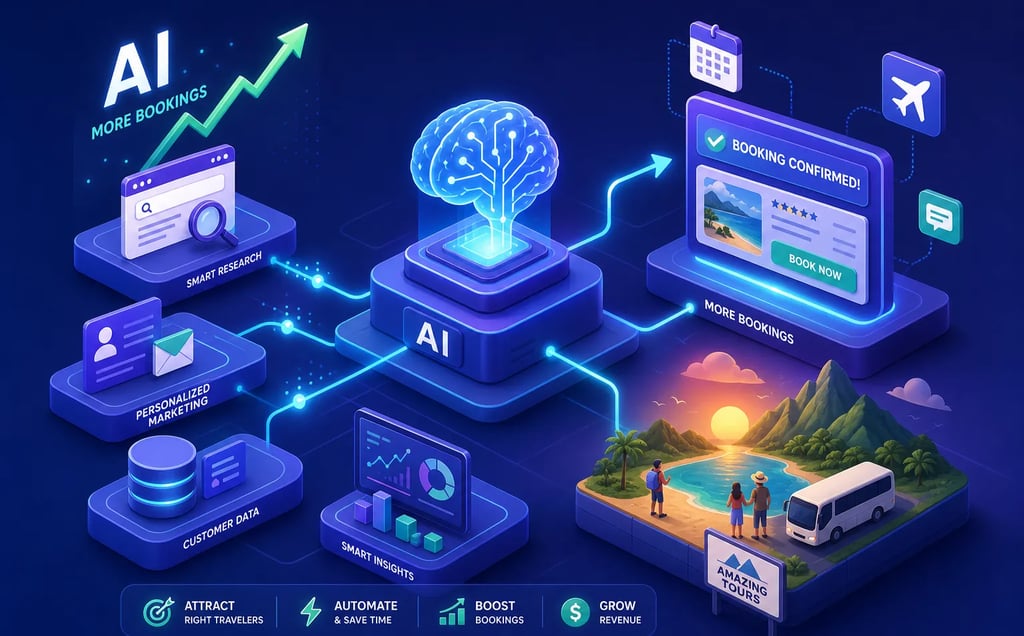
How to Use AI to Get More Tour Bookings in 2026
OTAs are running AI at every touchpoint right now: search ranking, price optimisation, personalised recommendations, and retargeting. Most tour operators are still relying on a static website, a single email blast, and a contact form that takes 24 hours to answer. That gap is widening fast, and it shows up directly in your booking numbers. This guide explains how to use AI to get more tour bookings by applying chatbots, personalisation, and smart PPC to your funnel, without rebuilding your entire operation from scratch.
This article is a practical field guide, not a tech lecture. Operators already working with AI-specialised travel marketing partners are pulling ahead on direct bookings while spending less per customer. They're not doing it by replacing their entire tech stack overnight. They're doing it by picking the right tactics, deploying them quickly, and measuring what works.
By the time you finish reading, you'll have three high-impact AI tactics ready to pilot this quarter, a shortlist of compatible tools, and a simple 90-day framework to measure whether your investment is paying off.
Why AI Gives Tour Operators a Real Edge Over OTAs Right Now
The OTA Advantage and How AI Closes the Gap
OTAs use real-time behavioural data to match the right offer to the right traveler at the right price, on every single visit. When a traveler searches for a kayaking tour near Asheville, Expedia already knows their budget range, their browsing history, and how many days they have to decide. Your website knows nothing about them.
The good news is that the tools OTAs use to do this are no longer locked behind enterprise budgets. AI-powered booking systems, personalisation engines, and smart ad platforms have become accessible to independent operators. You can now replicate many of the same personalization and speed advantages at a fraction of what it would have cost three years ago.
What "Using AI for Bookings" Actually Means in Practice
AI for tour operators is not a single tool. It's a stack of connected capabilities: a chatbot handling inquiries around the clock, an algorithm personalising email sends based on browsing behaviour, a PPC system optimising bids toward travellers with booking intent, and SEO automation keeping your tour pages competitive in search.
Each piece does a specific job in the booking funnel. Demystify the term and you realize you're not choosing between "using AI" or "not using AI." You're choosing which parts of your funnel to fix first, and understanding how to use AI to get more tour bookings starts with that decision.
How to Use AI to Get More Tour Bookings: Deploy a Chatbot That Books Around the Clock
How One US Tour Operator Attributed $60,000 in Bookings to a Chatbot
Arkansas River Tours deployed a conversational AI chatbot on their website and tracked the results. The outcome: 131 chatbot-attributed bookings totalling nearly $60,000 in revenue, with chatbot users booking at almost 300% the rate of regular site traffic. That's not a marginal improvement. That's a fundamentally different conversion rate from the same visitors.
The speed factor drives most of it. A traveler who asks a question and gets a useful answer in under a minute is roughly twice as likely to book compared to one who submits a form and waits 24 hours. Inquiries answered within one hour convert approximately seven times better than those left to sit overnight. A chatbot doesn't just save you time; it captures bookings you were already losing. Based on published case data from operators using purpose-built travel chatbots, an average 150% conversion lift is achievable when the bot is properly configured for booking intent.
Choosing an AI Chatbot Tool That Fits Your Booking Stack
The right chatbot acts as a conversational layer on top of your existing booking engine, whether that's FareHarbor, Bokun, Peek Pro, or Rezgo. It handles natural-language discovery, qualifies intent, surfaces real-time availability, and pushes the visitor to the booking link. The actual inventory management, pricing, and payment stay inside your booking platform.
Platforms worth evaluating include MyTrip.AI, which is built specifically for travel and can predict preferences from historical data; YourGPT, a no-code option that handles booking assistance and lead qualification; and Yellow.ai, which suits operators needing multilingual support and enterprise-level conversation management. When evaluating any chatbot tool, prioritise intent recognition, booking-link handoff capability, and how cleanly it connects to your existing availability feed.
Personalized Email Campaigns and Website Offers That Turn Browsers into Bookers
Behavioral Segmentation: Showing the Right Tour to the Right Traveler
Most tour operators send the same email to their entire list. A family traveling to a national park and an adventure seeker planning a white-water trip have completely different booking triggers. Sending both the same message means you're relevant to neither. AI segmentation fixes this by grouping visitors automatically based on intent signals: pages visited, tours viewed, time spent, destination interest, and whether they're browsing for the first time or returning after a previous visit.
Real-time website personalization takes this further. When a returning visitor who previously viewed a guided kayaking tour lands on your homepage, the hero image, featured tour, and CTA can all change to reflect what they already showed interest in. This dynamic adaptation is a proven conversion driver. According to McKinsey's research on personalisation at scale, organisations using AI personalisation report 15 to 25% conversion rate lifts compared to static, one-size-fits-all messaging.
Triggered Follow-Up Sequences That Recover Abandoned Visitors
A visitor who spent eight minutes on your four-day hiking tour page and then left without booking is not a lost lead. They're a warm prospect with a short decision window. AI retargeting workflows pick up where the session ended: a personalized email referencing the exact tour they viewed, an SMS follow-up with a limited-availability cue, or a targeted ad showing that same itinerary across their social feeds.
The highest-converting setup for tour websites combines three elements: a recommendation engine surfacing the right tour, a dynamic offer timed to engagement level, and a retargeting workflow that follows up on the specific activity the visitor showed interest in. Tools like OptiMonk and Personyze can run this on tour sites with limited traffic data, making them practical options even before you've built a large email list or CRM database.
How to Use AI to Get More Tour Bookings with Smart PPC and SEO Automation
AI-Powered PPC That Bids on Travelers Ready to Book, Not Just Browse
manual PPC campaigns waste budget on searches that look relevant but carry no booking intent. AI bidding systems, including Performance Max and smart campaign formats, analyze behavioral signals in real time and shift spend toward travellers who are actively ready to book. That means your budget concentrates on the searches that convert, rather than spreading evenly across the full keyword set.
Tour operators switching from manual to AI-managed PPC typically see efficiency gains within the first 60 days, with lower cost-per-booking and improved return on ad spend. The setup requirement is understanding both the platform's AI logic and how travel search behaviour actually works. Specialized travel PPC management, the kind offered by a dedicated travel marketing agency like Powerful Digital Marketing, removes the platform learning curve entirely and prevents the budget waste that comes from misconfigured campaign objectives.
SEO Automation and AI Travel Search Optimization That Keeps Your Tour Pages Ranking
Long-tail search queries like "private wine tour Douro Valley" or "family snorkeling tours Key West" are where tour operator bookings actually come from. These queries are highly specific, conversion-intent-driven, and too numerous to manage manually at scale. AI SEO tools automate the workflow: they identify query gaps, generate optimised page outlines, apply schema markup for tour listings and destinations, and monitor rankings to flag content that needs refreshing.
Effective AI travel search optimisation in 2026 means one landing page per destination, one page per high-intent activity, FAQ blocks targeting common question-based queries, and a monitoring loop that updates content as search intent shifts. Generic SEO tools that don't understand travel search behaviour will miss the seasonal patterns and destination-specific query structures that drive actual bookings. This is where sector-specific expertise makes a measurable difference.
AI-Driven Pricing for Tours That Fills More Seats and Protects Your Margins
How AI Reads Booking Pace to Price Tours Smarter
Dynamic pricing is one of the most underused revenue levers available to independent tour operators. Peek Pro research shows that a tour business generating $500,000 annually could recover between $50,000 and $105,000 in additional margin through variable pricing alone. The AI doesn't guess. It reads booking velocity at 30, 60, and 90-day windows, compares current fill rates against historical patterns, and surfaces a clear signal: if pace is ahead of history, raise the price; if pace is behind, introduce an incentive before capacity goes to waste.
The inputs are data you already have: booking dates, departure fill rates, seasonal demand curves, and your cost structure by tour type. AI-driven pricing for tours turns that raw data into a forward-looking demand forecast and translates it into a concrete pricing action. The outcome is a strategy that responds to what's actually happening in your booking calendar, not one based on assumptions made in January.
Setting Up Pricing Rules That Protect Customer Trust and Your Bottom Line
Dynamic pricing works best when it operates within defined boundaries. Set a floor based on your break-even cost per seat, and set a ceiling that reflects what your market segment will accept without feeling manipulated. Within those guardrails, AI can apply tiered seasonal pricing triggered by actual booking velocity rather than calendar dates. A departure filling 20% faster than last year's equivalent should be priced accordingly before it sells out at last year's rate.
The most practical model is to treat AI as a co-pilot here. It prepares the data, surfaces the trigger, and proposes the adjustment. You review and approve before the price changes. This keeps human judgment in the loop for edge cases and protects the trust you've built with repeat customers, while still capturing the margin that manual pricing consistently misses.
Picking Your First Three AI Tactics and Building a 90-Day Pilot
A Simple Framework for Choosing Where to Start
Start by identifying where your booking funnel is leaking the most potential revenue. If you're getting traffic but converting poorly on enquiries, the AI chatbot is your highest-priority tactic. If you have a reasonable inquiry volume but visitors aren't completing bookings, personalised email and behavioural retargeting will move the needle fastest. If your traffic itself is too thin or too expensive, smart PPC and SEO automation are the right starting point.
Pick three tactics that map across the funnel: one for new traffic acquisition, one for inquiry conversion, and one for nurturing and recovery. Choose tools that can be live within 30 days without requiring a full platform migration. The goal of a pilot is not perfection; it's measurable evidence that a tactic works in your specific context.
KPIs to Track in Your First 90 Days
Four metrics will tell you most of what you need to know in the first quarter:
Chatbot-attributed booking rate, track this separately from overall site conversion to isolate the bot's contribution.
Email sequence conversion rate, measure across each behavioural segment, not just opens and clicks.
Cost per direct booking, compare this against the OTA commission rate you're currently paying.
Organic ranking movement, track your five to ten highest-value tour pages for position changes.
Set a simple baseline before you launch any tactic so early results have something to measure against.
Why Working with an AI Travel Marketing Agency Accelerates Results
The tools exist. The challenge is configuring them correctly, connecting them to your booking stack, and optimising them based on travel-specific behaviour patterns that generic platforms don't account for. Most operators have the ambition but not the bandwidth to do all three simultaneously while running day-to-day operations.
That's the gap a specialised travel marketing partner fills. At Powerful Digital Marketing, we bring both the AI stack and the sector expertise together in one partnership. That means you're not starting from a generic template and hoping it applies to travel. You're working with a team that understands seasonal demand patterns, traveler psychology, booking window behaviour, and how to translate all of it into campaigns that convert. Operators who take this route skip six to twelve months of trial and error and start seeing booking uplift in the first quarter, not the second year.
The Next Step Starts This Week
Staying competitive as a tour operator in 2026 means closing the gap with OTAs on personalisation, speed, and search visibility. The five tactics covered here, an AI chatbot for 24/7 inquiry conversion, behavioural email personalisation, smart retargeting, AI-managed PPC and SEO, and dynamic pricing, are all deployable without rebuilding your entire operation. You don't need all five at once.
Pick the three that match your biggest booking constraint, build a 90-day pilot around them, and track the four KPIs that tell you whether it's working. The trajectory of AI for tour operators points toward deeper personalisation, tighter automation, and more precise targeting of booking-ready trave;lers. The operators who start now will be the ones with the data, the systems, and the results to show for it a year from now.
Whether you want to build this yourself or work with a team that specialises in travel marketing AI, the decision that matters is picking one tactic and starting this week. Start a 90-day pilot today to see how to use AI to get more tour bookings for your operation, because the bookings you're not capturing right now are going to someone else. Make sure they start coming to you.
ADDRESS
The Powerful Group Limited
124 City Road
London
United Kingdom
EC1V 2NX
WORKING HOURS
Monday - Friday 9:00 AM - 6:00 PM
Saturday - Sunday 8:00 AM - 12:00 PM
Want to Call? Ask our Powerful Bot for the Number