
AI Travel Marketing: Complete Guide for Travel Brands
Discover how AI travel marketing helps smaller travel brands boost bookings. Learn 2026 tools, real ROI examples, and a step-by-step launch plan.
AI IN TRAVEL
Powerful Digital Marketing
6/11/20268 min read
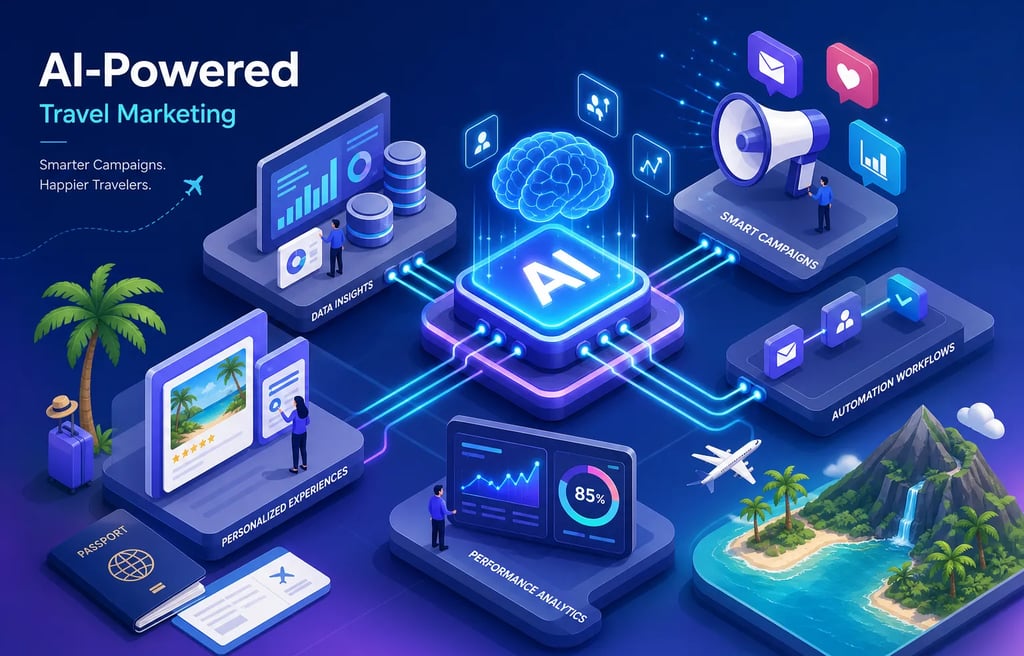
The Complete Guide to AI Travel Marketing for Travel Brands
A boutique hotel in the Cotswolds and Booking.com appear on the same search results page. A family-run tour operator competes for the same Google Ads impressions as Expedia. The digital travel market has never been more level in terms of access, and never more uneven in terms of resource. AI travel marketing is how smaller, sharper brands close that gap, without burning through their budget trying to outspend platforms that have billions behind them.
This guide covers what AI travel marketing actually is, which tools are delivering measurable results in 2026, what those results look like in real numbers, and how to get started without making expensive mistakes. It is written through the lens of Powerful Digital Marketing, a London-based agency that focuses exclusively on travel brands, combining AI tool deployment with deep travel industry knowledge across hotels, tour operations, cruising, and destination marketing.
What AI travel marketing actually is (and why it's built differently)
AI travel marketing is not simply AI applied to marketing. It is marketing built around how travellers actually think, search, and decide. The distinction matters because travel purchasing decisions often carry stronger emotional and identity weight than routine purchases, a laptop replacement or a taxi booking. A traveller choosing between two Caribbean cruise itineraries is weighing aspiration, family dynamics, and budget anxiety at the same time. Many generic AI marketing tools struggle to capture travel-specific signals such as school-holiday calendars, look-to-book windows, and the behavioural difference between a first-time solo traveller and a repeat family booker.
AI tools configured for travel, or deployed by specialists with genuine travel industry knowledge, can read the signals that actually drive bookings: intent fluctuating with school-holiday calendars, look-to-book windows stretching to nine months for luxury sailings, seasonal demand curves for specific destinations, and distinct conversion behaviours across traveller types. That travel-specific context is what separates AI travel marketing from AI marketing in general.
At its core, AI travel marketing operates across three functions: prediction (what is this traveller likely to book?), personalisation (what message should they receive, and when?), and automation (how do we deliver that message at scale without losing the human feel?). These functions connect across email, paid search, social media, chatbots, and content. All of them improve significantly when informed by travel-specific data rather than generic consumer behaviour models.
AI travel marketing tools reshaping 2026
The most useful tools for travel marketers fall across five categories: content creation, email and CRM, chatbots and conversational AI, paid advertising, and SEO. The shortlist below reflects tools with documented travel marketing use cases, not simply the most-hyped AI products on the market.
Content creation and campaign visuals
Adobe Firefly and Midjourney are widely used by travel marketing teams for generating campaign imagery that would otherwise require expensive destination photography shoots. Firefly sits inside Photoshop and Adobe Express, making it immediately usable for teams already on the Adobe stack. For SEO and content strategy, MarketMuse analyses a site's existing content, identifies keyword gaps, and guides travel brands toward the topics most likely to capture booking-intent traffic from organic search.
Email, CRM, and audience personalisation
Brevo handles AI-powered subject-line generation, send-time optimisation, and list segmentation. Its pricing starts at $9 per month for the Starter tier (verified at time of writing via Brevo's published pricing page), making it accessible for independent operators. Optimove operates at a more sophisticated level, building AI-mapped CRM journeys and analysing customer insight across the full booking lifecycle. Both tools require a well-structured customer data foundation to perform well; feeding poorly organised data into either produces poor results.
Chatbots and paid advertising
Tidio and Chatfuel handle website chat, lead qualification, and FAQ automation, capturing traveller intent data including destination, budget, travel dates, and group size. That data feeds directly back into personalisation workflows. Albert plans, executes, and continuously optimises paid campaigns across channels, removing much of the manual A/B testing burden from marketing teams without a dedicated paid search specialist on staff.
Which travel businesses are seeing the biggest gains from AI
The hotel sector has the strongest body of documented AI results available. Marriott reported a 35% increase in direct booking conversions and a 28% reduction in front desk call volume after deploying an AI reservations assistant. The Rose AI assistant case study documented $2.8 million in incremental revenue, a 40% conversion rate on upsell offers, and 80% of guest queries resolved without human intervention. IHG sent 12 million AI-assisted guest messages in 2024, an 84% increase year on year. Hotels using AI-driven dynamic pricing have seen RevPAR growth of up to 15% across a range of full-service properties, according to STR data cited by BCG. (Readers seeking to verify these figures should consult the original Marriott and IHG communications, the Rose vendor case study, and the BCG/STR RevPAR analysis directly; for broader examples see published hotel AI booking case studies.)
Many hotel case studies show a consistent pattern: AI can reduce the cost of reaching the right guest at the right moment and improve revenue generated per contact, though results vary by use case and data quality. For direct booking conversion specifically, well-implemented hotel email automation programmes reviewed by Powerful Digital Marketing have recorded conversion lifts from roughly 2% to 4, 5%, a relative improvement of 100, 150% over standard broadcast campaigns. Click-through rates on personalised email automation run approximately 41% higher than generic sends.
Tour operators and DMCs benefit most from AI in lead qualification, personalised email sequences, and SEO content that captures long-tail destination search traffic. Cruise lines managing multi-channel campaigns use AI to handle complex audience segmentation across traveller demographics with very different booking lead times. A luxury sailing buyer is typically nine to twelve months ahead of departure, while a last-minute cruise buyer operates on an entirely different set of triggers and price sensitivities. Travel agencies gain the most from chatbot automation that handles initial enquiries around the clock, filtering high-intent prospects before a human consultant follows up. For more on AI applied to cruising specifically, see How AI in Travel Marketing Is Transforming the Cruise and Travel Industry.
Putting AI to work: practical prompts and use cases
The difference between a chatbot that converts and one that frustrates travellers comes down to prompt structure. A well-built trip recommender bot should specify its role, ask for trip length, budget level, travel style, and up to three key interests, then return a destination recommendation with reasoning and a day-by-day outline. An itinerary builder prompt works best when it includes hard constraints: maximum travel time between activities, a requirement to balance one major attraction, one local food stop, and one offbeat experience per day, and a structured output format such as a table with morning, afternoon, and evening columns.
For email personalisation, the most effective framework is to create multiple versions of any campaign email targeting the same destination or offer, each tailored to a distinct traveller type. A version for budget travellers addresses price anxiety and value signals. A version for luxury travellers leads with exclusivity and quality. A version for families foregrounds ease, safety, and child-friendly logistics. The core offer remains identical across all versions; only the pain points, benefits, and calls to action change. Pre-trip upsell emails perform well when personalised to season, weather, and destination-specific events. Abandoned booking recovery emails perform best when they address the most likely friction for that specific destination and traveller type, whether that is price, timing, or availability concerns. For a deeper look at practical personalisation tactics see How AI Personalisation is Changing the Way Travel Brands Connect with Customers.
Content generation prompts for travel brands should always include destination, audience type, and output format as explicit parameters. A blog post prompt that specifies "first-time solo travellers visiting Lisbon in autumn, targeting travellers researching 7-day itineraries, output as a structured guide with a packing section and a costs breakdown" will produce usable content. The same prompt without those parameters produces generic output that adds no competitive advantage. For additional prompt templates and examples, consult a curated list of best ChatGPT prompts for travel planning.
Connecting AI tools to your travel tech stack without breaking things
Most AI travel marketing tools connect to existing systems through REST APIs, webhooks, and increasingly through Model Context Protocol endpoints that allow AI agents to call tools and query systems directly in real time. Understanding the dependency logic here matters as much as knowing the components: each connector in the chain depends on the quality and structure of the data flowing through the one before it. In practical terms, a chatbot can pull live availability from a booking engine, a CRM can feed personalised segment data to an email tool, and a CDP can unify guest profiles across a PMS, booking engine, and loyalty programme, for practical implementation notes see resources on CDP for travel.
Minimum connector set for a functional AI marketing stack
For travel brands starting out, the minimum connector set typically comprises a CRM or CDP connector, a PMS connector, a booking engine API, webhooks for real-time status updates, and a payment gateway API where the booking path includes transactional steps. Each element depends on the others: a personalisation layer built on a poorly integrated PMS will produce misfiring communications and erode guest trust faster than no personalisation at all.
GDPR and data privacy
Your data protection officer or legal adviser must document the lawful basis for each use case, whether consent or legitimate interest, before any AI tool goes live in a UK travel marketing context, not retrofitted after a problem occurs. The highest-risk failure points are over-collection of data (AI tools perform better with more data, but GDPR requires collecting only what is necessary), lack of transparency in automated decisions, and retention of personal data in intermediate files or model logs. A Data Protection Impact Assessment before deployment is not optional for high-risk use cases. Practical mitigation includes pseudonymisation of training data, encrypted storage and transfer, strict access controls, and human oversight for any AI output that directly affects a booking decision or customer communication.
How to choose the right AI travel marketing approach for your travel brand
The most practical starting point is to audit your current marketing funnel, identify the single biggest bottleneck, and then select the tool that addresses it most directly. A boutique hotel with limited marketing resource should prioritise a chatbot for lead qualification, an email platform with AI segmentation, and an SEO tool for capturing direct booking traffic. Those three address the highest-value gaps without requiring deep technical expertise to operate day to day. A tour operator competing with OTAs on paid search should add an AI ad optimisation tool and a CRM with journey automation. A cruise line marketing team managing complex multi-channel campaigns needs a more sophisticated CDP and audience segmentation layer before most other tools will perform well. If you're unsure whether your business is ready, read Signs Your Travel Business Needs AI Marketing Solutions for a practical checklist.
AI tools are only as effective as the strategy behind them. Configuring Tidio to ask the right qualifying questions, training Albert on travel-specific audience signals, or building Brevo segments that reflect real booking behaviour all require someone who understands both the technology and the industry. Powerful Digital Marketing was built specifically to address this gap. For travel brands that want AI travel marketing results without spending months on trial and error, partnering with a specialist agency that understands your sector's data, seasonality, and booking dynamics can significantly compress that timeline and reduce the risk of costly misconfigurations.
Getting started: where to focus first
AI travel marketing is not a future capability. It is a present competitive advantage for the travel brands that have deployed it thoughtfully, and the evidence from the hotel sector makes that increasingly clear. Tools are more accessible than they have ever been, and early adopters in hotels, tour operations, and cruise marketing are recording widening performance gaps over competitors still running on legacy marketing processes.
The most practical next step is to audit your current funnel before selecting any tool. Identify your highest-priority marketing challenge, match it to the right tool or combination of tools, integrate carefully with your existing tech stack, and build in GDPR and data governance from the start rather than retrofitting them after the fact. Whether you build this capability in-house or partner with a specialist agency, the travel brands that act on AI marketing now will be considerably harder to compete with in twelve months. The question is not whether to start; it is where to start and how to avoid the mistakes that slow most brands down in the first six months.
ADDRESS
The Powerful Group Limited
124 City Road
London
United Kingdom
EC1V 2NX
WORKING HOURS
Monday - Friday 9:00 AM - 6:00 PM
Saturday - Sunday 8:00 AM - 12:00 PM
Want to Call? Ask our Powerful Bot for the Number