
AI Travel Marketing: Tools, Tactics & Real ROI 2026
Discover which AI travel marketing tools to use, three practical workflows for content, personalization, and ads, prompt examples, and KPIs to prove ROI.
TRAVEL MARKETING
Powerful Digital Marketing
6/2/20268 min read
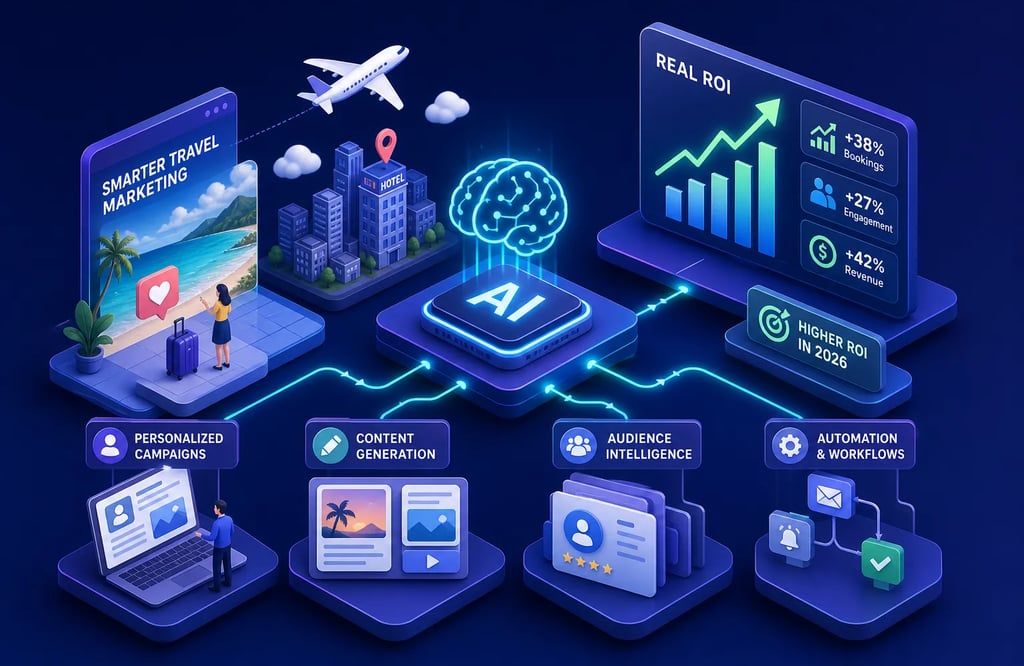
AI Travel Marketing: Tools, Tactics, and Real ROI in 2026
AI travel marketing gives travel brands access to more tools than ever before, but without an integrated strategy, those tools produce activity without impact. As of 2026, the ecosystem has expanded dramatically, yet many brands still deploy AI in fragments: a content tool here, a chatbot there, an automated email sequence that hasn't been refreshed in months. The result is a stack that looks busy but doesn't connect to how travellers actually search, compare destinations, and commit to a booking.
This guide closes that gap. You'll walk away knowing which tools belong in a travel marketing stack, how to build three practical workflows around content, personalisation, and ads, what prompts produce usable output, and which KPIs tell you whether any of it is working. It's the same framework the team at Powerful Digital Marketing uses when onboarding travel brands who are ready to stop experimenting and start executing.
How AI travel marketing actually works
Most travel brands treat AI as a content shortcut. Feed a prompt in, get a blog post out, publish, repeat. That's not a strategy, it's a production line that generates volume without direction. The real value of AI travel marketing sits across four connected functions: AI-powered travel personalisation, travel marketing automation, conversational customer service, and data-driven campaign optimisation. Each one solves a different problem in the booking funnel.
Personalisation turns generic destination pages into experiences that match what a specific traveler is looking for. Automation handles the follow-up sequences that most teams let slip after the first inquiry. Chatbots handle booking questions at 11 pm when your team is offline and have been shown in some cases to meaningfully improve off-hours conversion rates. Data-driven campaigns identify low-intent audiences through behavioural signals, reducing wasted ad spend on travellers who are nowhere near booking. Together, these four functions create a marketing operation that works continuously.
Traditional travel marketing relies on broad audience targeting, static creative, and seasonal planning based on instinct. AI replaces those defaults with behavioural signals, dynamic messaging, and decisions based on what each traveler is actually doing right now. The difference isn't just speed, it's relevance. A generalist AI tool won't know the difference between a traveler researching a cruise six months out and someone searching for a last-minute hotel in Miami. Travel-specific strategy maps AI outputs to booking windows, traveler personas, and seasonal demand patterns. That's what separates an isolated AI experiment from a coordinated AI travel marketing operation.
AI travel marketing tools: the right tool for each function
Not every AI tool belongs in a travel marketing stack. Mixing up tools or over-investing in the wrong category is one of the fastest ways to burn budget. The clearest way to evaluate any tool is by the job it does. There are four categories worth building around: content and SEO, personalisation and email, ad optimisation, and conversational AI for customer service. The list below reflects tools commonly used in the space, it isn't exhaustive, and the right choice for your brand will depend on your existing stack and team capacity. For a broader overview, see the AI marketing tools guide that summarises common platforms and use cases.
For travel content, Jasper handles brand-safe copy and campaign writing, while Claude produces stronger long-form itinerary prose and nuanced destination narratives. On the SEO side, Surfer SEO and Semrush handle optimisation and keyword strategy, making sure content ranks for the booking-intent queries that drive real traffic. MarketMuse adds content strategy depth by identifying gaps in your topic coverage before you write a single word.
For personalisation and email, Optimove maps CRM journeys using customer data and segments travellers by booking history and loyalty status. Brevo adds AI-powered subject-line generation and send-time optimisation, both meaningful advantages in an inbox as crowded as travel. For ad optimisation, Albert runs cross-channel campaigns autonomously and personalises ad delivery at scale. Google Ads AI via Performance Max automates search, display, and YouTube in one campaign structure. For customer service and lead capture, Tidio and Chatfuel handle website chat, FAQ automation, and traveler qualification around the clock.
The principle behind tool selection is straightforward: match the tool to the job, not to the hype. A travel brand doesn't need every platform on this list. It needs one strong tool per function, connected by a workflow that moves travellers through the booking funnel without gaps. For further examples of tools curated specifically for travel agencies, this roundup of the best AI tools for travel agencies is a useful reference.
Three AI workflows travel brands can run right now
Tools only produce results inside structured workflows. These three cover the highest-impact areas of travel marketing automation and generative AI for tourism, and they're practical enough to stand up in weeks, not months, without a large dedicated team.
Workflow 1: AI-powered content creation
Start with a content brief that includes destination, traveler type, budget range, and brand voice. Feed that brief into Claude or Jasper to generate a first draft of itinerary copy, a destination guide, or a pre-trip email. Run the output through Surfer SEO to align it with search intent and booking-intent keywords. Review for accuracy and brand tone before publishing. The cycle is typically faster and less expensive than manual creation, most agencies report significant time savings in pilot tests, and the output is built for both search visibility and traveler engagement.
Workflow 2: AI-powered travel personalization at scale
Segment your traveler database by booking behaviour, loyalty tier, and destination interest. Use Optimove or Brevo to build dynamic content blocks that swap out offers, imagery, and copy based on each segment. Set trigger rules so the right message goes out at the right point in the booking window. This is what turns a mass email list into a series of conversations that feel individual. Segmented email campaigns generate 14.31% higher open rates and over 100% higher click-through rates compared to non-segmented sends (Mailchimp), and that engagement difference translates directly into repeat bookings. For deeper reading on how AI-driven personalisation is already increasing bookings in tourism, see this piece on AI in tourism marketing and hyper-personalisation.
Workflow 3: Dynamic ad campaigns
Define three to five audience segments by traveler persona and intent stage. Generate ad variants by segment using AI copy tools, constraining each variant to your character limits, brand voice, and required CTA. Load the variants into Albert or Google Performance Max and let the algorithm determine which combinations perform best by segment. Review performance weekly and refresh creative monthly. Over time, this workflow functions less like running ads and more like operating a testing machine that sharpens with every iteration.
Prompt templates that get travel-specific results
Generic prompts produce generic output. The inputs that matter most in travel are destination, traveler profile, timing, and booking intent. Build those into every prompt you write, and your output becomes usable without three rounds of editing.
Itinerary copy prompt: "Create a 3-day itinerary for [destination] for [traveler type] with a [budget] budget and interests in [activities]. Group activities by neighbourhood for transit efficiency, include one backup option per day, and write in a [brand voice] tone."
Personalised email prompt: "Draft a pre-trip email for a traveler going to [destination] on [dates]. Their preferences include [travel history, loyalty tier, special requests]. Open warmly, include three personalised recommendations, one logistics reminder, and a single clear next step."
Dynamic ad variant prompt: "Generate 8 ad variants for [destination/offer] targeting [traveler segment]. Keep headlines under [X] characters and body copy under [Y] words. Vary the angle across urgency, value, and experience. Maintain [brand tone] and include [required CTA] in every version."
The principle across all three templates is the same: the more specific the inputs, the more usable the output. Destination, traveler type, timing, budget, and tone aren't optional details, they're the variables that turn an AI response into a piece of travel marketing that actually converts. Always iterate on the first draft. The best output rarely comes from a single pass.
Measuring what your AI campaigns actually deliver
AI investment only compounds when you're tracking the right signals at the right funnel stage. Broad metrics like "engagement" tell you almost nothing useful. What travel brands need is a layered KPI framework tied to actual booking behaviour.
At the top of the funnel, track CTR and engagement rate to measure how well AI-optimised creative resonates with your target audience. At the mid funnel, landing page conversion rate and lead-to-booking rate show whether traffic is turning into real interest. At the bottom line, CAC, CPA, and ROAS tell you whether AI is delivering bookings more profitably than your baseline. For long-term value, CLTV uplift and repeat booking rate reveal whether AI-acquired customers are worth more over time.
Published case studies offer directional benchmarks. Zoover's AI booking agent Vera converted users at three to five times the rate of non-assisted visitors. Travelbase reported a 20% increase in bookings after deploying an AI agent to improve response speed and follow-up consistency. Industry data on AI-driven segmentation suggests bookings can rise by as much as 25% in some implementations, with customer loyalty metrics also improving. These figures reflect specific contexts and implementations, treat them as a reference point, not a guarantee, and test against your own baseline.
The correct approach is to run AI campaigns against a holdout group and measure incremental lift, not just overall performance. Travel demand is seasonal, destination-specific, and channel-dependent. A CTR target that makes sense for a Caribbean resort in January looks completely different for a ski operator in October. Your own historical baseline is a more honest benchmark than an industry average drawn from a different market segment. For practical KPI frameworks and measurement strategies specific to AI investments, this guide on measuring the ROI of AI in marketing is a helpful reference.
Why travel expertise matters as much as the tools
This is where most AI travel marketing efforts stall. The tools work. The problem is applying them without deep knowledge of how travellers search, compare options, and commit to a booking, and that gap produces output that is technically functional but commercially weak: destination pages that rank for the wrong queries, email sequences that fire at the wrong point in the booking window, ad campaigns that reach the right geography but the wrong intent stage.
The most common mistake is using AI to produce more content and more ads without tightening the strategy underneath. AI amplifies whatever inputs you give it. If your segmentation is shallow, your prompts are vague, and your seasonal planning is based on guesswork, AI will scale all of that quickly. The technology doesn't automatically know that your peak booking window is 90 days out, that your highest-value segment books via mobile after 8 pm, or that a competitor just dropped prices on a competing route.
That's the gap Powerful Digital Marketing is built to close. The team combines purpose-built AI travel tech tools with hands-on experience across tour operations, hospitality, and cruise, so the strategy feeding the AI reflects genuine traveler psychology, documented booking behaviour, and real seasonal demand patterns. Travel brands working with a partner who understands that context get more from their AI investment than those who deploy the same tools without it. Technology without sector knowledge is automation. Technology with it is a measurable competitive advantage.
The bottom line on AI travel marketing in 2026
AI travel marketing in 2026 is not a future capability. It's a practical set of tools, workflows, and measurement frameworks that travel brands can act on right now. The key is matching the right tool to the right job, building workflows that connect content, personalisation, and ads into a coherent funnel, and tracking performance at every stage against benchmarks that reflect actual booking behavior.
The brands seeing the strongest results aren't the ones with the most AI tools. They're the ones combining AI advertising for travel with genuine sector expertise, the kind that understands what a traveler is weighing months before they book, and what finally pushes them to confirm the reservation. Booking windows vary by segment and destination, which means that expertise needs to be specific, not generic. That combination is where the real edge lives, and it's where the distance between experimenting and executing becomes clear.
If you're ready to build a travel marketing operation that uses AI the way it was designed to be used, start with one workflow, measure the lift against your baseline, and build from there. Or if you want a partner who already knows the terrain, the team at Powerful Digital Marketing is ready to talk.
ADDRESS
The Powerful Group Limited
124 City Road
London
United Kingdom
EC1V 2NX
WORKING HOURS
Monday - Friday 9:00 AM - 6:00 PM
Saturday - Sunday 8:00 AM - 12:00 PM
Want to Call? Ask our Powerful Bot for the Number