
Artificial Intelligence: Will It Replace Accountants?
Explore whether artificial intelligence will replace accountants, what tasks AI automates, and why judgment, tax strategy and client trust still matter.
AI NEWS
Powerful Digital Marketing
6/27/20267 min read
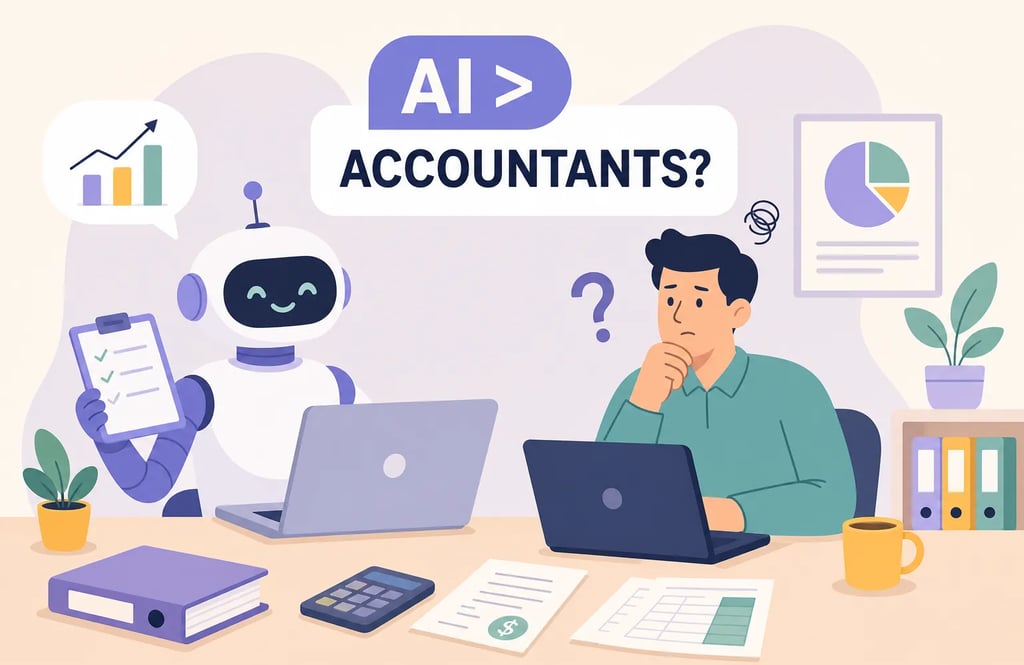
Can Artificial Intelligence Replace Accountants?
Every few years, a new technology arrives and the conversation starts the same way: which jobs will it take? Right now, the question being asked across finance departments and professional bodies alike is whether artificial intelligence will replace accountants entirely, and it is a question worth taking seriously rather than dismissing with professional optimism. But here is what the framing misses: it assumes that accounting is fundamentally a processing job. That the thing making an accountant valuable is their ability to move numbers from one column to another with accuracy and speed. If that were true, the profession would already be hollow. The reality is considerably more interesting.
The tasks that feel most like "accounting" to anyone who has never done it, reconciling statements, processing invoices, entering data, are precisely what machines do best. The capabilities that actually make an accountant worth retaining, worth trusting, and worth paying well for exist in a different category entirely. Understanding that distinction is not reassurance dressed up as analysis. It is the framework that determines what happens next to your career, your practice, and your value in the marketplace.
Will AI replace accountants? The tasks automation has genuinely taken over
AI and accounting: what automation means for bookkeeping and data entry
Credibility requires honesty here, so let us start with what automation has genuinely achieved. Data entry, invoice processing, account reconciliation, accounts payable and receivable management, journal entry creation, and month-end close processes are now handled, to a significant degree, by robotic process automation and AI-powered tools. These systems use optical character recognition to extract data from unstructured documents and post it with an accuracy rate reported at around 99% for invoice processing, compared with a manual error rate of 10, 15%. That is not a marginal improvement. That is a category shift.
The productivity numbers are equally striking. Tax preparation time has been reduced by up to 65% at firms that have adopted AI tools. Manual data entry errors have fallen by up to 90%. Research examining AI adoption in finance functions has found that monthly close cycles have shortened by as many as 7.5 days, allowing firms to finalise statements within two weeks of month-end. Deloitte's 2024 analysis of AI-driven reconciliation found reductions in month-end close time of up to 40%. These are measured outcomes from real finance departments, not projections.
The commercial infrastructure underpinning this shift is now mature. QuickBooks with Intuit Assist, Xero, Sage Intacct, Vic.ai, and Docyt have created an automation layer that sits beneath modern accounting practice. What was once specialist technology is now widely embedded across many finance functions, from small practices to large corporates. The question these tools raise is not whether they will arrive, but what remains once they do.
The judgement gap that no algorithm closes, and why it matters for accountant job security
Where AI falls short: professional judgement and HMRC compliance
Here is where the analysis needs to become genuinely precise. The most consequential accounting decisions are not calculation problems. They are interpretation problems. A machine can flag a tax anomaly with perfect consistency. What it cannot do is assess whether a client's aggressive deduction strategy reflects genuine risk tolerance, a sophisticated understanding of HMRC's current enforcement priorities, or a fundamental misunderstanding of where the boundary lies. Strategic tax planning, business restructuring advice, and audit defence require an understanding of the client's business, their personality, their sector, and their long-term goals. None of that exists in a dataset.
The relational dimension goes deeper still. A client who is quietly struggling with cash flow will not volunteer that information to a software prompt. An experienced accountant reads the hesitation in a conversation, notices the question that was not asked, and reframes the discussion before the problem becomes a crisis. This is the territory of trust built over years, professional judgement developed through thousands of client interactions, and contextual intelligence that exists nowhere in any algorithm's training data. Current AI and machine learning tools cannot replicate this dimension of practice, and the research suggests they remain far from doing so.
The AICPA's 2025 framework describes what it calls the "EPOCH" domains: Empathy, Presence, Opinion, Creativity, and Hope. The AICPA argues these are the areas where human expertise remains indispensable regardless of how capable the underlying technology becomes. That is not a sentimental claim. It is an observation about the structural difference between data processing and human understanding.
What the profession's own research actually concludes about will artificial intelligence replace accountants
The AICPA and CPA.com 2025 AI in Accounting Report, released in June 2025, states directly: "AI is not going to disrupt the accounting profession, but it will change what an accountant does." That is not optimism dressed as analysis. It reflects a measurable reallocation of accountants' time toward higher-value advisory work and away from the historical reporting function that automation has absorbed. The role is shifting from historical reporter, answering the question of what happened, to strategic adviser, answering the question of what to do about it.
The Intuit QuickBooks 2025 survey of accounting professionals reinforces this picture with specificity. Eighty-one per cent of accountants say AI improves their productivity. Seventy-nine per cent expect strategic advisory work to grow by an average of 38% over the next year. Ninety-eight per cent report improved accuracy following automation adoption. These are not numbers from firms predisposed to embrace technology uncritically. They are the reported experiences of practitioners who now spend measurably less time on reconciliation and measurably more time talking to clients about their futures.
The nuance matters, though. Sixty-two per cent of accountants surveyed in research examining AI adoption expressed concern about errors in AI-generated reporting. The MICPA annual survey found that 65% of AI users identify inaccuracy as a top concern. Accountant job security in an AI-augmented environment is a legitimate professional question, not an irrational fear. The honest answer is that practitioners who treat AI outputs as automatically reliable, rather than as a first draft requiring critical review, are the ones with genuine reason to worry. Bodies such as the ICAEW and ACCA have both emphasised the importance of maintaining professional scepticism when reviewing automated outputs, a principle that applies as much to AI-generated reports as it does to any other advisory deliverable.
The skills that will define the next generation of accountants
Job postings in 2026 describe a different role than those from 2021. Demand for GAAP reporting skills has grown substantially for bookkeeping roles, some job-postings analyses have recorded year-on-year increases exceeding 100% for certain specialisms. AI literacy and prompt engineering have moved from specialist credentials to baseline expectations. Data visualisation tools such as Power BI, which five years ago were the domain of dedicated analysts, now appear as standard requirements in accounting job advertisements. The shift is not gradual. It is structural. The core competency has moved from transactional accuracy to the ability to translate complex financial data into a clear, actionable narrative for a business owner who does not think in journal entries.
Research into AI adoption in finance quantifies what that shift looks like in practice. Accountants using generative AI tools reallocate approximately 8.5% of their working time from routine data entry toward business communication, quality assurance, and analytical work. That translates to roughly 3.5 hours in a standard working week redirected from tasks a machine can do toward tasks only a person can do well. The same research found that more experienced accountants leveraged the AI layer more strategically and captured proportionally larger performance gains.
Three concrete steps define the path forward for practitioners who want to build on this shift rather than be displaced by it:
Develop genuine fluency in at least one AI-augmented platform and learn to interrogate its outputs critically rather than accepting them as accurate.
Reposition client interactions around forward-looking advisory rather than historical reporting. Clients do not need another summary of last quarter. They need to understand what last quarter means for next year.
Invest seriously in communication skills. The ability to explain what financial data means for a client's future is the one skill that automation in finance roles cannot commoditise, and the one skill most accountants have historically underdeveloped.
Why the "replaced by AI" story misses the deeper truth
Return to the central paradox: the question assumes that the value of an accountant lies in processing. The genuine value lies in judgement, relationship, and trust built over years of understanding a specific client's business, their anxieties, their ambitions, and the particular way their sector works. AI-augmented accounting amplifies an accountant's capacity to serve those clients. It does not replicate the wisdom behind the service. The future of accounting jobs belongs to professionals who understand that distinction clearly enough to act on it.
Consider the travel industry as an illustration. A booking algorithm can compare cruise prices across every ship sailing the Mediterranean, generate a detailed itinerary, and confirm a cabin in seconds. What it cannot do is understand that you have always wanted to watch glaciers calving from a ship's bow at dawn, or that your idea of a perfect holiday involves no crowds, two very good restaurants, and a shore excursion nobody has packaged yet. That gap between data and understanding is exactly why personalised expertise still matters and still commands a premium. Specialist travel businesses exist not despite the availability of powerful booking technology, but because that technology has made the human layer more visible and more valuable than ever, a dynamic that Skylord Cruise and Holidays, as a specialist cruise and holiday operator, understands from direct experience. When everything routine can be automated, what remains is the part that was always the most important.
The same truth applies in accounting with equal force. Data has never been the scarce resource. Judgement always has been.
The answer, and what to do with it
Will artificial intelligence replace accountants? Not as a profession. But it will sideline accountants who define their value through the tasks that machines now perform faster and more accurately than any human can. The distinction matters because it determines whether automation arrives as a threat or as the most powerful lever practitioners have ever had access to.
The research is consistent across the AICPA, the major industry surveys, and the findings of academic studies into AI adoption: AI reshapes the profession rather than dismantles it. Entry-level roles will look different. The volume of purely transactional work will shrink. The demand for professionals who can interpret, advise, communicate, and build genuine client relationships will grow. That is not spin. It is the measurable direction of travel, and one that professional bodies including the ICAEW and ACCA are actively preparing their members to navigate.
The accountants who will thrive over the next decade are the ones who treat automation as leverage, not competition. Learn the tools, understand their outputs, and then spend the time those tools free up doing the work that only you can do: sitting across from a client who trusts you, understanding their situation better than any dataset could, and telling them something genuinely useful about their future.
ADDRESS
The Powerful Group Limited
124 City Road
London
United Kingdom
EC1V 2NX
WORKING HOURS
Monday - Friday 9:00 AM - 6:00 PM
Saturday - Sunday 8:00 AM - 12:00 PM
Want to Call? Ask our Powerful Bot for the Number