
Chatbot for Travel: Boost Direct Bookings & Engagement
Discover how a chatbot for travel captures bookings, cuts OTA fees, and boosts revenue. Learn which AI assistant fits your business and implementation costs.
POWERFUL BOTS
Powerful Bots
6/7/20268 min read
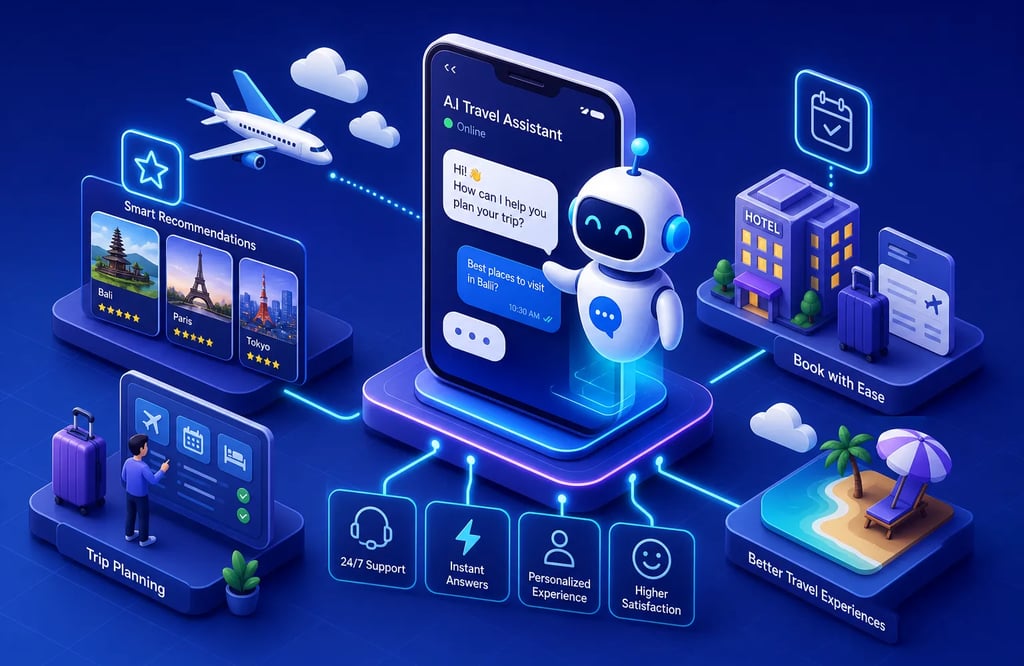
Chatbot for Travel: How AI Is Changing Customer Engagement
It's 11 PM. A traveler lands on your hotel website with specific questions: Is the ocean-view suite available for the long weekend? Can they request an early check-in? What's included in the spa package? Your team is offline. The booking window closes. The traveler ends up on an OTA and books through a platform that takes a commission, industry research puts typical OTA rates between 15% and 25% off the top. This exact scenario is what a chatbot for travel is built to prevent, and it plays out on hotel websites, tour operator pages, and travel agency platforms every single night. By the end of this article, you'll know which type of AI travel assistant fits your business model, which features to demand, which vendors to shortlist, and what implementation actually costs. At Powerful Digital Marketing, connecting chatbot tools to the full marketing picture is something our team works through with travel brands every day, because the technology alone isn't the strategy.
What types of chatbots are travel businesses actually using?
Not all travel chatbots are built for the same job. The category breaks into three distinct use cases, and picking the wrong type is the most common, and most expensive, mistake travel brands make. Understanding which type fits your operation is the first decision, not the last.
Hotel and hospitality chatbots
Hospitality chatbots are designed for pre-stay and in-stay communication: answering FAQs, handling room upgrade requests, managing check-in logistics, and pushing ancillary sales like room service or spa bookings. Edwardian Hotels London's AI assistant "Edward" is a widely cited example from the hospitality sector. In 2019, the hotel reported that Edward handled 69% of all guest requests and drove a 10% to 50% increase in room service sales (Edwardian Hotels, 2019). These bots are typically deployed on hotel websites and WhatsApp and are optimised for guest experience continuity, meaning the conversation doesn't reset every time a guest returns with a follow-up question.
Tour operator booking bots
Tour operator chatbots work differently. Their job is to move a prospect through the discovery-to-booking funnel: answering itinerary questions, surfacing availability, qualifying leads by budget and travel dates, and handing off to a human sales agent when purchase intent is confirmed. This directly reduces OTA dependency by capturing direct inquiries that would otherwise bounce to a comparison platform. A traveler who gets an instant, helpful answer to "what's included in your 10-day Peru tour?" is far less likely to restart that research on a competitor site.
Travel agency and DMC virtual agents
Travel agencies and destination management companies use conversational AI to automate lead qualification, deliver personalised itinerary recommendations, and handle follow-up sequences that human agents simply don't have bandwidth for. Think of these as virtual travel agents sitting at the top of the funnel, keeping it warm around the clock. They don't replace your sales team; they make sure every lead that arrives at 2 AM on a Sunday is still warm by Monday morning.
Why a chatbot for travel drives real revenue
A booking chatbot isn't a customer service tool. It's a revenue lever. The data from documented deployments makes this case clearly enough that the question for most travel brands isn't whether to deploy one, but which type to deploy first.
Round-the-clock engagement without adding headcount
Many travellers do their research and ask their most important questions outside business hours. A travel bot captures that intent in real time, keeps the conversation alive, and routes qualified leads to the right place. Contrast this with the cost of hiring additional agents to cover evening and weekend traffic, and the ROI math on a well-scoped chatbot deployment becomes straightforward. According to Zendesk research, at least 61% of consumers would use conversational AI to assist with travel plans, and 82% say they prefer a chatbot to waiting on hold for a phone representative, figures that underscore why after-hours coverage has become a direct booking priority rather than a nice-to-have.
Booking automation and documented conversion lifts
Luxury Escapes reported a 3x higher conversion rate than its standard website and over $300,000 in revenue within the first 90 days of deploying an AI travel assistant, with an 89% reply rate on bot messages. AA Ireland saw an 11% increase in quote conversion rate after chatbot implementation, reduced live-chat handling time from 16.5 minutes to 10 minutes, and found that 4 out of 5 bot users actively engaged with it. A spa booking case study showed a 13% rise in bookings and a 29% increase in site traffic within six weeks of deployment. These aren't marketing projections, they're documented outcomes from named travel businesses, and they establish a credible baseline for what your own deployment should be measured against.
Key features of a chatbot for travel: what separates top tools from generic ones
Most travel businesses evaluate chatbots on interface and price alone, which is an understandable starting point but rarely the one that predicts success. The features that actually determine performance are less visible but far more consequential. Two clusters of features should be non-negotiable on any shortlist.
NLP quality, booking flow, and payment handling
NLP quality in a travel context means the bot understands dates, multi-city itineraries, budget constraints, and incomplete requests, not just keywords. A traveler who types "two weeks somewhere warm, not too expensive, good food" is communicating real intent, and the bot needs to interpret it. The booking flow should allow users to search, book, modify, or cancel within the same conversation. Payment handling is a key differentiator: the best systems keep the user in one conversational path instead of redirecting to a separate checkout, which is where most bookings drop off. If a vendor's demo shows a payment redirect, that's worth pressing on before you sign.
Multilingual support, human handoff, and analytics
Multilingual capability matters for US-based travel brands targeting international visitors or serving non-English-speaking domestic segments. Yellow.ai supports 135+ languages including code-mixed dialects; Engati covers 50+ without heavy engineering effort. Human handoff is equally critical: the best AI travel assistants escalate smoothly to a live agent for refunds, complaints, and complex itineraries without trapping the user in a loop. Analytics close the picture, what conversations your chatbot generates tells you more about traveler intent than most other data sources combined, and gives you the feedback loop to keep improving over time.
Integrations and compatibility: what to check before you commit
A chatbot that can't talk to your booking engine or CRM is just a FAQ page dressed up with a chat interface. Integration compatibility is the make-or-break evaluation step, and it's one many travel brands skip until after they've already committed to a vendor.
GDS, booking engine, and CRM connectors
Streebo's WhatsApp travel chatbot integrates natively with Amadeus, Sabre, Travelport, and Expedia, plus Salesforce and Microsoft Dynamics, and supports in-chat booking and payment processing. Fini integrates natively with Amadeus, Sabre, and Travelport with read/write PNR capability, plus Salesforce Service Cloud.
What these integrations enable in practice is real-time availability checks, booking modifications, and payment processing inside the conversation, which is the difference between a chatbot that closes bookings and one that just collects inquiries. For any vendor without a documented GDS connector, ask specifically before signing, and if you need to compare the technical trade-offs, see a detailed comparison of Travelport, Amadeus, and Sabre. This is also where conversational AI for travel earns its keep: when the bot connects to live inventory, the experience shifts from informational to transactional.
Channel coverage and deployment environments
Channel coverage is often overlooked until it's too late. A booking chatbot that only works on your website misses a significant share of travel inquiries coming through WhatsApp, Facebook Messenger, and mobile apps. Check whether the vendor supports multi-channel deployment from a single configuration, because each channel requiring separate setup dramatically increases ongoing maintenance overhead. The best deployments meet travelers where they already are, not where your IT team finds it easiest to install a widget.
Vendor shortlist matched to your business type
The platforms below represent a practical starting point for evaluation, not a definitive ranking. Each was selected based on documented integrations, published pricing, and fit for a specific travel business type. The right platform ultimately depends on your booking stack, your budget, and which use case you're solving first.
Best options for hotels and hospitality brands
Asksuite and Book Me Bob are hospitality-specialist tools built specifically for direct booking and guest service. Both are custom-priced based on booking volume, so request a scoped proposal with your real numbers rather than relying on a list price. Zendesk covers the enterprise end with transparent per-agent pricing: Support Team at $19 per agent per month, Suite Team at $55, and Suite Professional at $115, with a 14-day free trial available. For larger hotel groups needing an enterprise platform with deep workflow customisation, Engati is worth including in the evaluation, though pricing is contact-sales only.
Best options for tour operators and travel agencies
Botsonic offers an accessible entry point for smaller operators: a free tier is available, and the Starter plan runs $40.83 per month. It uses ChatGPT-powered bots and works well for operators that need a functional solution without a large deployment budget. Yellow.ai is the enterprise-tier option for agencies needing high-volume multilingual support across channels, with a free tier and a 21-day trial before moving to custom enterprise pricing. Tars is specifically positioned for tourism use cases as a versatile trip planning chatbot builder and is worth including if your primary need is a structured booking conversation rather than open-ended AI dialogue.
Getting implementation right: from pilot to full rollout
The technology is only half the equation. Most chatbot deployments underperform not because the tool was wrong but because deployment wasn't connected to the broader marketing strategy. Getting this part right is where travel brands either compound their investment or stall it.
Realistic timelines and what rollout phases look like
Pilot-to-production is achievable in around four weeks on modern platforms, anything over twelve weeks is a red flag worth questioning. Full rollouts with custom workflows typically run four to eight weeks; enterprise platforms with deep GDS integrations can take six to twelve weeks or longer. On costs, pilots are low-commitment by design, while full rollouts range from $5,000 to $25,000 per month for mid-market platforms and $100,000 to $300,000 ARR for established enterprise systems. Total cost of ownership grows with ongoing optimisation, not just licensing, so factor in the time your team will spend refining conversation flows and reviewing analytics post-launch.
Why your chatbot strategy needs to connect to your full marketing funnel
A travel chatbot that isn't aligned with your SEO strategy, your paid media targeting, and your email follow-up sequences generates conversations that lead nowhere. This is the step where the investment either compounds or stalls, and it's the one many travel brands treat as optional until results disappoint. An AI-specialised agency like Powerful Digital Marketing, which works exclusively with travel brands, connects chatbot implementation to the full acquisition and conversion picture. The bot isn't just answering questions; it's reinforcing brand messaging, qualifying leads for your CRM, and supporting the same traveler persona your paid ads are targeting. That's the difference between a chatbot as a support tool and a chatbot as a growth channel.
Where to go from here
You now have the framework to make four decisions: identify which chatbot category fits your business model, confirm that shortlisted vendors offer the integrations your booking stack actually requires, structure a pilot that runs in four weeks or less, and measure against conversion and resolution metrics from day one rather than anecdotal feedback.
The chatbot for travel market in 2026 has matured enough that there's a credible option for every budget and business size. The risk isn't picking the wrong platform, it's deploying a platform in isolation and expecting it to perform without a connected strategy behind it. Some independent hotels that have integrated chatbot deployment with direct booking conversion efforts have reported meaningful reductions in OTA dependency over 12 to 18 months, but only when the bot is integrated with pricing, lead capture, and re-marketing, not when it's used as a standalone FAQ tool. Results vary by property and market, and your own baseline metrics should anchor any projection you build.
If you want a custom recommendation based on your booking stack and growth goals, that's exactly the kind of scoping conversation the team at Powerful Digital Marketing runs every week. A well-integrated chatbot for travel doesn't just answer questions at 11 PM. It books the room.
ADDRESS
The Powerful Group Limited
124 City Road
London
United Kingdom
EC1V 2NX
WORKING HOURS
Monday - Friday 9:00 AM - 6:00 PM
Saturday - Sunday 8:00 AM - 12:00 PM
Want to Call? Ask our Powerful Bot for the Number