
Google Ads for Travel Businesses: Run Profitable Campaigns
Run profitable Google Ads for travel businesses: set up conversion and offline tracking, align landing pages, and use value-based bidding to improve ROAS.
AI IN TRAVELPOWERFUL CLICKS - AFFORDABLE SEO AND PPC
Powerful Clicks
6/6/20269 min read
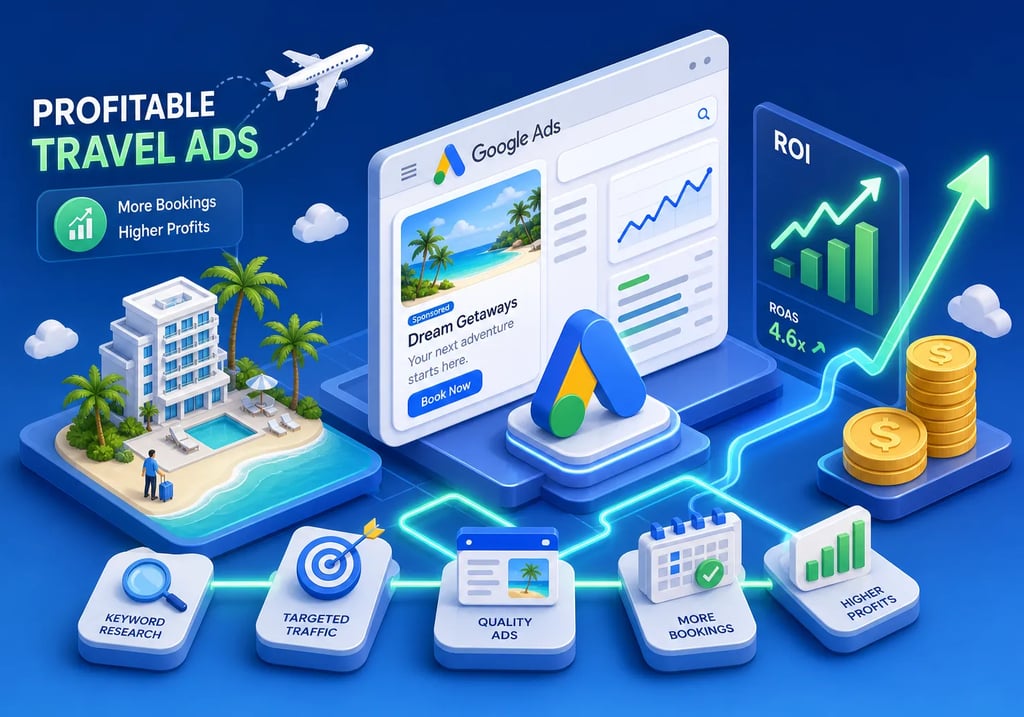
How to Run Profitable Google Ads Campaigns for Travel Businesses
If you want to know how to run profitable Google Ads campaigns for a travel business, start with this uncomfortable truth: most travel operators are optimising for the wrong thing. They build campaigns around impressions and clicks, then wonder why a £10,000 monthly ad budget produces a handful of enquiries and almost no confirmed bookings. The problem isn't the budget; it's the architecture underneath it.
The travel and hospitality industry has specific performance benchmarks a well-structured account should be hitting: a blended industry CPC of around £1.50, a Search-specific CPC of approximately £2.00, CPA between £25.00 and £40.00, conversion rates of 3.55% to 4.68%, and a target ROAS of roughly 6.5:1. Many accounts we examine fall short of these numbers because they ignore the factors that actually drive bookings: intent-matched keywords, proper conversion tracking, message-matched landing pages, and bid strategies calibrated to booking value. This guide covers exactly how to build that foundation and run profitable Google Ads campaigns for a travel business that hit those benchmarks and improve over time.
Every layer of the funnel matters. Skip conversion tracking and your bid strategy optimises toward nothing. Skip message match on landing pages and you pay for clicks that were never going to convert. Get all five layers working together, tracking, structure, ad copy, landing pages, and bidding, and the campaigns start generating real bookings, not just traffic reports.
Why most travel Google Ads accounts leak budget before a booking is made
What budget leaking actually looks like in a travel account
The three most common culprits are broad match keywords pulling irrelevant traffic, conversion tracking that only fires on a thank-you page, and a campaign structure copied from a non-travel playbook. Consider a tour operator bidding on "things to do in Italy." That phrase captures travellers in pure research mode: people browsing ideas, comparing destinations, months away from booking anything. Contrast that with "small group Italy tours 7 days" and you're reaching someone who has chosen a destination, defined a trip type, and is actively looking for a provider. The booking intent difference between those two queries is enormous, but they look nearly identical in a broad match setup.
Conversion tracking: getting it right from day one
Travel businesses face a tracking challenge most industries don't: bookings happen online, by phone, and through agents, sometimes weeks after the original ad click. A setup that only counts website thank-you pages misses a significant portion of actual revenue. The recommended architecture starts with a primary online booking conversion tag, a call tracking number with dynamic number insertion for phone leads, and a CRM that captures the Google click ID at the moment of the first inquiry. When phone calls and agent-assisted bookings close, those confirmed bookings get imported back into Google Ads as offline conversions matched to the original click ID. For a step-by-step walkthrough on importing phone and offline leads back into Google Ads, see this guide on how to set up offline conversion tracking in Google Ads.
Critically, pass booking value, not just conversion counts. A couple booking a 14-day expedition cruise represents a fundamentally different revenue outcome than a solo traveler booking a half-day tour. If your bidding algorithm treats both as equal conversions, it will optimise toward volume instead of margin. Value-based tracking is what allows Smart Bidding to eventually find your most profitable customers rather than just your most frequent clickers.
How to run profitable Google Ads campaigns for a travel business: campaign structure and keyword research
Choosing the right campaign type for your travel product
Search campaigns are the foundation for travel businesses at any stage. They capture users actively searching for what you sell and give you the keyword-level control needed to protect CPA while the account builds conversion history. For hotels and properties driving direct bookings, Hotel Ads are the highest-ROI option available: they appear directly in Google's hotel search results and reach travellers in active comparison mode. Performance Max becomes a strong secondary option once you have solid conversion volume, quality creative assets, and a product feed. According to a Google travel and hotel study, Performance Max delivers roughly 18% incremental conversions at a similar CPA compared to Search alone for hotel advertisers. When implementing Performance Max for travel, follow best practices for campaign structure and asset grouping outlined in dedicated travel guides such as the Performance Max campaign structure for travel. Display and Video support re-marketing and awareness but rarely lead primary ROI for small to midsize operators.
For tour operators, travel agencies, and DMCs just starting out, a Search-first build with a remarketing Display layer is the practical starting point. A good rule of thumb: add Performance Max once your Search campaigns consistently generate at least 30 conversions per month, your conversion data is clean, and you have enough creative assets to feed the algorithm properly.
Keyword research focused on booking intent, not search volume
Travel keywords fall into four intent tiers: destination research ("best time to visit Costa Rica"), trip comparison ("Costa Rica vs. Panama for eco-tourism"), booking intent ("Costa Rica nature tours 10 days book online"), and branded queries. Your paid budget should concentrate heavily on the booking intent and branded tiers, with re-marketing campaigns catching comparison-stage browsers who didn't convert the first time. Use Google Keyword Planner to identify high-intent terms, search term reports to find what's actually triggering your ads, and competitor ad analysis to see which terms your direct competitors are prioritising.
Start with exact and phrase match on proven booking terms. Broad match has its place, but only after you have enough conversion data for the algorithm to distinguish between a high-intent booking query and an irrelevant research phrase. Expanding to broad too early is one of the fastest ways to drain a travel ad budget without producing bookings.
Ad group architecture that keeps quality scores high
Single-theme ad groups organised by destination, trip type, or accommodation category produce better quality scores, lower CPCs, and stronger ad relevance than catch-all campaign structures. For a tour operator running Italy campaigns, separate ad groups for "Tuscany wine tours," "Amalfi Coast boat tours," and "Rome private day tours" outperform one broad Italy ad group on every meaningful metric. Tightly themed groups allow headlines to mirror the exact search intent, which improves quality score, and quality score directly affects both ad position and the cost you pay per click.
Ad copy that converts travel browsers into confirmed bookers
Writing headlines and descriptions that match booking intent
Responsive Search Ads give you up to 15 headlines, but the three that matter most are the first three users typically see. Lead with the destination or trip type in headline 1 so the relevance is immediate. Use headline 2 for a concrete benefit: group size, key inclusions, a price anchor, or a differentiator like "ATOL Protected" or "Small Groups of 8 Max." Save headline 3 for a direct call to action. Generic phrases like "Great Deals on Travel" tell the user nothing. Specific headlines like "Small, Group Tuscany Wine Tours" or "Book Direct, Save 15%" earn the click because they confirm relevance and signal value in the same breath.
Your description lines should reinforce the headline and pre-qualify the click. If your tours start at £1,000 per person, say so. Someone who sees that price and clicks is far more likely to book than someone who discovers it on the landing page and leaves.
Ad assets that improve quality and pre-qualify your visitors
Fully built-out assets consistently improve CTR and reduce wasted clicks. For travel businesses, the highest-impact assets are:
Site link extensions linking to specific trip or property pages (not your homepage)
Callout extensions for trust signals like free cancellation or 24/7 support
Structured snippets listing destinations or trip types
Call assets for phone-first bookers
Price assets where the numbers strengthen rather than discourage the click
Google's guidance consistently highlights that accounts using assets comprehensively benefit from improved quality scores and stronger impression share. Build out every relevant asset type from day one.
Landing pages that turn ad clicks into paid bookings
The mobile-first booking experience travelers expect
Sending traffic to your homepage is one of the most common and costly mistakes in travel PPC strategies. If someone clicks an ad for "Amalfi Coast boat tours" and lands on a general tour homepage, they have to work to find what they were promised. Most won't. Every ad group should point to a dedicated landing page that mirrors the ad's headline exactly: same destination, same trip type, same key benefit. That message match is what keeps the conversion funnel intact from click to booking. For a checklist of design and content elements that consistently lift booking rates, see guidelines on high-converting landing pages.
Mobile accounts for a large and growing share of travel search traffic, and the experience has to match. The page needs to load fast, use a single-column layout with thumb-friendly buttons, and present the booking CTA above the fold. A sticky booking bar that stays visible as users scroll dramatically reduces drop-off on longer trip pages. Keep inquiry forms short. Every additional field is a point of friction that costs you conversions.
Social proof, availability, and pricing that close the decision
Place reviews and trip ratings near the primary CTA, not buried at the bottom of the page. Destination-specific testimonials outperform generic five-star ratings because they confirm relevance alongside trust. Display your pricing clearly, with a "from" price and a summary of what's included; hidden costs are one of the top abandonment triggers in travel booking flows. A date picker or real-time availability indicator removes the hesitation that comes from uncertainty, and urgency cues like "only 4 spots remaining" or "early booking discount ends Friday" push fence-sitters toward a decision without being manipulative.
Bidding and budget strategy that protects your margin as you scale
Matching your bid strategy to your conversion data volume
Bid strategy selection follows a three-stage progression for travel businesses. When an account is new or a campaign hasn't yet accumulated 30 conversions per month, start with Maximise Conversions (or Maximise Clicks during the initial data-collection phase) to build a reliable signal without letting the algorithm optimise toward nothing. Once you have a consistent conversion signal at 30 or more conversions per month, the algorithm can start finding meaningful patterns. When you're tracking booking value reliably and sustaining that conversion volume, graduate to Target ROAS with an initial target calibrated around the 6.5:1 industry benchmark, then tighten it as your data matures. For agencies or operators managing multiple campaigns toward a single booking goal, portfolio bidding can stabilise performance across the account without requiring each individual campaign to hit the conversion threshold on its own.
Seasonal budget management and scaling what works
Travel demand is inherently seasonal, and static monthly budgets punish businesses twice: overspending during peak periods when competition drives up CPCs, and underinvesting during shoulder-season booking windows when demand and cost efficiency are actually favourable. Align budget ramp-up with booking windows, not departure dates. If your peak summer departures book out in February and March, that's when your budget needs to be highest, not June. Reallocate budget regularly from underperforming campaigns to proven converters, and use bid adjustments for high-intent audience segments, high-converting geographic markets, and device types to protect margin as you scale.
How AI-powered travel PPC management pushes campaigns past the manual ceiling
What AI bid optimisation and audience automation actually do
Manual bid management hits a ceiling when campaigns grow complex. Multiple destinations, overlapping audiences, mixed booking windows, and seasonal demand shifts all happening simultaneously create more variables than any manual process can optimise in real time. AI-powered travel PPC strategies address this by automating bid adjustments based on real-time conversion probability signals, refining audience segments from first-party data and behavioural patterns, and dynamically adjusting targeting by device, location, time of day, and traveler intent. The result is consistent performance at a scale and speed that manual management simply cannot match, particularly during high-stakes periods like peak booking season.
Why travel-specialized PPC management produces a different outcome
AI tools alone are not enough. They need to be calibrated with genuine travel industry knowledge, or they optimise toward surface-level signals that look good in a dashboard but don't reflect how travel customers actually book. Booking windows vary dramatically between a weekend city break and a 14-day adventure tour. The traveler persona for a river cruise is fundamentally different from the one for a backpacking itinerary. OTA competitive dynamics affect bid strategy in ways a generic algorithm won't account for unless someone with real travel experience has set the parameters.
That's the gap Powerful Digital Marketing is built to close. We combine purpose-built AI with deep travel sector experience to manage travel lead gen Google Ads campaigns with both algorithmic precision and strategic human judgment. Our aim is to move accounts from the industry average toward the top of the benchmark range, giving travel businesses a realistic path to competing against OTAs without inflating budgets to match them dollar for dollar. For travel brands that want to improve ROAS without building an in-house PPC team, a travel-specialised partnership is where the real gains live.
Build the framework, then let it compound
Learning how to run profitable Google Ads campaigns for a travel business comes down to five connected layers working in sequence: tracking that captures the full booking picture, a structure built around booking intent, ad copy that earns the right clicks, landing pages that complete the job the ad started, and bid management that protects margin as volume grows. None of these layers operates in isolation. A strong bid strategy with weak landing pages loses money. Great ad copy pointing to a slow, mismatched homepage loses the click it earned.
AI-powered management removes the manual ceiling and lets travel brands compete more efficiently against larger platforms without proportionally larger budgets. The compounding effect of getting all five layers right, then letting AI optimisation refine performance continuously, is what separates accounts that generate bookings from accounts that generate reports, departure manifests versus dashboards.
If this framework sounds like a lot to manage while also running a travel business, that's because it is. A conversation with a specialist who has built and optimised these accounts across the travel industry is a logical next step. Reach out to the team at Powerful Digital Marketing and let's look at where your current setup is leaving bookings on the table.
ADDRESS
The Powerful Group Limited
124 City Road
London
United Kingdom
EC1V 2NX
WORKING HOURS
Monday - Friday 9:00 AM - 6:00 PM
Saturday - Sunday 8:00 AM - 12:00 PM
Want to Call? Ask our Powerful Bot for the Number