

Google Gemini for Travel Agencies: Grow Content Fast
Google Gemini strategies for travel agencies: learn how Powerful Digital Marketing used Gemini to scale content, streamline campaigns, and boost bookings.
AI IN TRAVEL
Powerful Digital Marketing
6/9/20268 min read
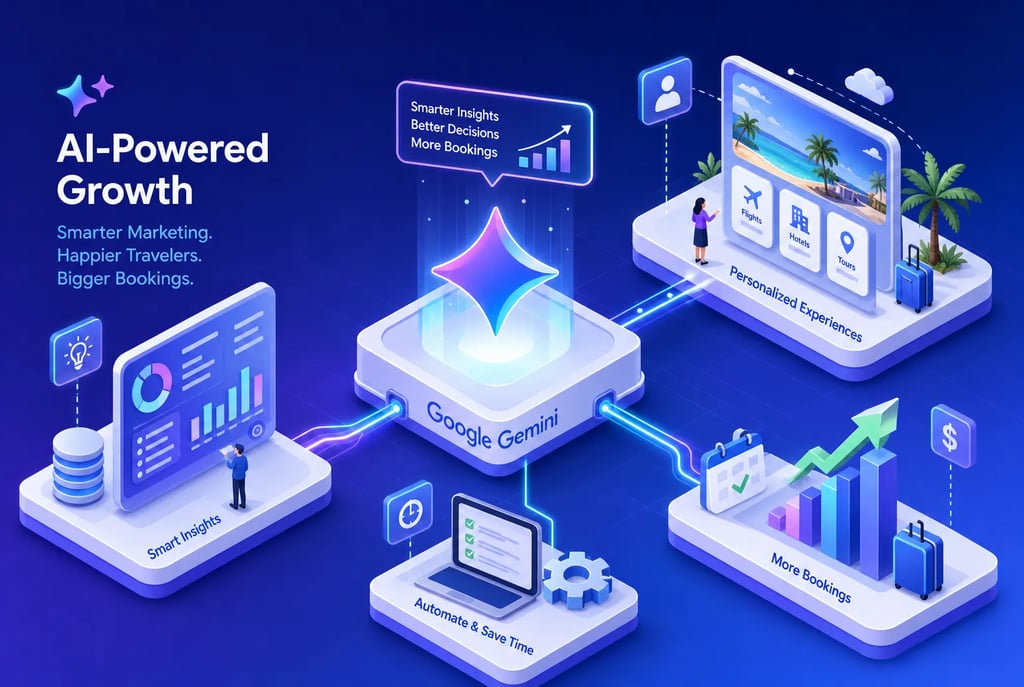
How Travel Agencies Can Use Google Gemini to Grow
Travel agencies face a content challenge that never lets up. Destination guides, trip itineraries, ad copy, SEO landing pages, email campaigns: all of it needs to be produced consistently, on brand, and at a pace that most small teams simply cannot sustain. When you add the pressure of competing with OTAs that employ entire content departments, the gap becomes genuinely difficult to close. AI Google Gemini is changing how forward-thinking agencies respond to that pressure, and the results, for those using it strategically, are hard to ignore.
This is not a gimmick or a glorified autocomplete tool. Gemini is a genuinely capable AI model built for complex, multi-format tasks. At Powerful Digital Marketing , our London-based agency works exclusively with travel brands, and we have been integrating it into marketing workflows across tour operators, boutique hotels, and destination management companies. Based on that work, we are seeing measurable improvements in content output, campaign efficiency, and team capacity.
This guide covers what Gemini actually is, the real use cases for travel agencies, how to access it in the UK, and what smart implementation looks like.
What Google Gemini is and why it matters for travel brands
From Google Bard to Gemini: what actually changed
Google Bard was the earlier chatbot product, powered by older Google models including LaMDA and PaLM 2. Google retired the Bard brand in 2024 and replaced it with Gemini, which now serves as both the name of the chatbot application and the underlying model family. Bard no longer exists as a separate product. For travel marketers, the important point is that Gemini is not simply a rebranded chatbot: it is a fundamentally more capable system built on a different architecture, with far greater practical utility for content production, data analysis, and campaign development.
The multimodal design that sets Gemini apart
Multimodal means Gemini can natively process text, images, audio, video, and code within a single session. For travel brands, this is a meaningful advantage. A marketing manager can feed Gemini a hotel's photo gallery, a set of guest reviews, and a destination brief, then ask it to produce a social caption series that reflects the visual identity and guest sentiment simultaneously. Tools that handle only text require additional steps for each input type, which creates friction and limits what you can produce in one working session.
The context window is another differentiator. According to Google's technical documentation, the latest Flash model supports a context window of up to one million tokens, which means it can hold an entire destination brief, a competitor analysis document, and your brand guidelines in memory at once, producing content that stays coherent across a long document without losing the thread midway through. For more detail on the Flash tier and recent model improvements, see Google's write-up on the Gemini 3.5 Flash model Gemini 3.5 Flash.
Generating travel content that performs with AI Google Gemini
Drafting itineraries and destination guides at scale
The practical workflow is straightforward. Give Gemini a destination, a traveller profile (family, solo, adventure-focused), and a trip duration. The model returns a detailed itinerary draft with a daily structure, suggested activities, and local dining notes. This is a starting point for a human editor to refine, not a finished product ready to publish. The long context window means you can include your entire brand voice guide, past itineraries for reference, and proprietary information about your tours, all within the same prompt.
The most effective prompt structure follows a clear pattern: role, objective, context, constraints, and output format. For example: "Act as a travel planner. Create a five-day itinerary for the Algarve for two adults travelling in September with a mid-range budget. They prefer coastal walks, local restaurants, and relaxed pacing. Present it in a day-by-day table with morning, afternoon, and evening plans." That level of specificity consistently produces output that requires far less editing.
Ad copy, email campaigns, and social content
Gemini handles conversion-focused copy well when you give it proper context. A boutique safari operator can brief Gemini on a limited availability promotion and receive multiple ad copy variants optimised for urgency and booking intent, quickly. The same session can produce A/B variant pairs for email subject lines and Instagram captions tailored to different audience segments.
Quality improves significantly when you give Gemini specific context about the audience, the offer, and the desired tone. Vague prompts produce generic output. When you include the target traveller profile, the competitive positioning, and the emotional trigger you want to activate, exclusivity, adventure, family connection, the output shifts from passable to genuinely usable. This is a principle our team applies consistently across every client campaign we build with AI.
Using Gemini to analyse customer data and sharpen your campaigns
Making sense of reviews, feedback, and CRM exports
Gemini's large context window makes it useful for data analysis tasks that previously required a dedicated analyst. A travel agency can paste in hundreds of TripAdvisor reviews, a CSV export of booking data, or a batch of post-trip survey responses and ask Gemini to identify the most common sentiment themes, recurring pain points, and the precise language travellers use to describe their experiences. This intelligence feeds directly into messaging and campaign targeting.
Language lifted from genuine guest reviews frequently performs well in copy tests, often outperforming lines written from scratch. When your campaigns reflect the words your guests actually use, conversion rates tend to respond. It is worth running your own A/B tests to verify what resonates with your specific audience.
Spotting seasonal demand and tailoring your offers
Travel agencies can use Gemini to cross-reference booking patterns with seasonal data and produce a narrative summary of where demand is building, which traveller segments are underserved, and which destinations are generating repeat interest. Tasks that once took hours of manual analysis can often be completed far more quickly when data is structured clearly and fed into a well-constructed prompt. The caveat is that accuracy depends entirely on the quality and recency of the data you provide, structured input matters, and any output should be verified before informing commercial decisions.
AI Google Gemini for SEO content generation
Producing keyword-rich destination content consistently
Gemini can help travel agencies build out their SEO content library: destination landing pages, travel FAQ sections, "best time to visit" guides, and comparison articles between destinations. A practical brief structure includes the target keyword, search intent, word count, audience, and any proprietary information about tours or packages your agency offers. Gemini's multimodal capability means it can also analyse competitor pages shared as PDFs and suggest structural improvements, giving you a content audit and a content brief in a single session, though you should verify any factual claims it produces before publishing.
In our experience working with travel brands, the agencies seeing the strongest SEO results in 2026 are not publishing raw Gemini output. They are using it to generate structured first drafts, then applying human expertise to add accuracy, brand nuance, and the kind of specific local knowledge that AI cannot fabricate. That combination of speed and expertise is what produces pages that both rank and convert. If you want to explore how to combine AI with high-impact creative formats, read our piece on Unleash the Power of AI to see how bots and avatars can be used together effectively.
Keeping your content fresh without burning out your team
SEO content needs regular updating to reflect seasonality, new travel conditions, and shifting traveller behaviour. Gemini can be tasked with refreshing existing articles by identifying outdated sections, suggesting structural improvements, and rewriting paragraphs for clarity. It is worth noting that Gemini does not guarantee up-to-date facts, so any statistics or time-sensitive claims it introduces should be verified against current sources before going live. For agencies managing dozens of destination pages, the efficiency gains from AI-assisted content refreshes compound significantly across a year.
How to access Gemini and start using it in the UK
Web, app, and Google AI Studio: the three access routes
UK travel marketers can access Gemini through three main routes. The web application at gemini.google.com works on any desktop or laptop browser with a Google account; no installation is required. The Android app is available from the Google Play Store. On iPhone and iPad, Gemini is accessed through the Google app rather than a standalone Gemini application. For most marketing tasks, the web interface is sufficient and requires no technical setup whatsoever. Note that feature availability can vary by region, so it is worth checking Google's current guidance for UK-specific access.
Using the AI Google Gemini API for marketing automation
For agencies or in-house teams that want to go deeper, the API route unlocks automation at scale. Sign in to Google AI Studio, create a project, generate an API key, and use it to build automated workflows. A travel agency's technical team can connect Gemini to their CRM, booking platform, or email marketing tool to generate personalised content at volume. For example, a post-booking email sequence that references the specific destinations, travel dates, and package details for each individual booking can be generated automatically rather than written manually for each customer. Developers can also ground responses with location data, see examples of grounding Gemini with Google Maps for richer, place-aware outputs.
According to Google's published benchmarks, the Flash model tier is best suited to high-volume, speed-sensitive tasks, delivering near-Pro-level quality at significantly faster output speeds than comparable frontier models, making it the practical choice for production workflows where you need consistent quality across large numbers of content requests. Verify the current model naming and specifications on Google's documentation before building automations, as model designations are updated regularly. For organisations that need contractual assurances and enterprise controls, review the offerings for Gemini Enterprise.
Turning Gemini into a travel growth engine, not just a content tool
The gap between using Gemini and using it strategically
Most travel agencies start using Gemini for ad hoc tasks and see moderate gains. The bigger opportunity is systematic integration: a structured prompt library, clear workflows for each content type, and a feedback loop that improves output quality over time. Without that structure, Gemini becomes a novelty rather than a competitive advantage. For ideas on operational change and how powerful bots can revolutionise your travel operation, see our guide on The Future of Travel Sales.
Data privacy is also a practical consideration. Google's default Gemini activity retention is 18 months, and teams should review these settings, available under Gemini's Privacy and Safety controls, before inputting sensitive customer data. For travel businesses handling personal booking information, understanding what data Google processes is not optional. For enterprise use through Google Workspace or the paid API, content is governed by contractual terms and is not used to train models, which offers a cleaner compliance position for agencies handling guest data at scale. For the model's official terms and data handling details, consult Gemini's privacy policy.
Where a travel-specific AI strategy makes the difference
Gemini is a powerful tool, but a tool without a travel-specific strategy behind it produces generic output that looks like every other AI-generated travel page on the internet. The agencies succeeding with Gemini are those combining it with genuine knowledge of traveller psychology, seasonal demand patterns, and booking intent signals specific to their audience.
At Powerful Digital Marketing , we work with travel agencies to build the prompt frameworks, content calendars, and campaign structures that make Gemini output genuinely competitive. That means destination content that reflects real traveller language and SEO pages built around actual booking intent, as well as ad copy that speaks to the emotional drivers behind each travel decision. The difference between experimenting with AI and actually scaling with it is a structured strategy built on travel industry expertise, and that is precisely what we provide. If you're wondering about tooling, scope, or common implementation pitfalls, our FAQ covers many of the typical concerns, common questions about AI marketing tools for travel businesses.
Getting started: the practical next step
AI Google Gemini is one of the most capable AI assistants available to travel agencies right now, and the gap between teams using it well and teams ignoring it entirely continues to widen. The core use cases are clear: content generation, customer data analysis, SEO page production, and campaign copy. Access is straightforward whether through the browser, the mobile app, or the API via Google AI Studio.
The agencies that will pull ahead are those that move from occasional AI use to a structured, repeatable system built around their specific audience and offer. If you want to make that shift, Powerful Digital Marketing is the partner to do it with. We bring the travel industry expertise that generic AI agencies do not have, combined with the technical knowledge to integrate Gemini into your existing workflows in a way that drives direct bookings and reduces your marketing overhead. Speak to our team and we can build your travel AI strategy together.
ADDRESS
The Powerful Group Limited
124 City Road
London
United Kingdom
EC1V 2NX
WORKING HOURS
Monday - Friday 9:00 AM - 6:00 PM
Saturday - Sunday 8:00 AM - 12:00 PM
Want to Call? Ask our Powerful Bot for the Number