
Lion's Mane Mushroom Benefits: 9 Science-Backed Gains
Discover 9 Lion's Mane mushroom benefits backed by human studies. Learn which effects are proven, dosing guidance, and how to choose quality supplements.
SUPPLEMENTS
Powerful Digital Marketing
5/31/20265 min read
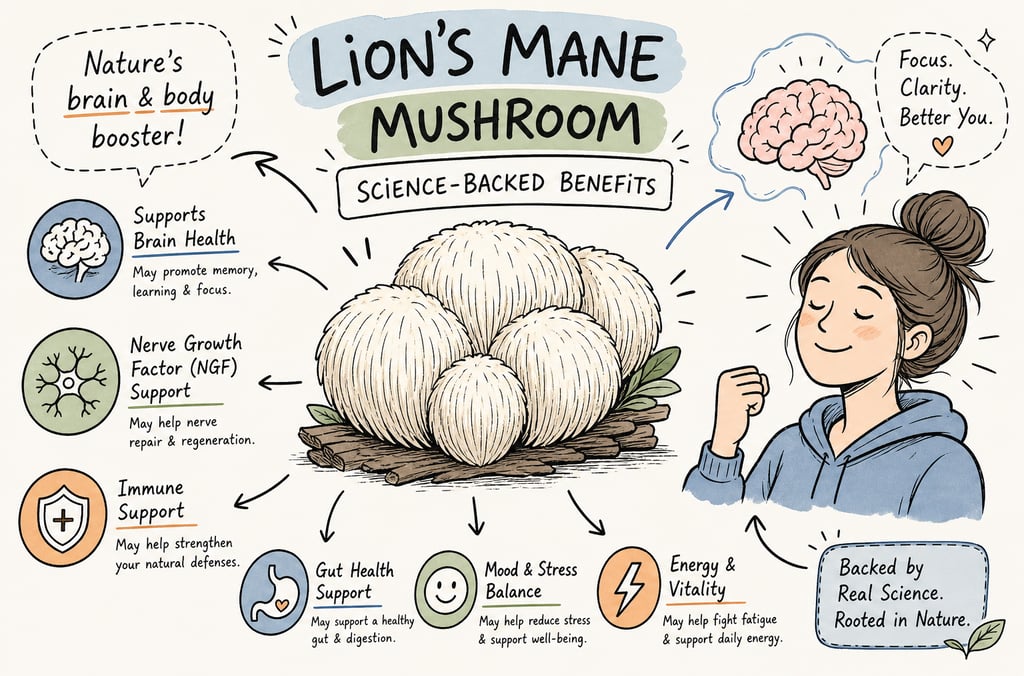
9 Lion's Mane Mushroom Benefits Backed by Real Science
This isn't purely theoretical. Low NGF levels have been associated with depressive states in clinical research, and the pathways by which Lion's Mane supports neuronal health may also support emotional resilience over time. The 28-day arm of the Docherty et al. trial also found a trend toward reduced subjective stress after chronic dosing, though it fell just short of conventional significance (p = 0.051). The mood data is plausible, not proven, it makes biological sense, but larger trials are needed before drawing firm conclusions.
Immune health and neuroprotection: the broader picture
Beyond cognition and mood, Lion's Mane has a wider pharmacological profile worth understanding, even where the evidence is primarily preclinical.
Anti-inflammatory and antioxidant mechanisms
Erinacine A-enriched extracts have shown reduced inflammatory cytokines, including IL-1β, IL-6, and TNF-α, in animal models of ischemic stroke. The mushroom also activates Nrf2 pathways, which regulate antioxidant responses in the body. These findings are preclinical, but they align with the broader research on beta-glucans and fungal polysaccharides as immune modulators. Standardized Lion's Mane extracts are often reported to contain 30% to 70% beta-glucans, the structural polysaccharides associated with immunomodulatory activity, though this range varies by product and testing method. More beta-glucan content generally means more of the bioactive fraction per dose, but quality and independent testing matter as much as the percentage on the label. For a practical breakdown of how beta-glucans function and why testing methods matter, see this beta-glucan breakdown.
Early evidence on long-term neuroprotection
Preliminary animal studies suggest erinacine A may support neuron survival pathways and reduce apoptotic (cell death) activity. One longer human study used 1,000 mg per day of Lion's Mane extract in adults with Alzheimer's disease over 49 weeks. The neuroprotective mechanism is scientifically coherent and supported by the same NGF and anti-inflammatory pathways described above. File this as promising and worth watching, not proven and ready to act on.
Lion's Mane dosage, forms, and safety
Practical guidance is where research becomes useful. Here's what the clinical literature actually tells you about dosing.
How much do human studies actually use?
Powdered fruiting body trials used gram-level doses, typically 3 g per day or more, while concentrated extracts were studied at lower totals of 1,000 to 1,800 mg per day. That variation comes from product concentration and form, not a single ideal number. The full range used across trials runs roughly 500 mg to 3,000 mg per day. For most adults using a standardised extract, 500 mg to 1,500 mg per day is a practical starting range, while higher gram-level doses reflect raw powder protocols. Morning dosing with food is the best-supported schedule based on trial protocols, and consistency matters far more than the exact hour of day. For further reading on clinical studies and dosing across trials, consult a recent clinical review on Hericium erinaceus dosing and outcomes available via PubMed Central.
Powder, capsule, or tincture
Extracts standardised for polysaccharides and beta-glucans are generally more efficient than raw dried powder, because you're getting a denser concentration of active compounds per dose. Capsules are the most consistently studied delivery format in human trials. Tinctures vary widely in quality and concentration, making them harder to dose predictably. The fruiting body versus mycelium question is also relevant: because hericenones concentrate in the fruiting body and erinacines in the mycelium, a quality dual-extract capturing both parts provides the most complete bioactive profile.
Safety profile and who should be cautious
Lion's Mane is well tolerated in clinical trials, with 3 g per day over 16 weeks producing no serious adverse events in controlled studies. The most common issues are mild GI discomfort, occasional headache, and skin reactions in sensitive individuals. People with mushroom allergies should exercise real caution, not just theoretical caution. There are no published human interaction studies with anticoagulants like warfarin, but Lion's Mane may have mild antiplatelet activity based on pharmacological data. If you're on blood thinners, antidiabetic medications, or immunosuppressants, check with your doctor before starting.
How to choose a Lion's Mane supplement that actually delivers
The mushroom supplement market has a quality problem. Understanding what to look for protects you from spending money on products that don't deliver on the science.
Fruiting body vs mycelium: why the label matters
Because hericenones and erinacines come from different parts of the mushroom, a quality product needs to either specify which part is used or offer a standardised dual-extract that captures both. Products that don't disclose their mushroom source are worth skipping. More concerning still are products that use grain-based mycelium carriers and count the starch content toward their beta-glucan numbers, inflating the percentage without delivering the real bioactive material. A practical comparison of fruiting body versus mycelium profiles can help you evaluate labels and marketing claims; see a clear discussion of mycelium vs fruiting body differences.
Top lion's mane benefits checklist: what a quality label includes
When you're reading a Lion's Mane label, look for: standardised polysaccharide or beta-glucan content, a specified mushroom part (fruiting body, mycelium, or dual-extract), vegan-friendly capsule material, no fillers or grain-based carriers, and third-party testing verification. Hyoomen's Lion's Mane supplement is formulated with these criteria in mind, a clean vegan formulation sourced from fruiting body, with transparent labeling and no grain-based fillers. As with any supplement purchase, we encourage you to review third-party test documentation and make the choice that fits your needs.
The honest bottom line on lion's mane mushroom benefits
The benefits of Lion's Mane mushroom are supported by human trials and grounded in a logical biological mechanism. The NGF pathway, the anti-inflammatory and antioxidant activity, the cognitive and mood signals in controlled studies, none of this is invented. But the human evidence base is still relatively small: trials to date have been short, involved limited sample sizes, and have shown mixed results across populations. The evidence is promising enough to act on cautiously, particularly for focus, mood, and cognitive support, but larger, longer randomised trials are still needed to confirm effect sizes and long-term generalisability.
Lion's Mane is a functional botanical, not a stimulant. It doesn't work in an afternoon. It works over weeks, supporting your brain's underlying structure rather than pushing a short-term performance spike. The practical next step, if this science resonates with you, is to start with a quality standardised extract, take it consistently with breakfast, and give it 8 to 12 weeks before drawing conclusions. That's how the trials were run, and that's what the data actually supports.
Hyoomen's Lion's Mane is formulated to align with these standards, a clean, transparent starting point for anyone ready to add a genuinely evidence-informed nootropic mushroom to their daily routine. Act on the evidence with honest expectations and a product you can verify. Those two things together are what actually move the needle.
Frequently asked questions about Lion's Mane mushroom benefits
How much Lion's Mane should I take per day?
Human trials have used a wide range, from 250 mg of concentrated extract up to 3 g or more of raw powder per day. For most adults using a standardised extract, 500 mg to 1,500 mg per day is a reasonable starting range. Higher doses were typically used in raw powder protocols. Always follow product-specific guidance and consult a healthcare provider if you have underlying health conditions.
Is Lion's Mane safe to take daily?
In published clinical trials, daily use of up to 3 g for 16 weeks was well tolerated with no serious adverse events. The most commonly reported side effects are mild GI discomfort and occasional skin sensitivity. Those with mushroom allergies should avoid it, and anyone on blood thinners, antidiabetic drugs, or immunosuppressants should consult their doctor first.
What's the difference between fruiting body and mycelium Lion's Mane?
Hericenones, one of the key bioactive compound families, are concentrated in the fruiting body, while erinacines are found in the mycelium. A dual-extract product captures both. Be cautious of products using grain-based mycelium carriers, which can inflate beta-glucan counts without delivering meaningful bioactive content.
How long does it take to feel Lion's Mane benefits?
Most human studies ran for 4 to 16 weeks before significant effects were measured, though one acute study did find improvements in processing speed within 60 minutes of a single dose. For sustained cognitive and mood benefits, consistent daily use over 8 to 12 weeks is the most evidence-supported approach.
Want to try the highest grade Lion's Mane for yourself? Check out Hyoomen for more information.
ADDRESS
The Powerful Group Limited
124 City Road
London
United Kingdom
EC1V 2NX
WORKING HOURS
Monday - Friday 9:00 AM - 6:00 PM
Saturday - Sunday 8:00 AM - 12:00 PM
Want to Call? Ask our Powerful Bot for the Number