
Rank a Travel Website on Google: Actionable Guide Now
Learn how to rank a travel website on Google with targeted keywords, content clusters, technical SEO, and link building. Tactics for small travel brands.
POWERFUL CLICKS - AFFORDABLE SEO AND PPC
Powerful Clicks
6/2/20268 min read
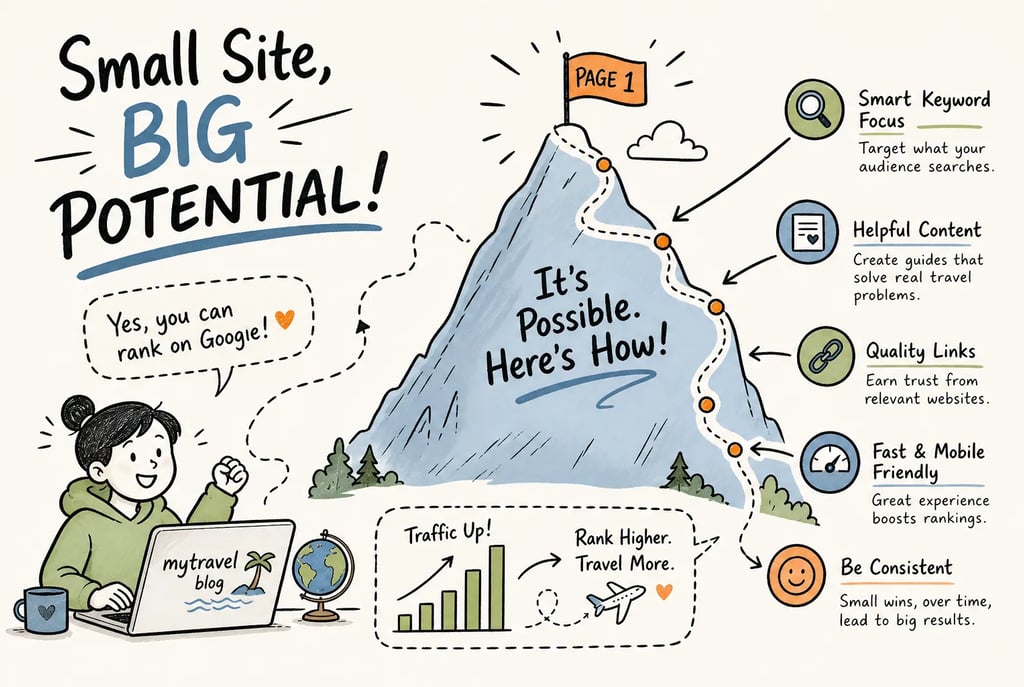
Can a Small Travel Website Rank on Google? Here's How to Do It
Expedia, Booking.com, and TripAdvisor have domain authority built over decades, armies of SEO specialists, and content teams that publish at scale. For a small tour operator or independent travel brand, the first page of Google search results can look completely locked up, with virtually every spot occupied by a platform you can't outspend or out-resource. If you're trying to figure out how to rank a travel website on Google in a competitive market, the answer isn't a bigger budget, it's a sharper strategy.
The travel brands that actually break through don't fight OTAs on their own turf. They win by targeting smarter, building tighter content clusters, and exploiting the structural gaps that massive platforms are too broad to fill. This is a prioritised playbook covering the four areas that move the needle most: keyword targeting, content differentiation, technical optimisation, and link building. It's the same framework that Powerful Digital Marketing applies when helping independent travel brands rank in markets dominated by OTA spend and algorithm-favoured giants. The difference isn't budget. It's precision.
Why OTA dominance has real gaps your site can exploit
OTAs optimise for breadth, not depth. They rank well on head terms like "flights to Miami" or "hotels in Barcelona" because those queries carry massive search volume and direct commercial value. But that broad coverage often produces template-driven pages across thousands of destinations, pages that tend to be less detailed and less specific than what a genuine subject-matter expert would write. SERP analyses of competitive destination queries consistently show OTA pages ranking on aggregated signals and domain authority rather than on-page depth.
Google increasingly rewards genuine depth and topical authority, two things an independent travel brand can build that Expedia won't bother with because niche queries don't move the revenue needle at their scale. A focused operator publishing expert content on a specific destination, such as a family-owned Costa Rica company producing a thorough series on cloud forest trekking, can often outrank OTAs on those long-tail queries precisely because the big platforms aren't competing for them. This aligns with research on the shift from keywords to context in travel.
The opportunity lives in specificity: niche itineraries, experience-type clusters covering adventure, slow travel, or multi-generational trips, and local destination guides that go deeper than any OTA aggregator page ever will. That's where your travel website optimization strategy starts, and it's where small travel sites consistently find traction.
How to rank a travel website on Google, picking keywords you can realistically win
Travel search queries fall into four intent tiers, each with distinct keyword difficulty and conversion value. Understanding which tier to target first is what separates a winnable strategy from wasted effort. Destination plus "book" terms carry the strongest commercial intent but the highest competition, with keyword difficulty scores typically ranging from 29 to 72. Those are OTA territory for now.
Destination plus "best" queries sit in a more manageable range, with keyword difficulty between 10 and 30 and wide volume variation depending on how specific the destination is. Destination plus "things to do" lands in a similar middle band. But the fastest wins for most small travel sites are destination plus "itinerary" queries: keyword difficulty of 8 to 20, planning intent, and frequently underserved by the big platforms. A query like "10-day Patagonia itinerary" or "Costa Rica cloud forest hiking route" is exactly the type of search where a genuinely expert operator can rank within months, not years.
Real-time competitor analysis changes how you find winnable keywords. Rather than chasing what OTAs rank for, the smarter move is identifying which mid-tail queries your direct competitors, other indie operators and niche travel blogs, rank for but haven't fully built out. That's where AI-driven SEO tools and sector-specific analysis reveal the gaps before other small brands catch on. For any tour operator SEO strategy, start there, not with the head terms that look most attractive.
Building content that OTAs won't bother competing with
The highest-ROI content structure for travel website optimization is the topic cluster. A strong pillar page targets a broader destination or experience keyword, supported by tightly linked articles targeting specific intent queries underneath it. A pillar page on "Costa Rica adventure tours" connects to articles on cloud forest hikes, multi-day itineraries, packing guides, and local operator recommendations. Each supporting article strengthens the pillar, and internal links pass authority throughout the cluster, for example, anchoring from "cloud forest hiking guide" back to the pillar using phrases like "Costa Rica adventure tours" or "cloud forest trekking overview."
Google rewards the site that owns the topic, not the site that published one good article. That's a structural advantage for focused independent operators: you can build genuine topical authority around your specific destinations and experiences in a way that a platform covering 190 countries simply cannot. The content investment is concentrated, not spread thin.
Differentiation comes from firsthand experience, specific local expertise, and original data. Generic destination content won't separate you from a Lonely Planet listicle or an OTA overview page. What sets you apart are content formats that work well with Google's AI Overviews for travel queries: answer-first sections at the top of pages, FAQ blocks with concise and specific responses, and comparison tables for destinations or tour types. These formats increase the chance of being cited in AI Overview results, which is increasingly where informational travel search visibility lives.
It's worth noting that AI Overviews do reduce click-through rates on informational queries. Industry data points to CTR drops in the 15, 34% range for top-ranking pages on affected queries, a figure worth tracking in your own Search Console data as AI features continue to roll out. Being cited inside the AI response partially offsets that loss, which is why destination content strategy and content structure matter as much as ranking position itself.
Technical SEO and schema your travel site must get right
Travel sites are structurally harder to optimise than most. Heavy imagery, embedded booking widgets, and dynamic inventory pages create real performance drag. The competitive benchmarks are clear: LCP under 2.5 seconds (ideally closer to 2.0 seconds on key landing pages), INP under 200 milliseconds for booking flows and search filters, and CLS under 0.1 to prevent layout shifts from hero images and sticky CTAs. These aren't aspirational targets, they're the floor for competing on mobile search.
Practical performance fixes
The fixes that move Core Web Vitals fastest include converting images to WebP or AVIF format, implementing lazy loading for below-the-fold galleries, deferring third-party booking scripts where possible, and using a CDN for faster global delivery. Booking widgets and search filters are the most common culprits for poor LCP and INP scores on travel sites, so those deserve specific attention before anything else. For a travel-focused technical SEO checklist and deeper practical guidance, see this technical SEO guide for travel sites.
Schema markup for travel sites
Structured data is your way of making facts unambiguous to Google's crawlers and AI systems. Travel-relevant schema types to implement include TouristAttraction, LodgingBusiness, Trip , LocalBusiness, FAQPage , and HowTo for step-driven planning content. Adding BreadcrumbList and AggregateRating (where genuine reviews exist on the page) supports both classic organic rankings and entity-level understanding in Google's Knowledge Graph. For practical examples and implementation advice on schema markup, this schema markup guide is a useful reference.
For a tour operator page, a minimal Trip schema implementation looks like this:
{
"@context": "https://schema.org",
"@type": "Trip",
"name": "Costa Rica Cloud Forest Trekking Tour",
"description": "A 5-day guided trekking experience through Monteverde cloud forest.",
"itinerary": {
"@type": "ItemList", "itemListElement": [ { "@type": "ListItem", "position": 1, "name": "Arrive San José, transfer to Monteverde" },
{ "@type": "ListItem", "position": 2, "name": "Full-day cloud forest hike with naturalist guide" }
]
},
"provider": {
"@type": "TouristInformationCenter",
"name": "Your Tour Company Name"
}
}
Pair this with an FAQPage block on any page that includes a Q&A section, placing both scripts in the or just before the closing tag. Schema doesn't guarantee AI Overview inclusion, but it significantly improves how reliably Google extracts your page's key facts when synthesising search results.
Earning travel backlinks without a big PR budget
For small travel brands, the three highest-return backlink sources are tourism boards and destination organisations, mid-tier niche travel bloggers, and digital PR through journalist platforms like HARO. Tourism board links carry strong topical trust and are often attainable with a well-constructed destination resource. The outreach process is straightforward: research the board's priorities, find the partnerships or media contact, and send a pitch that explains exactly how your content helps visitors to their region.
Mid-tier travel bloggers frequently outperform top-tier outlets for link building because they're reachable, their audiences are genuinely travel-intent, and collaboration is mutually beneficial rather than a one-sided ask. A blogger focused on adventure travel in Southeast Asia is both easier to reach and more valuable for your link profile than a broad travel media outlet that covers everything.
Generic "we'd love a link" emails fail. The outreach angles that actually get responses are specific and audience-first:
For tourism boards: "We created a practical planning guide for visitors to your region that complements your existing resources and could be useful to travellers on your site."
For bloggers: "Our destination expertise overlaps with your adventure travel audience; we'd like to co-create a destination guide that genuinely helps your readers plan their trip."
For broken-link replacement: identify the dead resource, build a better version, then pitch the swap concisely with the specific URL you're replacing.
For digital PR: "We can provide a short expert quote or firsthand data on [destination topic] if you're covering this angle for your travel piece."
Each of these pitches works because it leads with value to the recipient's audience, not with what you need. Pitches built around audience relevance consistently outperform generic link requests, and the gap in response rates between the two approaches is significant.
Tracking your SEO progress and knowing when to accelerate
Traffic volume tells you very little in the early months of a travel SEO campaign. The metrics that actually reflect momentum are organic impressions by keyword cluster (are you appearing for target queries?), average position movement on those queries week over week, click-through rate on pages you've optimized with schema and answer-first content, and conversion rate from organic sessions on destination pages.
Google Search Console gives you impression and position data at no cost. Pair it with a rank tracker focused on your specific keyword clusters, not vanity head terms like "travel agency." Watching your position move from 28 to 14 on "cloud forest hiking itinerary" is a more meaningful signal than tracking where you sit on "Costa Rica tours", a query you won't compete for on domain authority alone for years.
The gap between a tactic and a program is systemisation. Doing this manually across a full content calendar, competitor monitoring workflow, and technical audit cycle is slow and easy to deprioritise when operational demands take over. This is where a specialist partner like Powerful Digital Marketing shifts the pace: running AI-driven competitor analysis, automated content gap detection, and travel-specific SEO frameworks as a continuous system rather than a quarterly project. Consolidating these workflows under one integrated system removes the guesswork and builds compounding momentum that ad-hoc execution rarely achieves.
The ranking playbook in practice
Small travel websites rank on Google every day. They do it not by outspending OTAs but by out-specializing them, owning specific destination clusters, writing content with genuine depth, keeping technical performance clean, and building relationships that earn real links from travel-relevant sources. Learning how to rank a travel website on Google in a competitive market comes down to executing these four moves with consistency.
Start with your keyword gaps, targeting itinerary and "best" queries within your actual domain authority range. Build the first content cluster around your strongest destination or experience type. Fix the top technical issues on your highest-value pages, starting with LCP and CLS on mobile. Then pursue backlinks from tourism boards and niche bloggers using audience-first outreach. Measure position movement and impressions, not just sessions.
If you want to run this faster with AI tools and sector-specific travel SEO expertise built in, that's exactly what a focused travel marketing partner is designed for. The brands that break through in competitive travel markets aren't the ones with the biggest budgets. They're the ones with the sharpest strategy and the systems to execute it consistently. Powerful Digital Marketing exists to be that system for independent travel brands ready to grow.
ADDRESS
The Powerful Group Limited
124 City Road
London
United Kingdom
EC1V 2NX
WORKING HOURS
Monday - Friday 9:00 AM - 6:00 PM
Saturday - Sunday 8:00 AM - 12:00 PM
Want to Call? Ask our Powerful Bot for the Number