Tour Operator SEO: Rank Higher on Google - 2026 Guide
Learn precise SEO tactics for tour operators to outrank OTAs. From Google Business Profile wins to technical fixes and content strategies that drive bookings.
POWERFUL CLICKS - AFFORDABLE SEO AND PPC
Powerful Clicks
7/5/20267 min read
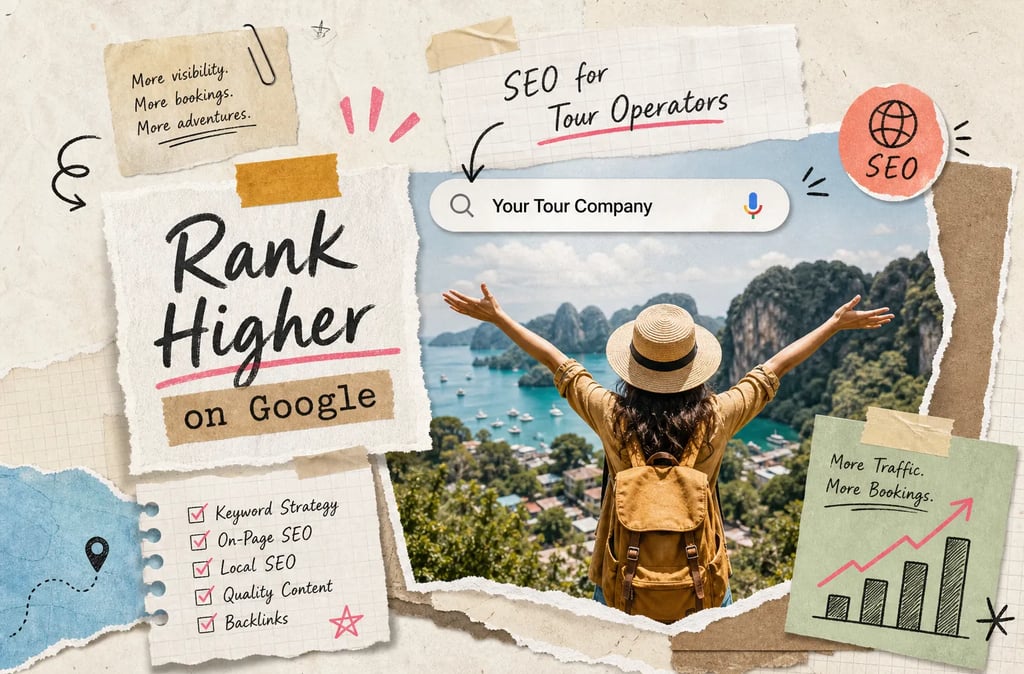
SEO Tactics for Tour Operators to Rank Higher on Google
How do tour operators rank higher on Google when OTAs, aggregators, and Google's own travel products dominate page one? The honest answer is that independent operators break through consistently, not by outspending the big players, but by being more precise about how search actually works in the travel sector. This guide breaks down the exact tactics, from quick wins on your Google Business Profile to technical fixes that unlock crawlability, so you can build organic visibility that compounds month after month.
Why tour operators lose Google visibility and what changes that
OTAs rank on volume and domain authority, not because their individual tour listings are better optimised than yours. A well-structured, technically sound operator site with strong local signals can absolutely outrank aggregate listings for specific destination and activity queries. Minzifa Travel, a Central Asia-based adventure company, is a clear example: through focused on-page optimisation, technical fixes, and long-form content, they achieved top-three positions for highly specific itinerary keywords, including a number-one ranking for "Golden Silk Road trip in Uzbekistan". The search volume on those queries is far smaller than generic terms, but the intent behind them is exceptionally high value.
Google uses three pillars to determine both local and organic rankings: relevance (does your content match what the searcher actually wants?), prominence (do reviews, backlinks, and authority signals confirm your credibility?), and proximity (for locally anchored searches, how close are you to the searcher?). Every tactic in this guide builds one or more of those signals. Start by thinking of your tour operator SEO work in those terms and the priorities become obvious.
How tour operators rank higher on Google with a strong Google Business Profile
Most tour operators underestimate how much work their Google Business Profile can do. The essentials that operators consistently miss include selecting the correct primary category ("Tour Operator" or "Sightseeing Tour Agency" rather than a vague "Travel Agency"), completing every available attribute, uploading fresh photo content regularly, and writing a keyword-rich business description that mirrors how real travellers search. Your GBP also feeds directly into Google Maps rankings for tours, making it a genuine two-for-one asset worth treating seriously.
Review velocity matters more than star rating alone. A steady stream of recent reviews tells Google the business is active and currently serving customers, which is a direct ranking signal. According to the Whitespark Local Search Ranking Factors survey, reviews influence roughly 17 to 20 percent of local pack ranking factors, so this is not a marginal consideration. Build a consistent review request system by asking post-tour via SMS or email with a direct link to your GBP review page. Aim for three to five new reviews per week rather than chasing a one-time burst, and respond to every review within 24 to 48 hours. Google's own guidance encourages prompt responses, and engaged businesses that reply consistently tend to perform better in local results over time. For guidance on Google reviews and their local ranking impact, see this analysis of best practices and ranking influence: Google reviews best practices and local ranking impact.
Winning the local pack for "tours near me" and destination queries comes down to a handful of specific moves. Add service-area cities to your GBP to extend your relevance beyond a single pin location. When uploading photos, use descriptive filenames and add keyword-rich captions in the GBP photo UI, as Google uses these fields to understand image context. Post regular GBP updates through Google Posts, and make absolutely certain your name, address, and phone number match exactly across every directory, your website, and your social profiles. Any inconsistency here undermines the prominence signal you are working to build.
On-page optimisation for tour and activity pages
The mechanics that move the needle on individual tour pages are not complicated, but they require deliberate execution. Front-load your primary keyword in the title tag within 60 characters, use clean and descriptive URL slugs such as /tours/coastal-kayaking-cornwall, and structure H1 and H2 headings to give both users and Google a clear content hierarchy. These elements matter not just for rankings but for click-through rate from the results page, and a higher CTR strengthens user engagement signals, which can indirectly improve visibility over time. For a practical audit you can run on each page, consult this on-page SEO checklist.
Schema markup is the structured data most tour operators overlook entirely. TouristTrip schema is the priority implementation for itinerary-specific pages, while LocalBusiness schema (using the TravelAgency subtype) handles the main business entity. Implement both in JSON-LD format, as Google recommends. Done correctly, this improves your eligibility for AI-powered search overviews and richer search appearances, both of which are increasingly valuable as Google's results page evolves. Use Event schema as a secondary addition only for time-bound departure dates, not as your primary implementation.
How internal linking helps tour operators rank higher on Google
Internal linking is where many operators leave ranking potential untapped. The hub-and-spoke model works well here: a destination or activity pillar page links out to individual tour subpages, while blog content links back to booking pages using descriptive anchor text. Match the content on each page to the actual traveller intent behind the target keyword. Someone searching "things to do in the Lake District" is in inspiration mode; someone searching "guided walking tour Lake District two days" is comparison-ready or booking-ready. Serving the right content to each intent stage is what converts ranked traffic into actual enquiries. For a full blueprint on organising destination and tour content, see our Travel SEO Guide: Travel Brands & Tour Operators 2026.
Technical health: what Google checks before it ranks your site
Core Web Vitals directly influence rankings, and booking sites are particularly exposed to failures across all three metrics. LCP (Largest Contentful Paint) should be 2.5 seconds or under, on tour sites, the culprit is almost always the hero image. INP (Interaction to Next Paint) should stay at 200 milliseconds or under for page responsiveness, and CLS (Cumulative Layout Shift) should sit at 0.1 or below for layout stability. Mobile traffic now accounts for over 60 percent of sessions on travel sites (according to aggregated industry analytics), so a slow or unstable page destroys both rankings and conversions simultaneously.
The practical fixes are straightforward to action: compress all images to WebP format, defer non-critical scripts, and test regularly using Google PageSpeed Insights. If more than 25 percent of your URLs fail the LCP threshold, treat it as a critical issue requiring immediate attention. A page passes Core Web Vitals when 75 percent of its visitors experience "good" performance, so check the data at scale, not just on a single test page.
Crawlability is the prerequisite that everything else depends on. Googlebot will spend its crawl budget on your least important pages if your site architecture is disorganised, which means your best tour pages may not get crawled as frequently as they should. Check for crawl blocks on key tour pages, resolve any 5xx errors, and audit canonical tags to prevent duplicate content across filtered or similar listings. Set a target indexation rate of around 90 percent of submitted pages and use Google Search Console's Coverage report as your starting diagnostic tool. If Google cannot reliably find and index your pages, no amount of on-page work will produce results.
Content that captures travellers before they start comparing prices
Travellers begin their journey with informational searches long before they look for a specific operator. Queries like "things to do in the Cotswolds" or "best hiking routes in Snowdonia" happen weeks or months before a booking decision, and the operators who show up at that stage earn a significant trust advantage. Creating genuinely useful destination guides positions your site as an authority at the top of the funnel, builds topical relevance, and generates internal links that pass authority through to your tour booking pages.
The results here are not theoretical. Meadowlark Motel, a destination accommodation in North Carolina, optimised a single "Things to Do" page using Google Search Console data and a content audit, then watched organic traffic grow by 434 percent month-on-month, with that page alone reaching over 1,000 organic visits per month. The principle transfers directly to tour operator content strategies.
Publish destination content six to eight weeks before your peak booking window, not during it. Tour searches are heavily seasonal, and content needs time to be indexed and to build rankings before demand peaks. Use Google Search Console to identify existing pages with high impressions but low click-through rates; these are fast-win optimisation targets that often outperform new content creation for immediate gains. New content, however, is where you get ahead of competitors for seasonal demand in the following year.
Measuring what matters: tracking organic bookings, not just traffic
Traffic alone is a vanity metric. What you need to know is how many bookings or qualified enquiries are coming from organic search, what they cost relative to paid channels, and which specific pages and keywords are driving those results. Set up conversion events in GA4 for enquiry form completions, booking initiations, and phone call click-throughs. For operators running a booking platform on a separate subdomain, enable cross-domain measurement in GA4 to ensure the user journey is tracked end-to-end without breaking at the booking step. This guide to Google Analytics 4 for tour operators explains the essentials and why GA4 matters for bookings.
Connect your GA4 property to Google Search Console so you can see which queries are driving organic conversions, not just which queries are sending traffic. Extend your conversion window to 90 days in GA4 settings, because travel bookings frequently involve a longer decision cycle than a single session. Use UTM parameters on any links between your blog content and booking pages to attribute revenue accurately to organic search rather than lumping it into direct traffic.
The metrics that tell you your local SEO for tours is genuinely working are: organic booking conversion rate, cost-per-booking from organic versus paid channels, and keyword position progress for your core tour and destination queries. Specialist travel marketing agencies build reporting around these booking signals rather than generic session data, which means you see clearly which SEO efforts are driving real revenue rather than just page views. For operators weighing in-house versus agency support, our Affordable SEO & PPC for Travel Brands article compares cost and strategy trade-offs.
Your prioritised action plan
Work through this in phases. Start with your Google Business Profile and review strategy, these deliver the fastest local visibility gains and require no developer involvement. Once your GBP is fully optimised and a review request system is running consistently, move to on-page optimisation and schema implementation for your core tour pages. Address technical health next, with Core Web Vitals and crawlability as the primary focus. Then build out destination content that intercepts travellers early in their research phase, publishing well ahead of your peak booking windows.
The operators who rank consistently are not outspending OTAs. They understand how tour operators rank higher on Google and follow through on the fundamentals without skipping steps. Each element reinforces the others: better technical health helps content rank faster, stronger content builds authority that lifts all pages, and a well-managed GBP amplifies everything through local signals.
If you would rather have a specialist team implement and manage this entire framework, Powerful Digital Marketing works exclusively with travel businesses, applying AI-powered tools and travel-sector expertise to the full tour operator SEO process. Read our full framework in Travel SEO 2026: Master SEO for Travel Brands & Tours. Start with one section from this guide, measure it properly, then build from there.
ADDRESS
The Powerful Group Limited
124 City Road
London
United Kingdom
EC1V 2NX
WORKING HOURS
Monday - Friday 9:00 AM - 6:00 PM
Saturday - Sunday 8:00 AM - 12:00 PM
Want to Call? Ask our Powerful Bot for the Number