
Travel Company Lead Generation: Google vs Meta Ads
Decide Google Ads vs Meta Ads for travel company lead generation. Learn UK CPL benchmarks, campaign formats, attribution setup, and a 30-day test plan.
TRAVEL MARKETING
Powerful Digital Marketing
6/10/20269 min read
Travel Company Lead Generation: Google Ads vs Meta Ads Compared
Every travel marketing team eventually faces the same budget conversation: Google Ads vs Meta Ads for travel company lead generation, which platform deserves your spend? Both promise leads, both consume budget, and both can look productive in a dashboard while quietly underperforming where it counts: booked trips. The mistake most travel brands make is treating them as direct competitors and splitting spend without a clear strategy, which means neither platform gets the investment, structure, or time it needs to prove its worth.
Travel-specialist agencies managing campaigns across both platforms daily see a consistent pattern emerge from the data. Google and Meta are not rivals; they are different stages of the same traveller journey. Once you understand that distinction, the allocation question becomes considerably simpler. By the end of this article, you will have UK CPL benchmarks for both platforms, niche-specific recommendations, the right campaign formats and attribution setup, and a structured 30-day test plan you can run immediately.
Why these two platforms work completely differently for travel leads
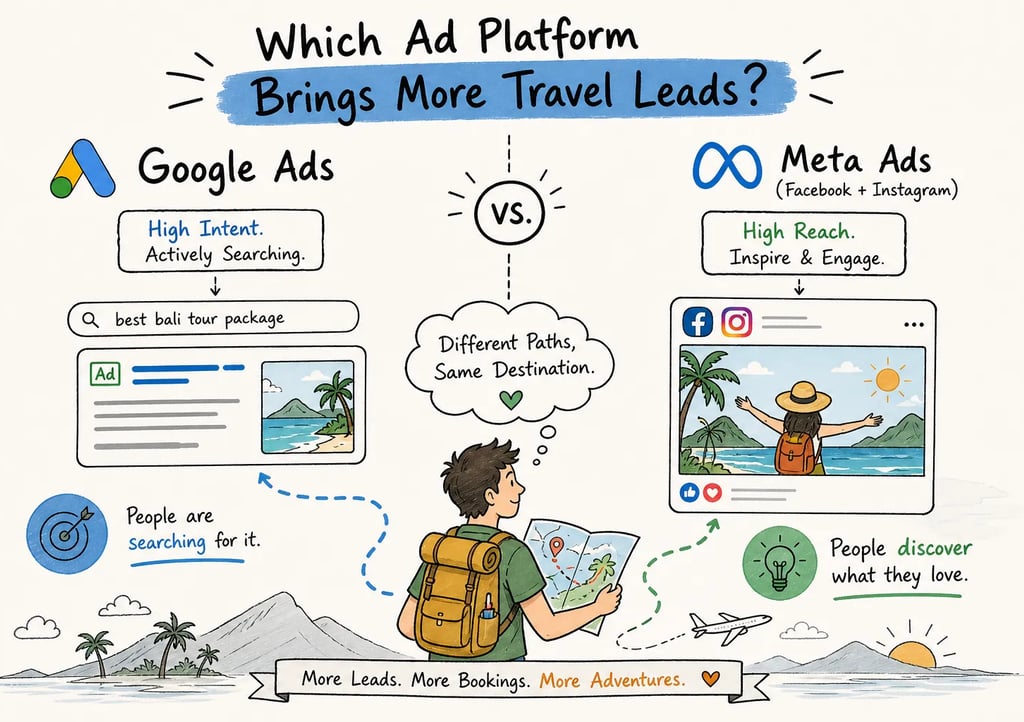
The strategic difference between Google and Meta is not about reach or cost, it is about intent. Google Ads captures existing demand: travellers who are already searching for a destination, a package, or an operator. Meta Ads create demand: they surface travel ideas to audiences who were not actively looking. This distinction shapes CPL, lead quality, and conversion timelines in ways that affect every other decision you make.
Understanding the look-to-book window matters here. A search-driven lead often converts faster because the intent is already formed before the click. A Meta-generated lead may need more nurturing, an email sequence, a retargeting campaign, a follow-up call, before it progresses to a deposit. Travel brands that grasp this stop trying to force Meta to behave like Google and start using each platform for what it genuinely does well.
How search intent shapes lead quality for travel bookings
Google Search captures high-intent queries: "luxury Maldives tours 2026", "family safari packages UK", "honeymoon cruise Caribbean". These travellers are mid-decision. They have a destination in mind, a rough budget, and a booking timeline. These leads tend to have shorter close windows and higher deposit readiness. The trade-off is cost: the commercial value of that intent is reflected in the CPC, which is why travel search clicks are among the most expensive of any category on the platform. Industry breakdowns on Google advertising costs can help you model those higher CPCs across different campaign types: how much it costs to advertise on Google.
What Meta actually does for travel lead generation
Meta's strength is audience precision, not query intent. Travel brands can reach users by interest, behaviour, life stage, and income bracket, targeting people who match the profile of their ideal traveller without waiting for them to initiate a search. This makes Meta exceptionally powerful for inspiration-led niches and for building remarketing audiences that feed back into Google's lower funnel. Lead volume is higher at a considerably lower CPL than Google Search, though lead quality on first touch is typically lower.
The funnel overlap and where both platforms intersect
The two platforms are not mutually exclusive at any stage of the funnel. A traveller may see a Meta carousel ad for a Tuscany villa holiday on a Tuesday, get inspired, and then search "boutique villa holidays Tuscany 2026" on Google two days later. That cross-channel journey is where most travel brands leak revenue, by attributing the conversion to the last click and underinvesting in the channel that started the journey. Mapping the full path is what allows travel brands to scale rather than stagnate. If your account uses rules-based automation that flattens platform differences, read Why Automated Travel Marketing Might Not Be Working for You for common pitfalls and fixes.
Google Ads vs Meta Ads for travel company lead generation: CPL benchmarks
Planning a paid media budget without CPL benchmarks is guesswork. The figures below are working ranges drawn from 2026 UK market data, not guarantees. CPL within any range moves based on offer type, destination category, landing page quality, and audience temperature. Use these as starting points for budget modelling, then let your own account data refine them.
What to expect from Google Search, Performance Max and Display
For Google Search, a realistic UK travel CPL sits at roughly £40 to £90 per lead, with approximately £45 as a credible midpoint for standard travel lead generation. Performance Max, when feed and asset quality are strong, typically delivers in the £35 to £80 range, slightly below Search because it blends intent levels across placements. Display sits at £80 to £200 or more per lead, because conversion intent on cold Display audiences is low and the economics rarely favour direct response. Display is best treated as a remarketing tool, not a cold lead acquisition channel.
Meta Lead Ads and traffic-to-form funnels: what the numbers show
Facebook and Instagram lead forms for tour operators and travel agencies typically produce CPLs in the £10 to £50 range for broad travel audiences, with stronger service-market campaigns landing around £20 to £80. Traffic-to-landing-page funnels can match or beat that range when the page is well optimised, but they add friction and often perform at the higher end. The raw CPL flatters Meta: a lead-to-booking conversion rate of 10 to 30 per cent is a reasonable planning range, and where your campaign lands within that range depends heavily on speed-to-lead, offer strength, and how well your sales process qualifies enquiries. For updated benchmarks on Meta advertising costs in 2026, see reporting on how much Meta ads cost in 2026.
Why comparing CPL across platforms without factoring in lead quality misleads you
A £15 Meta lead and a £60 Google Search lead are not the same asset, and treating them as equivalent is one of the most common and expensive mistakes in travel marketing. If the Google lead converts to a £2,500 booking at 25 per cent and the Meta lead converts at 8 per cent, the effective cost per booked trip is dramatically lower from Google despite the higher CPL. Measure CPL alongside lead-to-booking rate and average booking value. Without that fuller picture, you will consistently optimise toward cheaper leads rather than more profitable bookings.
Which travel niche gets better results on which platform
There are clear patterns across niches, even if there is no single universal answer. Whether Google Ads or Meta Ads delivers stronger travel company lead generation for your business depends on whether travellers in your category search with specific intent or whether they need to be inspired into awareness before they will ever reach a search bar. The niche breakdowns below reflect patterns that recur consistently in practice.
Niches where Google Search dominates (and why)
Some categories attract buyers who arrive at the search results already committed to a decision. Luxury travel, cruises, and destination weddings attract high-intent searchers who have already formed a strong preference. Honeymoon packages and business travel follow a similar pattern. Last-minute deals occupy a different position, time pressure compresses the journey and makes Search the natural interception point.
These segments all perform strongly on Google Search because the ads intercept buyers at exactly the right moment. Once a Search campaign has accumulated sufficient conversion data, typically 30 or more conversions per month, Performance Max can extend reach across Gmail, YouTube, and Maps at a lower CPC, amplifying the Search programme rather than replacing it.
Niches where Meta's audience targeting pulls ahead
Adventure travel, group tours, solo travel over 50, experiential holidays, and boutique wellness retreats are driven by curiosity and personal aspiration rather than active search. These products benefit enormously from visual storytelling through Carousel and Reel formats, where a stunning itinerary preview or a 15-second Reel of a Patagonia trekking route can trigger the kind of desire that eventually becomes a booking. Meta's behavioural targeting can pinpoint users by travel frequency, household income, and interest clusters that signal travel readiness, none of which is available through keyword-based targeting on Google.
When the strongest strategy is running both simultaneously
For tour operators, travel agencies, and destination management companies with multi-product offerings, the most effective approach is platform stacking: Meta for audience building and initial lead capture at lower CPL, Google Search for intercepting warm prospects at the moment of decision. This is where AI-driven budget allocation across both platforms delivers the highest blended return on ad spend. Running both channels as a single, integrated paid media programme, rather than as two separate campaigns managed in isolation, is where the real performance advantage lies.
Ad formats and attribution that actually measure booking outcomes
Choosing the right format and tracking it correctly are two halves of the same decision. The best campaign in the world produces no useful data if your attribution model only measures form fills rather than actual bookings.
Google Ads formats ranked by lead quality for travel
Search campaigns targeting high-intent keywords deliver the strongest lead quality and should anchor any Google strategy for travel lead generation. Re-marketing campaigns re-engage warm audiences who already visited destination or booking pages and remain one of the highest-converting formats on the platform. Performance Max works best once there is sufficient conversion data in the account, launching PMax too early means the algorithm optimises toward low-quality signals. Avoid relying on broad match keywords without rigorous negative keyword management: in travel, query intent varies wildly, and irrelevant clicks will inflate your CPL quickly.
Meta formats that produce the best travel leads
Native Lead Form Ads on Facebook and Instagram reduce friction and typically produce lower CPL than traffic-to-landing-page funnels for cold audiences, because auto-fill and in-platform submission remove the drop-off point of a page load. Carousel ads are strong for itinerary previews and multi-destination storytelling that pre-qualifies traveller interest before the form is even seen. Dynamic Travel Ads in re-marketing mode are the most powerful Meta format for travel, re-surfacing specific destinations and packages to users who browsed related pages and bridging Meta's awareness strength with retargeting logic that mirrors what Google does in the lower funnel. For a succinct guide to the formats that perform best on Meta, see this overview of the best Meta ad types.
The attribution setup that connects leads to actual bookings
The recommended tracking model uses GA4 as the source of truth for the full lead lifecycle. The setup involves four connected steps. First, fire a GA4 generate_lead event at form submission. Second, trigger a qualify_lead event from your CRM when a lead is marked as qualified by your sales team. Third, fire a close_convert_lead event from the CRM when a booking is confirmed. Fourth, mirror generate_lead to Google Ads as an imported conversion and to Meta via the Conversions API for server-side deduplication. Without that CRM-stitching layer, both Google and Meta will optimise toward form fills, many of which never convert to revenue, and your campaigns will consistently drift away from the outcomes that actually matter. For the latest guidance on GA4 event recommendations specifically tailored to lead generation, review the GA4 recommended events for lead generation documentation: GA4 recommended events for lead generation.
Running a 30-day Google Ads vs Meta Ads for travel company lead generation test
The cleanest way to cut through benchmarks and niche theory is to run your own structured test. Thirty days is sufficient to gather meaningful data on both platforms, provided the setup is clean and you resist the urge to make budget decisions too early.
How to structure a 30-day Google vs Meta split test
Start with a 60/40 or 70/30 budget split favouring the platform most aligned with your niche, based on the guidance in the previous section. Keep the offer, landing page, and lead form identical across both channels so that the platform is the only variable under examination. Define three tracking milestones: lead volume at day 7, qualified lead rate at day 14, and cost per qualified lead at day 30. Resist making budget reallocation decisions before day 14. Meta campaigns in particular need a learning phase of at least seven to ten days before CPL stabilises, pulling budget during that window produces misleading data.
Why dynamic AI budget allocation outperforms a fixed split
A fixed 60/40 split is a starting point, not a strategy. Platforms shift in performance based on season, destination trends, and competitor activity in ways a fixed split cannot reliably track. AI-driven allocation tools can shift budget in real time between Google and Meta based on current CPL, conversion rate, and lead quality signals, maximising booked trips per pound spent rather than optimising each platform in isolation. Travel brands that manage both channels as a single integrated programme consistently outperform those treating them as separate campaigns with separate budgets and separate reporting. See Why AI PPC Travel Industry Campaigns Are Changing the Travel Advertising Game for deeper context on AI-driven allocation in travel PPC.
Working with a travel-specialist agency that manages both at once
Most travel brands do not have the in-house bandwidth to manage Google Ads, Meta campaigns, CRM attribution, and real-time budget reallocation simultaneously. That is exactly what Powerful Digital Marketing is built to do. The agency manages both Google and Meta for travel brands, uses AI to monitor performance signals across both platforms in real time, and shifts budget dynamically toward whichever channel is producing the strongest lead quality at any given point. For those also looking at organic and paid channel alignment, we cover practical approaches in Affordable SEO & PPC for Travel Brands. For travel businesses that want the benefits of both platforms without the overhead of managing them separately, this is the most direct path to a lower blended CPL and a higher booking conversion rate.
The verdict: use both, but use them differently
Neither platform universally wins for travel company lead generation. The right answer depends on your niche, your average booking value, and whether you are trying to capture existing demand or build new audiences from scratch. Use Google to intercept travellers at the moment of intent; use Meta to create that intent in the first place. Measure both at the qualified-lead and booking level, not just the form fill, and let performance data drive your budget allocation rather than instinct or industry convention.
When you compare Google Ads vs Meta Ads for travel company lead generation in practice, the brands compressing their cost-per-booking fastest are not those who picked a single channel and committed. They are running Google and Meta as a unified paid media programme, with AI optimisation shifting spend toward whichever channel is producing the strongest signal at any given moment, and reviewing blended CPL weekly rather than platform CPL in isolation. That integrated approach is what the data consistently supports.
ADDRESS
The Powerful Group Limited
124 City Road
London
United Kingdom
EC1V 2NX
WORKING HOURS
Monday - Friday 9:00 AM - 6:00 PM
Saturday - Sunday 8:00 AM - 12:00 PM
Want to Call? Ask our Powerful Bot for the Number