
Travel Marketing Agency: How to Choose & What to Expect
Avoid costly mistakes: learn what specialist travel marketing agencies do, why generalists fall short, 2026 UK pricing, and interview questions to choose one.
TRAVEL MARKETING
Powerful Digital Marketing
6/16/20268 min read
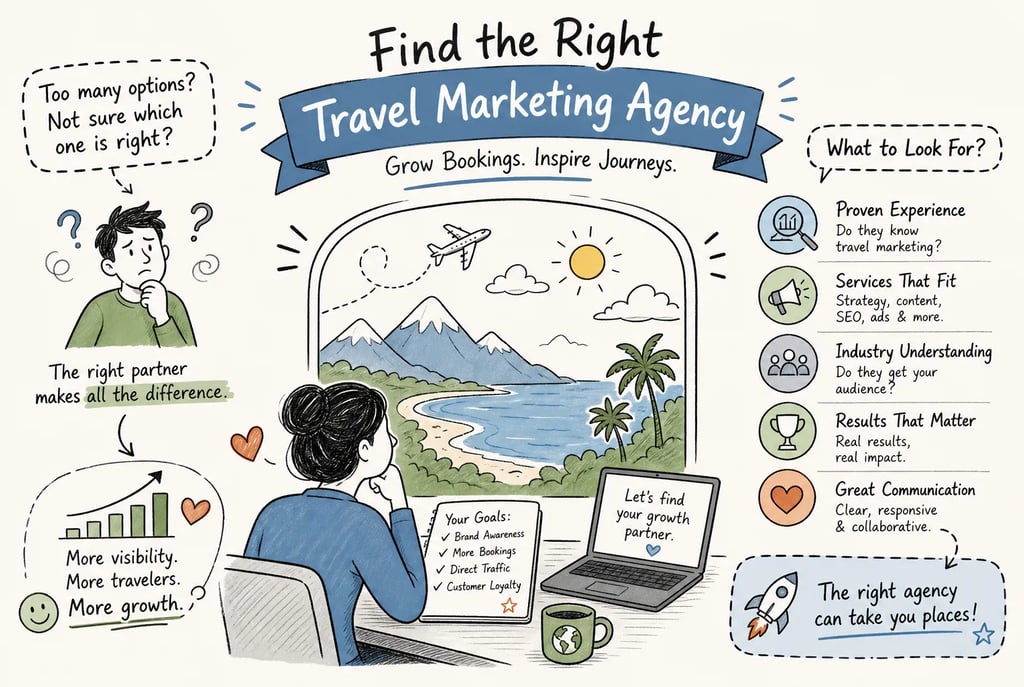
Travel Marketing Agency: What to Expect and How to Choose One
Hire the wrong marketing agency and you'll spend months watching campaigns that ignore your peak booking window, social posts that feel interchangeable with any other industry, and ad copy written by someone who clearly doesn't understand the difference between a tour operator and a travel agent. The frustration is real, and the cost is significant. Choosing the right travel marketing agency is one of the highest-leverage decisions your travel business will make. The wrong choice doesn't just waste budget, it can delay your direct booking growth by several months, or in some cases a full season.
This guide gives you a practical framework for evaluating your options: what services a specialist agency actually delivers, why the generalist-versus-specialist distinction matters far more than it sounds, what UK pricing looks like in 2026, and the interview questions that separate capable agencies from convincing ones. For context, Powerful Digital Marketing is a London-based specialist travel marketing agency that combines AI-powered tools with deep sector knowledge across hotels, cruise, tour operations, and hospitality. We've written this guide to help travel brands make a smarter decision, whether they choose to work with us or not.
What a travel marketing agency actually does
More than just running ads and posting on social
A travel marketing agency manages the digital channels that turn browsers into booked travellers. That covers paid search, SEO, social media, content creation, and increasingly, AI marketing solutions such as smart chatbots, automated personalisation, and real-time competitor analysis. Execution, however, is only part of the picture. The function extends into strategy: which channels to prioritise at each stage of the booking window, how to position your brand against OTA dominance, and where to find high-intent travellers at the lowest possible cost per acquisition.
The strategic layer is where genuine expertise shows. A competent agency doesn't just run your Google Ads campaigns, it understands how to allocate budget differently in the weeks before peak season than it does during a slow period, and it knows how to build an SEO strategy around booking intent rather than generic traffic. If an agency can't explain those distinctions in the first conversation, the execution won't be much better.
How the travel context changes everything
Travel marketing is a specialist discipline, not simply "digital marketing applied to holidays." Traveller behaviour follows patterns that don't exist in other industries: look-to-book windows that shift by destination and product type, seasonal demand spikes that can make or break a financial year, and the constant pull of major OTA platforms that typically have substantially larger paid media budgets than most independent travel brands. A marketing agency that works across retail, professional services, and travel simultaneously will apply the same playbook to all three. That's an expensive shortcut for your business to subsidise.
Generalist vs specialist: why the difference matters more than you think
What a generalist agency gets wrong about travel
Generalist agencies are competent at the mechanics. They can set up a Google Ads account, run Meta campaigns, and build an email automation sequence. What they consistently miss is the nuance that actually moves bookings. They often don't know, for example, that many tour operators see conversion rates climb significantly in the weeks leading up to peak season, a window that varies by product and market, or that boutique hotel guests respond very differently to retargeting than cruise passengers do. The result is wasted ad spend outside booking intent windows, audience segments built on demographic assumptions rather than travel behaviour, and content that fails to reflect real traveller psychology.
The performance gap is measurable. In our experience working across travel clients, specialist approaches to high-consideration buying cycles consistently produce stronger CPA and ROAS outcomes than generalist ones. For travel brands, that difference typically shows up in cost per acquisition, return on ad spend, and booking conversion rates.
What a specialist agency brings to the table
A specialist travel marketing agency treats industry knowledge as a core product, not a bonus. Strategies are built around actual booking behaviour: how far in advance different traveller segments research, which platforms they use at the inspiration stage versus the decision stage, and how pricing transparency from OTAs shapes their expectations. Competitor insights are drawn from real market intelligence, not guesswork. AI-driven personalisation is calibrated to meaningful traveller segments rather than broad demographic buckets, targeting travellers based on behaviour and intent rather than age bracket or postcode.
As an example of how this works in practice: at Powerful Digital Marketing, sector expertise is the foundation everything else is built on. Combining genuine travel experience across hotels, cruising, tour operations, and hospitality with purpose-built AI tools produces results that neither element achieves alone. The AI accelerates performance; the sector knowledge ensures that performance is pointed in the right direction.
Core services to expect from a travel marketing agency
The channels that drive direct bookings
A standard retainer from a UK travel marketing agency in 2026 typically bundles several core services. These commonly include SEO optimised for travel search behaviour and booking intent and SEO and PPC management across Google and meta-search engines such as Trivago and Kayak, social media strategy and management, and content creation across the full booking journey. Reporting and analytics are commonly included as well, since without them neither the agency nor the client can judge what's working.
PR, conversion rate optimisation, and influencer outreach tend to sit outside the core retainer and are priced as project add-ons or separate engagements. If these channels matter to your strategy, clarify what's included before signing and ask for them to be scoped explicitly rather than left as vague commitments.
AI-powered tools and automation in travel marketing
The most capable agencies now include AI-driven tools as part of their core offering rather than positioning them as premium extras, a trend increasingly evident across the travel marketing sector. In a travel context, this means chatbots that handle booking enquiries around the clock and significantly reduce response times for routine queries, automated nurture sequences that take a prospect from initial inspiration through to confirmed booking, and real-time competitor analysis that informs bid strategies and offer positioning. These aren't theoretical capabilities, they are live, working tools that directly affect acquisition costs and conversion rates.
The key question is whether the agency has actually implemented these tools for travel clients. An agency that offers AI automation as a concept but has never built a chatbot for a tour operator or configured dynamic creative for a hotel campaign is offering you a development project, not a proven capability.
How to evaluate and shortlist agencies
The questions to ask before you sign anything
Treat the agency pitch like a hiring interview. Ask what travel clients they have worked with at your scale and in your category, and request a specific case study that shows a measurable increase in bookings or revenue. This single question filters out agencies that will learn the travel industry on your budget. An agency with genuine experience will answer without hesitation; one without it will pivot to generic capability statements.
Ask how they set and report on KPIs, and whether those KPIs connect directly to bookings and revenue rather than reach or impressions. For a useful primer on which metrics matter for hotels, see the guidance on top hotel marketing KPIs and how to track them. Ask who will actually manage your account day to day, not just who presents the pitch. And ask how they handle seasonality, if the answer is vague, the strategy will be too. Here are the four questions that reveal the most in practice:
Can you show a case study where you measurably increased bookings or revenue for a business similar to ours?
How do you adjust campaign pacing and budget allocation around our peak booking windows?
Who will manage our account daily, and what is their specific travel marketing experience?
What KPIs will you report on, and how do they connect to our revenue targets?
Credentials and experience that actually predict results
The credential that matters most is direct experience with the same distribution model and buyer type your business relies on. An agency with OTA experience understands rate strategy, commission structures, and the direct-versus-OTA balance that dominates decision-making for hotels and accommodation providers. An agency with DMO experience understands destination demand generation, visitor segmentation, and market development, which is far more relevant for tour operators and destination management companies.
"We work with travel clients" is not enough. Press for specific client categories and the outcomes achieved. An agency that has helped a boutique hotel chain grow direct bookings by reducing OTA dependency has demonstrated something genuinely transferable. An agency that ran a social campaign for a travel brand three years ago has not.
How a destination marketing agency differs from a general travel agency
It's worth distinguishing between a destination marketing agency, one focused on driving visitor demand to a specific place or region, and a broader travel marketing agency working across multiple product types. Destination-focused agencies tend to specialise in place branding, visitor economy strategy, and partnership marketing with DMOs and local tourism boards. If your business spans multiple destinations or product categories, a travel marketing agency with wider sector coverage is typically the stronger fit. Travel marketing consultants who have worked across both models can help you determine which approach suits your growth objectives.
Pricing: what UK travel marketing agencies typically charge
Retainer structures and what they include
For UK travel marketing agencies in 2026, SME retainers typically run from £1,500 to £5,000 per month for lighter or more focused engagements. Mid-range specialist retainers that include ongoing strategy, paid media, SEO, and content generally sit between £3,000 and £8,000 per month. More comprehensive multi-channel programmes, where the agency is acting as an embedded growth partner rather than a single-service supplier, commonly exceed £8,000 and can move well above £10,000 for complex accounts. Setup or onboarding fees typically range from £250 to £1,500 depending on scope. For a broader look at typical marketing agency monthly retainer cost benchmarks, that resource can help with context.
These are ranges, not rules. What's included within a retainer varies considerably between agencies, so comparing monthly fees without comparing deliverables is a reliable way to choose badly. One agency's £3,000 retainer may include content creation and reporting; another's may not.
How to judge whether the fee represents value
The right question isn't whether the retainer is expensive, it's whether the projected return justifies the investment. For travel advertising, a ROAS of 3:1 or higher is a widely cited profitability benchmark, meaning at least £3 in revenue for every £1 spent. Your CPA should sit comfortably below the average booking value or customer lifetime value. An agency that won't engage with this conversation before you sign is worth treating with caution. The fee should make financial sense before the contract is in place, not six months into the retainer.
Red flags that should end the conversation
Warning signs in the pitch and onboarding process
No travel-specific case studies is the clearest signal to walk away. If an agency pitches "growing your brand" without attaching measurable KPI commitments to that promise, they're describing activity rather than outcomes. An agency that presents with a senior team but hands the account to a junior once the contract is signed is a common frustration in the industry. Ask explicitly who will manage the account and get the answer confirmed in writing.
Watch for agencies that can't explain what booking intent means or why seasonality should shape campaign pacing differently across the year. These are fundamental concepts in travel marketing. If they're unfamiliar at the pitch stage, they won't improve once you're paying a monthly retainer.
What a strong agency relationship actually looks like
A capable travel marketing agency sets measurable targets from day one and reports against them honestly. When results underperform, they adjust strategy and communicate clearly rather than deflect with attribution complexity. They understand the difference between a tour operator's long consideration cycle and a hotel's direct booking challenge. They bring proactive ideas shaped by market intelligence rather than waiting passively for a brief.
The best agency partnerships feel genuinely collaborative. You bring the brand, the product knowledge, and the market understanding. The agency brings the channel expertise, the AI tools, and the analytical rigour to amplify what you've built. When both sides are doing their job, the relationship accelerates growth rather than merely managing it.
Making the right choice
The decision comes down to four steps: define the services you need, confirm that the agency has genuine travel sector expertise rather than superficial familiarity, ask for evidence of results rather than promises of capability, and set clear KPIs before any contract is signed. The generalist-versus-specialist question is the single most important filter in the shortlisting process. A generalist agency may be cheaper in the short term. A specialist agency, in our experience, often delivers higher ROAS and better conversion efficiency over a full season.
Powerful Digital Marketing was built specifically to address this gap: AI-powered tools, deep sector knowledge across the full travel industry, and a genuine focus on bookings and revenue as the metrics that actually matter. If you're evaluating a travel marketing agency and want a conversation grounded in strategy rather than sales, get in touch with the team at Powerful Digital Marketing to discuss what a specialist approach would look like for your business.
ADDRESS
The Powerful Group Limited
124 City Road
London
United Kingdom
EC1V 2NX
WORKING HOURS
Monday - Friday 9:00 AM - 6:00 PM
Saturday - Sunday 8:00 AM - 12:00 PM
Want to Call? Ask our Powerful Bot for the Number