
Travel PPC Advertising: Strategies to Drive Bookings
Travel PPC advertising strategies to drive direct bookings: campaign structure, seasonal bids, audience targeting, and revenue-focused measurement for 2026.
AI IN TRAVELPOWERFUL CLICKS - AFFORDABLE SEO AND PPC
Powerful Clicks
6/8/20268 min read
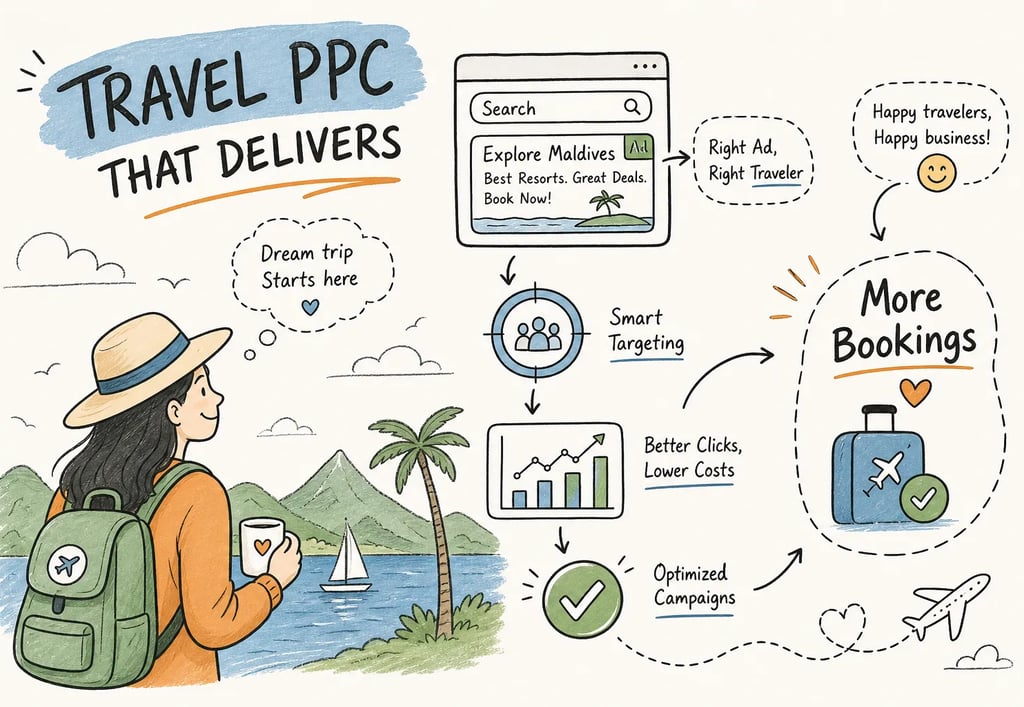
Travel PPC Advertising Strategies That Drive More Bookings
Major OTAs like Expedia and Booking.com are among the largest paid-search spenders in the world, commanding paid search results with scale that independent hotels, tour operators, and travel agencies simply cannot match dollar for dollar. But that's not the game you need to win. Effective travel PPC advertising isn't about outspending OTAs, it's about outthinking them, using the right paid search structure, audience strategy, and seasonal timing to capture travellers at exactly the moment they're ready to commit. The travel marketing teams at Powerful Digital Marketing see this consistently: the brands growing direct bookings are the ones with smarter campaign architecture, not bigger budgets.
This guide covers the full playbook for travel PPC advertising: which platforms actually convert in travel, how to structure bids around booking intent and seasonal demand, which audiences deliver the highest conversion rates, and how to measure real revenue impact rather than vanity metrics. Whether you're running campaigns in-house or briefing an agency, these are the strategies that move bookings in 2026.
What makes paid search in travel fundamentally different
Travel paid search isn't like running ads for a software product or a retail store. The booking journey is long, non-linear, and emotionally driven. A traveler might search "Caribbean cruises in January" weeks before they ever convert, cycling across multiple devices and sessions before they make a decision. Research consistently shows that travel purchases involve multiple touch points spanning days or weeks, that gap between first search and actual booking means campaigns built around a single intent stage will burn budget at the wrong moments. Here's what that means for campaign structure and platform selection.
The booking intent window and why it matters for campaign structure
Early-stage searches like "best places to travel in October" are inspiration queries. Late-stage searches like "boutique hotel Santa Fe book direct" signal purchase intent. Your ad copy, landing pages, and match types should look completely different for each stage. Hotels typically see booking windows in the range of two to three weeks, while tour operators often work with a four to ten week research-to-booking cycle. Structuring separate campaigns around these stages, rather than pushing everyone to the same landing page with the same message, is one of the most impactful structural improvements most travel advertisers can make. It's the foundation that makes every other tactic in this guide work properly.
How seasonal demand patterns shape search behavior
Search volume for travel spikes dramatically in the weeks before peak travel months. If your campaigns run at a flat budget and flat bids year-round, you're either overpaying during low-demand periods or losing impression share precisely when travellers are most ready to book. Mapping your campaign budget and bid strategy to seasonal intent cycles is a prerequisite for efficient spend, and it sets up the bidding framework covered in the next section.
Platforms and ad formats for travel PPC advertising
Not every Google Ads format delivers equally in travel. Responsive Search Ads are the strongest format for direct bookings, capturing high-intent travellers at the exact moment they're searching, with travel and hospitality Search campaign conversion rates ranging from 3.5% to 5.4% according to 2026 U.S. industry benchmarks, compared to roughly 0.57% for Display. That spread matters when you're deciding where to concentrate budget.
Google Search, Hotel Ads, and Performance Max for direct conversions
Responsive Search Ads work because they meet travellers mid-search, when intent is highest and the decision to book is already forming. Google Hotel Ads compete directly with OTA listings in search results, displaying your real-time rates and availability alongside theirs, and they remain underutilised by many independent properties despite their effectiveness for hotel PPC management. Performance Max can extend reach across Google's full network and has delivered incremental conversion lifts in hotel accounts; its effectiveness as a primary conversion driver versus a reach-expansion layer depends on budget level, inventory depth, and account maturity. Testing Performance Max alongside Search campaigns, rather than replacing one with the other, tends to produce better outcomes than an either/or approach.
Display and remarketing formats for the upper funnel
Display and Discovery ads are best used for awareness and retargeting travellers who visited your site but didn't book. Their conversion rates are low against cold audiences, but their real value is building remarketing pools that feed the higher-converting RLSA audiences you'll use in Search campaigns. Think of Display as the audience-building engine, and Search as the conversion closer.
Bidding strategies that align with how travelers actually book
Smart bidding options like Target CPA, Target ROAS, and Maximise Conversions work well when accounts have enough conversion data to train the algorithm. New campaigns or lower-volume travel businesses often don't have that volume yet, and forcing smart bidding too early leads to erratic performance. Starting with manual or enhanced CPC control and transitioning toward Target CPA or Target ROAS as conversion data accumulates is a sound progression for most travel advertisers.
Smart bidding vs. manual control: when to use each
The 2026 U.S. travel and hospitality benchmarks for Search campaigns sit at $1.53 average CPC, $44.73 average CPA, and a conversion rate of around 3.55%. Use these as reference points when evaluating whether your bids are producing competitive CPAs or whether the algorithm needs more data before it can perform reliably. Once an account reaches 30 to 50 conversions per month per campaign, smart bidding can begin optimising effectively. Below that threshold, enhanced CPC with manual bid adjustments by device, location, and audience gives you more reliable control without the noise.
Seasonal budget allocation across peak, shoulder, and off-season
A flat annual budget is one of the most common and costly mistakes in travel PPC advertising. The allocation framework that consistently outperforms is:
Peak months (45, 60% of budget): highest bid multipliers to protect impression share when booking intent is highest
Shoulder season (25, 40% of budget): medium-high multipliers to capture efficient demand as OTA auction pressure drops
Off-season (10, 20% of budget): focused on brand defence and building re-marketing pools for the next peak cycle
Shoulder season deserves more attention than most travel advertisers give it. Competition is lower, costs are more efficient, and travellers who book shoulder periods often show higher flexibility and stronger purchase intent than peak-season browsers. See proven approaches for maximising ROI in the shoulder months from industry practitioners focusing on shoulder-season strategies.
Audience targeting for travel PPC advertising
The audience you target matters as much as the keywords you bid on. Broad in-market travel audiences are the least conversion-efficient option available. RLSA (Re-marketing Lists for Search Ads) and Customer Match audiences built from past guests and site visitors consistently deliver the highest conversion rates because you're re-engaging people who already have a relationship with your brand. For any travel business competing directly with OTAs, building this audience stack is not optional.
RLSA, Customer Match, and custom intent audiences ranked by conversion potential
RLSA works by applying bid multipliers to your Search campaigns for people who previously visited your site or booking page. When someone who browsed your tours last week searches again, you bid higher to recapture them. Google's own data and agency-observed results indicate RLSA consistently delivers 18 to 25% higher conversion rates than standard search targeting. Customer Match lets you upload your past guest email list and re-engage those travelers directly in Google Search, accounts using past-guest email audiences have recorded conversion rates as high as 12%, a figure reflected in hospitality industry reporting. Custom intent audiences built around competitor searches and destination keywords fill the prospecting layer, delivering two to three times higher conversion rates than broad in-market targeting.
OTA defense: the paid search tactics that reclaim your direct bookings
One hotel case study found that focusing paid search on non-brand keywords in the four to ten week pre-trip window produced a 13% increase in direct bookings and a 10% reduction in OTA bookings year over year. A separate hospitality case study showed that activating Google Hotel Ads with real-time rate feeds grew direct bookings by 180%. These results reflect what happens when travel advertisers stop ceding the paid search results page to OTAs. The creative angle matters too: exclusive direct-booking benefits like room upgrades, flexible cancellation, and best-rate guarantees are more compelling to travellers than small price differences, and they belong in every ad and landing page you run.
Measuring campaign ROI the right way for travel
Most travel advertisers track clicks and impressions. The ones winning track cost per booking, revenue per campaign, and how each touchpoint contributed to a sale that happened days or weeks later. Getting measurement right is what lets you reallocate budget with confidence, because you know which campaigns are actually driving bookings rather than which ones happened to be the last click before conversion.
The KPIs and benchmarks that matter for travel paid search
The core metrics for any travel PPC advertising account are: CPC (2026 U.S. benchmark: $1.53 for travel and hospitality), CPA (benchmark: $44.73), conversion rate (benchmark: 3.5% to 5.4% for Search campaigns), and ROAS as the ultimate profitability measure. Cost per booking is more actionable than cost per click for travel businesses, because two campaigns with identical CPCs can produce very different revenue outcomes depending on average booking value and cancellation rates. New campaigns will typically underperform these benchmarks before the algorithm has sufficient data; optimised accounts with strong audience strategies should aim to beat them.
Attribution models that reflect the real multi-touch booking journey
Last-click attribution dramatically undervalues the campaigns that started the travel research journey. A traveler who clicked a Display ad two weeks ago, returned through a branded Search ad yesterday, and converted today should not have that revenue credited entirely to the branded Search campaign. Data-driven attribution is the preferred model when conversion volume allows, because it uses machine learning to assign credit based on each touchpoint's actual contribution. For accounts where volume is too low for data-driven attribution, time-decay or position-based (U-shaped) models are more defensible than last-click and better reflect how travel bookings actually happen. Importing offline conversions for phone bookings is also worth prioritising, phone reservations represent a meaningful share of travel revenue that standard Google Ads tracking misses entirely.
Why travel-specialized PPC management outperforms generic agencies
A generalist PPC agency can open a Google Ads account and build campaigns. What they typically can't do is structure those campaigns around seasonal demand cycles they've never operated in, write ad copy that speaks to real traveler psychology, or recognise that a tour operator's booking window peaks eight or more weeks before departure. That gap in domain knowledge is where travel advertising budgets quietly erode, and it's a structural knowledge problem, not a talent problem.
The hidden cost of a generalist managing your travel campaigns
Generic agencies default to flat year-round budgets, miss the shoulder-season efficiency opportunity, and write creative that ignores the intent signals specific to travel. They don't distinguish between an inspiration query and a booking-ready query, so they treat both the same way. The result is campaigns that generate clicks but not bookings, low ROAS, unchallenged OTA dominance, and a failure to build the remarketing pools needed for efficient audience targeting down the line. The performance gap compounds over time.
What travel-specialised PPC management delivers in practice
Powerful Digital Marketing is a London-based, AI-powered agency focused exclusively on the travel industry, with hands-on experience across holidays, cruising, hospitality, and tour operations. The team combines travel-specific PPC services with purpose-built AI tools for booking intent modelling, seasonal demand forecasting, and real-time competitor insights. That means campaigns are structured around how travelers actually research and book, not around generic platform best practices built for any industry. For travel brands that want paid search performance without building an in-house team, it's a faster and more cost-efficient path to measurable results than working with a generalist agency learning the travel category on your budget.
The strategy is clear: execution is what separates winners
The campaigns that win in travel PPC advertising are structured around intent stages, built on layered audience data, and measured against actual revenue, not activity metrics. That means aligning campaign architecture to booking windows, choosing ad formats that match conversion goals, concentrating budget around seasonal demand cycles, and building audience targeting from RLSA and Customer Match outward. None of this is complicated in theory, but all of it requires the kind of depth that only comes from understanding how travellers move from research to booking.
The travel brands that execute this well stop losing direct bookings to OTAs and start owning their paid search presence. If you're ready to improve your travel PPC advertising performance, reach out to Powerful Digital Marketing for a free audit and travel-specific PPC expertise without the overhead of an in-house team. The strategy is here, the results depend on who's executing it.
ADDRESS
The Powerful Group Limited
124 City Road
London
United Kingdom
EC1V 2NX
WORKING HOURS
Monday - Friday 9:00 AM - 6:00 PM
Saturday - Sunday 8:00 AM - 12:00 PM
Want to Call? Ask our Powerful Bot for the Number