
Travel SEO Strategy to Drive Direct Bookings that Convert
Stop chasing traffic. Learn a travel-focused SEO framework that maps keywords to the booking funnel, fixes site leaks, and turns visits into bookings.
POWERFUL CLICKS - AFFORDABLE SEO AND PPC
Powerful Clicks
7/17/20268 min read
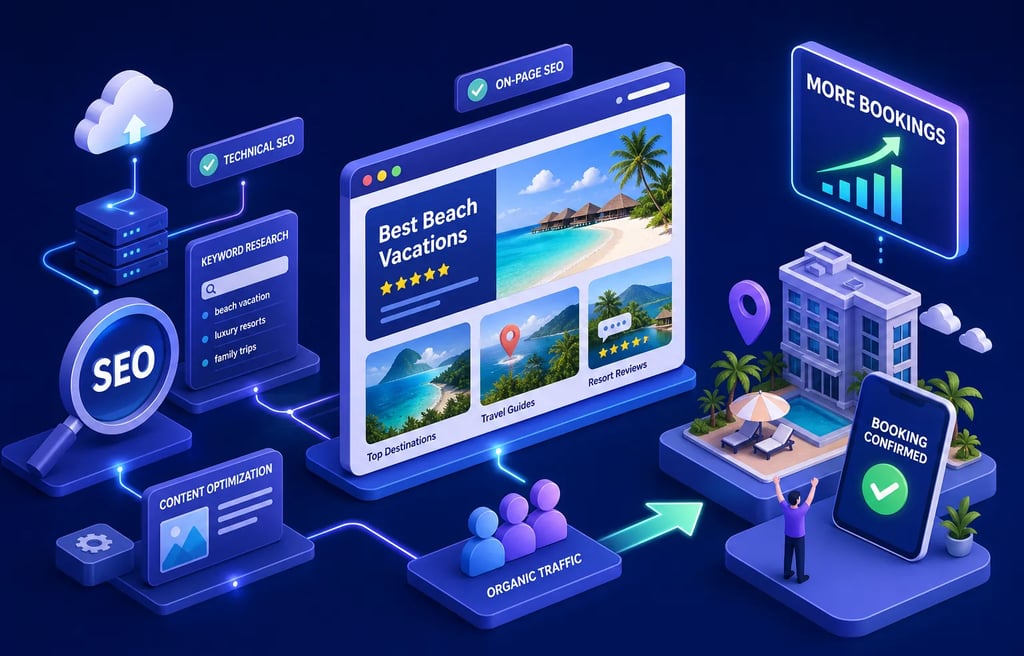
Travel SEO Strategy That Actually Drives Bookings
Many travel brands investing in SEO are solving the wrong problem. They chase higher traffic numbers, celebrate ranking improvements, and then wonder why the bookings aren't following. The gap between organic visitors and paying travellers is where most travel SEO strategies fall apart, because ranking for travel content and ranking for booking intent are two entirely different disciplines. A focused travel SEO strategy maps every ranking goal to booking intent from day one, which is what separates campaigns that drive revenue from those that merely drive reports.
This article gives you a complete framework: how to map keyword targeting to the booking funnel, resolve the technical issues that quietly suppress rankings on travel sites, build destination content that guides travellers from inspiration to purchase, win locally, and measure organic performance against revenue rather than vanity metrics. No padding, no generic advice recycled from retail playbooks.
At Powerful Digital Marketing , working exclusively within the travel industry means seeing this gap regularly across audits and campaigns. Generic SEO advice misses the booking cycle entirely, because it was never designed around how travellers search, compare, and ultimately decide. What follows is built specifically for that reality.
Why Generic SEO Leaves Travel Brands Behind
Travel decisions unfold over weeks or months, with search intent shifting dramatically at each stage. A traveller searching "best things to do in Lisbon" is in a completely different headspace from someone typing "boutique hotel Lisbon city centre direct booking." Both represent the same person at different moments in the same journey, but they need completely different pages to convert. A generic SEO approach treats both queries identically and optimises for volume, missing the point of both.
Travel search moves through four distinct stages: dreaming, planning, booking, and experiencing. Each stage demands distinct content, different keyword targeting, and a specific conversion goal. Dreaming content builds awareness. Planning content earns consideration. Booking content closes revenue. Mixing these up, or simply publishing destination guides and hoping travellers convert, leaves significant booking opportunity on the table.
A specialist travel SEO strategy also accounts for seasonality, booking windows, OTA competition (Outrank Expedia & Booking.com in Niche SERPs), and geo-intent, none of which appear in a standard SEO framework built for e-commerce or SaaS. At Powerful Digital Marketing , strategies are calibrated for traveller behaviour and booking cycles, not retrofitted from unrelated industries after the fact. That distinction determines whether your organic channel drives revenue or just traffic reports.
Travel SEO Strategy: Targeting Keywords That Signal Booking Intent
Keyword selection is where most travel SEO strategies break down at the foundation. High search volume feels reassuring, but volume without intent alignment means your pages attract browsers who never intend to book. The framework that actually works maps every keyword to a specific stage of the booking funnel before a single piece of content is briefed.
At the awareness stage, broad discovery phrases like "beach trip ideas" and "cooler holiday destinations summer 2026" bring in travellers who are still dreaming. Consideration-stage searches shift toward specifics: "best street food tours Mexico City", "solo travel women Southeast Asia", "beach clubs Mallorca", "family-friendly resorts Tenerife". Conversion keywords are the smallest in volume but carry the highest purchase intent: "boutique hotel direct booking discount", "tour groups Italy slow travel", "all-inclusive beach packages departing Manchester". These conversion-stage keywords belong on landing pages and product pages, not buried in blog posts that carry no booking mechanism.
Seasonal intent reshapes this keyword calendar throughout the year. Search volumes for popular destinations peak in January as travellers plan ahead, and again in July during peak summer demand. The timing principle: publish seasonal content several weeks to months before the search peak, not at it, use historical analytics and Google Trends to identify when interest in a specific destination begins rising, then work backwards from that date to set your publication schedule. A guide targeting "Christmas market breaks Europe" needs to be indexed and building authority by October. A page for "summer family holidays Greece" needs to be live by March.
Technical SEO Checklist for Your Travel SEO Strategy
Travel websites frequently accumulate significant technical debt due to large imagery, booking widgets, and faceted navigation systems. High-resolution destination photography, interactive maps, availability calendars, and filtering tools create a perfect environment for slow load times, duplicate content, and crawl budget waste, all of which suppress rankings quietly and consistently. Technical performance carries significant ranking weight, making it a primary SEO priority rather than a housekeeping task.
Page Speed and Core Web Vitals
Start with page speed. Convert destination imagery to WebP or AVIF format, implement lazy loading for all below-fold assets, and defer non-critical JavaScript from booking widgets until after initial content loads. In Google Search Console, monitor Largest Contentful Paint across your key pages. If more than 25% of URLs fail the 2.5-second threshold, rankings across the entire site are suppressed. Mobile performance is non-negotiable: a large share of travel searches happen on mobile devices, and poor Core Web Vitals scores on mobile pages directly reduce visibility where your audience actually is. For an accessible primer on how Google crawls and indexes sites, a useful context when diagnosing crawl budget and indexing issues, read this guide on how Google crawls websites.
Faceted Navigation and Crawl Budget
Faceted navigation is the next priority. Filtering by date, price, room type, or departure point generates thousands of thin, duplicate URLs that consume crawl budget without earning rankings. Remove these URLs from your XML sitemap entirely and apply noindex tags to low-value filter pages. Audit canonical tags using Screaming Frog: canonical chains (Page A pointing to B, B pointing to C) and canonical tags pointing to 404 pages are high-priority issues that confuse Google's understanding of your preferred URL structure. Point every canonical tag directly to a single preferred URL.
Hreflang for International Travel Sites
For international travel sites, hreflang implementation errors are a widespread and consistent problem. Every page must include a self-referencing hreflang tag, and every cross-language link must be reciprocal. Use correct ISO codes throughout: en-GB and fr-FR, not en_GB. A broken hreflang implementation can send travellers to the wrong language version of a booking page, a conversion-killing error that is invisible in standard traffic reports.
Destination Content Clusters That Guide Travellers to Booking
The pillar-and-cluster model is the most effective content architecture for destination SEO and tourism SEO more broadly. A pillar page provides the comprehensive, authoritative resource on a destination or travel category: "Complete guide to visiting Santorini" or Northern Thailand Trekking Tours . Cluster pages radiate outward from the pillar, covering supporting topics: best restaurants, specific activities, transport options, packing guides. Each cluster page links back to the pillar and, critically, to the relevant booking or product page. This internal linking structure passes authority through the content architecture and guides users deeper into the funnel with each article they read. For a practical, step-by-step walkthrough of content architecture for travel brands, see our Travel SEO Guide: Travel Brands & Tour Operators 2026.
For a tour operator, the model looks like this: pillar page Northern Thailand Trekking Tours links to cluster pages covering "best time to trek Chiang Mai", "what to pack for Northern Thailand", and "guided vs independent trekking Thailand". All three cluster pages link to the tour product page. The booking page benefits from the authority of the entire content cluster, not just its own individual optimisation. Travellers research in a predictable arc, broad destination interest first, then specific logistics, then booking, and this architecture meets them at every step rather than just at the top of the funnel.
Schema markup amplifies this content structure in search results. Hotels should implement LodgingBusiness schema with starRating, checkInTime, checkOutTime, priceRange, and HotelRoom for room-level detail, plus AggregateRating and FAQPage schema for rich snippets. Tour pages benefit from TouristTrip schema with tripOrigin, touristType, itinerary (using ItemList when sequence matters), and departure and arrival times. Destination pages should use TouristDestination schema with TouristAttraction, amenities, and audienceType properties. Implement everything in JSON-LD format, Google's preferred method, and prioritise revenue-generating pages first: booking pages, tour product pages, and core hotel landing pages. For details on the recommended pricing markup for hotels, consult the official hotel price structured data documentation.
Local SEO for Hotels, Tour Operators, and Activity Providers
For location-dependent travel businesses, local SEO is where organic traffic converts fastest. A traveller searching "boutique hotel Edinburgh city centre" is moments away from a booking decision, not weeks into a research process. Capturing this traffic requires a different approach from destination content clusters; it demands precision in local signals and profile management.
Google Business Profile is the foundation. Complete every field without exception: primary business category, service areas, attributes (pet-friendly, accessible, family rooms), high-quality photographs updated regularly, and Google Posts for seasonal offers and availability. Citation consistency reinforces everything: the business name, address, and phone number must be identical across all directories, travel aggregators, and local listings. Discrepancies confuse Google's local ranking signals and can suppress map pack visibility entirely. Encourage reviews consistently and respond to every one, review quantity and recency are recognised local ranking signals, and responses signal active management to both Google and prospective travellers reading before they book.
Create dedicated landing pages for each location a business serves. A tour operator running experiences from Edinburgh, Glasgow, and Inverness needs three separate pages with unique, locally relevant content targeting specific intent phrases: "guided walking tours Edinburgh Old Town", "day trips from Glasgow to Loch Lomond". Each page should include LocalBusiness schema, an embedded Google Map, nearby attraction references, and links into the relevant destination content guides. This combination of local signals tells Google precisely what the business does, where it operates, and which travellers it serves.
Measuring What Actually Matters: KPIs for Organic Bookings
Total sessions and page views tell you almost nothing about whether your travel SEO strategy is generating revenue. Session counts are particularly misleading for travel marketers because high volumes of informational traffic, travellers researching but not yet ready to book, routinely inflate the numbers without moving the revenue needle. The KPIs that connect organic effort to business performance are: organic search conversion rate, bookings attributed to organic sessions, revenue from organic traffic, and visitor lifetime value compared to paid channels. For a DMO- and CVB-focused perspective on modern measurement, review this discussion of modern SEO KPIs.
In Google Analytics 4, navigate to Acquisition, then Traffic Acquisition, and filter for Organic Search as the session source. Segment by landing page to identify which destination guides, product pages, and local landing pages drive the highest booking rates. Track engagement signals alongside conversions: engaged sessions, time spent on itinerary pages, brochure downloads, and enquiry form completions for high-consideration products such as group tours or multi-destination packages. These engagement metrics act as leading indicators of conversion before a booking is confirmed. For benchmark context on direct-booking conversion rates versus OTAs, see the hotel website conversion rate benchmarks.
Travel bookings rarely happen in a single session. A traveller may discover a tour operator through a blog post, return via branded search days later, compare pricing on an OTA, then book directly. Single-click attribution misses the contribution of organic content that initiates the journey, systematically undervaluing your content investment. Use multi-touch attribution to assign fractional credit across all touchpoints. In 2026, also segment AI-referred traffic separately in GA4: travellers increasingly use tools like ChatGPT and Perplexity for travel planning, and traffic arriving from chatgpt.com and perplexity.ai represents organic discovery that belongs in your blended organic ROI model. Set a quarterly review cycle covering organic conversion rate, lifetime value from organic bookings versus paid, and branded keyword impression growth as an indicator of growing traveller loyalty.
Building a Travel SEO Strategy That Compounds Over Time
A travel SEO strategy built around booking intent, technical health, destination content clusters, local visibility, and honest measurement will consistently outperform broad approaches applied without context or industry specificity. The advantage compounds: strong technical foundations allow content to rank; content clusters build topical authority; local signals capture high-intent travellers at the moment of decision; attribution clarity reveals what's actually working and where to invest next.
For travel brands that want to compress the learning curve, working with a specialist like Powerful Digital Marketing removes months of trial and error. The agency's strategies are already built around traveller search behaviour, seasonal booking cycles, and the competitive dynamics of the travel industry, covering everything from schema implementation to local citation audits to GA4 attribution configuration. That industry-specific foundation means results compound faster than a generalist approach ever could. Learn more in our Travel SEO 2026: Master SEO for Travel Brands & Tours.
Start this week by auditing one section of your current SEO setup using this framework. Begin with keyword intent mapping across your top ten pages: are those pages targeting awareness, consideration, or conversion keywords, and do the page types match the intent? Done consistently, this framework converts your organic channel from a traffic counter into a booking engine.
ADDRESS
The Powerful Group Limited
124 City Road
London
United Kingdom
EC1V 2NX
WORKING HOURS
Monday - Friday 9:00 AM - 6:00 PM
Saturday - Sunday 8:00 AM - 12:00 PM
Want to Call? Ask our Powerful Bot for the Number