
Travel SEO vs PPC: Where to Spend Marketing Budget
Travel SEO vs PPC for UK travel brands: compare costs, timelines, conversion benchmarks and a short action plan to prioritise limited marketing budgets.
TRAVEL MARKETING
Powerful Clicks
7/5/20268 min read
Travel SEO vs PPC: Where to Put Your Marketing Budget
Every travel brand hears the same advice: "You need to be doing both SEO and PPC." What rarely follows is a clear explanation of which to prioritise when budgets are tight, or a realistic picture of what each channel actually costs and delivers in the UK travel market. This guide examines travel SEO vs PPC to help UK travel brands decide where to prioritise marketing spend, whether the goal is filling seats this season or building compounding visibility over time. The result of getting it wrong is either scattered spend across both channels without a coherent strategy, or a binary choice made on gut instinct rather than data.
This is not a theoretical comparison. It is built on real cost and conversion benchmarks from the UK travel sector, combined with the channel strategy experience we apply every day at Powerful Digital Marketing when working with tour operators, boutique hotels, cruise agencies, and destination management companies. By the time you finish reading, you will know which channel fits your business right now, understand the true cost picture, apply a budget split that matches your business model, and follow a short action plan to generate bookings while building long-term visibility.
Travel SEO vs PPC: What each channel does for travel brands
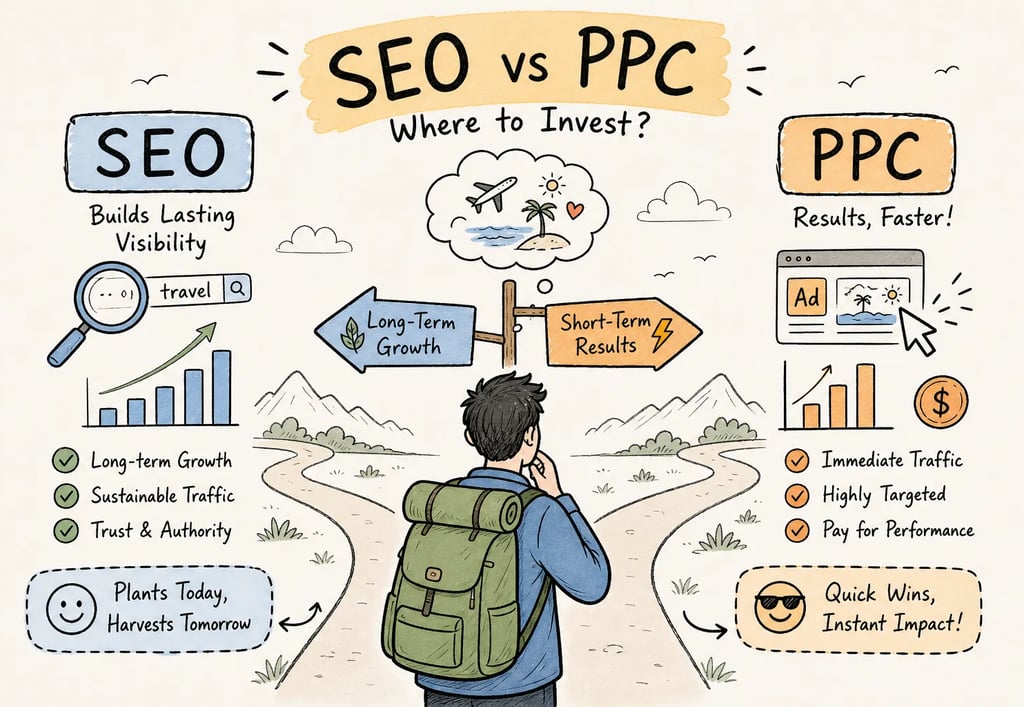
The fundamental difference between the two channels is not quality, it is timing and ownership. Organic search builds compounding visibility through content and domain authority. Paid search rents visibility immediately for a recurring cost. Both target the same travellers; they just intercept them at different stages of the booking journey and on very different financial terms.
What organic search visibility builds over time
SEO earns rankings for the destination and itinerary queries travellers use during early research, then gradually captures higher-intent booking searches as your domain authority grows. A well-optimised travel website compounds returns: a destination guide written once continues to attract travellers for years, with minimal additional spend attached to each subsequent visit, though content does require periodic refreshing and initial promotion to reach its potential. That compounding effect is the core of any organic travel search strategy and the reason mature travel brands protect their SEO investment even when short-term budgets are squeezed.
What paid search for travel delivers immediately
PPC for travel brands captures high-intent queries the moment a campaign goes live. Google Search, Shopping, and Performance Max campaigns can position your brand in front of travellers who are actively comparing and ready to book within hours of launch. The trade-off is unambiguous: the moment budget stops, visibility stops with it. There is no residual value, no authority built, and no traffic that outlasts the spend. Paid search is a tap, not a well.
Travel SEO vs PPC: The honest timeline comparison
Vague promises about SEO results "taking time" are frustrating when you have targets to hit. The clearest way to plan is to work from realistic timelines and then match them to your business calendar.
Why SEO takes 3, 6 months to move bookings for travel brands
For most travel websites, measurable bookings from organic search emerge between three and six months after consistent SEO work begins, with tour operator sites often requiring six to twelve months for sustainable volume. The process has three distinct stages: technical and on-page fixes, content indexing and ranking, and then the booking lag specific to travel, where a traveller researches in January and books in March. A realistic conversion rate target for organic travel traffic is around 2% in the early stages, rising as content authority and ranking positions improve with quarterly review and optimisation.
Why PPC can fill seats this week but compounds nothing
Paid search for travel converts at approximately 3.6% on average, based on aggregated travel industry benchmarks, according to Unbounce's conversion benchmarks for travel and hospitality, which sounds solid until you compare it against organic search's higher conversion rates, figures that can reach 8.5% for well-established brand content, though non-brand and hotel-specific organic pages often perform closer to 1.5, 3% depending on device and query intent. The short-term speed advantage of PPC is genuine and valuable. But the long-term picture is clear: every booking generated through paid search carries an ongoing cost, while every booking generated through organic search becomes progressively cheaper as rankings mature. The question is not which channel is better. The question is which one your business needs most urgently right now.
Which is cheaper: PPC or SEO for travel?
Budget decisions in travel marketing fail most often because brands work from generic industry averages rather than segment-specific UK data. The numbers below give you a grounded starting point for planning rather than guesswork.
UK travel CPC benchmarks by market segment
Across the UK travel sector, cost-per-click ranges by segment in 2026 break down as follows:
Flights: £1.90, £2.30
Hotels: £2.00, £3.20
Tours: £2.40, £2.90
Premium or bespoke packages: £3.60+
Luxury, transactional, and "book plus destination" queries carry the highest CPCs because commercial intent is explicit and competition is fierce. These figures are drawn from 2026 UK paid search data and can be cross-referenced against Google Keyword Planner for your specific segments, and for an accessible summary of travel ad costs see PPC travel cost benchmarks. With a UK travel cost-per-lead averaging around £58, £60 (figures based on industry benchmark data converted to GBP at current rates), brands with lower average booking values need to model their numbers carefully before committing heavily to paid search. Note that cost-per-acquisition will differ from cost-per-lead depending on your lead-to-booking conversion rate.
Why organic conversion outperforms paid in the long run
For established travel brands with strong content authority, organic search conversion rates can reach 8.5% versus paid search's 3.6%, nearly double, though these figures vary considerably by segment, device, and whether traffic is brand or non-brand. The underlying reason is rooted in traveller psychology. A traveller who finds your brand through an organic search result has typically already consumed content, built a degree of trust, and moved further along the booking journey before clicking. Paid clicks capture intent but not the same depth of engagement. This makes SEO not just a cost-saving channel but a conversion quality advantage that compounds as your content library grows and your domain authority rises. Industry analysis such as Phocuswire's closer look into hotel conversion rates offers useful context on where hotels and accommodation pages tend to land across different traffic sources.
Budget allocation by business type and growth stage
The right channel mix is not a permanent setting. It is a variable that changes as your business matures, your organic presence builds, and your booking volumes shift the economics of each channel.
How budget split changes from startup to established travel brand
New travel brands with no organic presence should weight 70, 80% of their search marketing budget toward PPC to generate revenue while SEO builds from the ground up; see our Affordable SEO & PPC for Travel Brands guide for practical budgeting examples. Growing brands with at least a year of trading and some organic traction can move toward a balanced 50/50 split. Mature brands with established domain authority should shift to 60, 70% SEO, using paid search selectively for high-intent, bottom-of-funnel campaigns during peak booking windows. This is a phased strategy, not a formula applied once and forgotten.
Typical allocation patterns for tour operators, hotels, and OTAs
The nuances by business model matter. Tour operators typically benefit from front-loading ad spend six to twelve weeks before peak travel windows rather than running flat monthly budgets. Boutique hotels see strong returns from allocating roughly 80% of content budget to evergreen destination content, building organic visibility that reduces OTA dependency over time. High-volume OTAs and online platforms often direct 40, 60% of total marketing to PPC because direct ROI tracking is cleaner at scale and the volume of bookings justifies the recurring cost. At Powerful Digital Marketing, these are the exact frameworks we use when building channel strategies for travel clients, adjusting the mix based on seasonality, booking window, and CPA targets specific to each business.
How seasonality reshapes your paid vs organic travel traffic mix
Seasonality is where travel marketing diverges most sharply from generic digital marketing advice. The interplay between peak demand, rising CPCs, and organic visibility requires active management rather than a set-and-forget approach.
Peak season PPC tactics that protect your spend
During peak months, CPCs rise significantly above baseline and impression share becomes harder to hold as competition intensifies across the same high-intent queries. Three adjustments make the biggest difference:
Increase peak-season budgets proportionally to your historical sales split, if July represents 30% of annual bookings, it should receive roughly 30% of annual PPC budget.
Shift bid strategies to Target ROAS when conversion volume is sufficient to give the algorithm reliable data.
Reallocate spend from declining destinations to rising ones based on real-time demand signals.
Retargeting should absorb 10, 20% of PPC budget year-round as a typical guideline, warming audiences in the research phase so they convert more efficiently when peak booking intent arrives. The right allocation within that range will depend on your average booking value and lead time. For practical approaches to adjusting campaigns for demand, budget and ROI across seasons see this seasonal strategy in travel PPC guide.
Using SEO content to maintain visibility through the off-season
Evergreen destination guides, itinerary content, and FAQ-style articles continue to generate organic traffic and qualified leads when PPC spend is scaled back in quieter months. The smartest travel brands treat the off-season as an SEO investment period, building content authority during low-cost months so that organic rankings are strong and established when CPCs spike in peak season. This approach directly reduces the paid search budget needed to maintain visibility at the moments that matter most, improving overall marketing efficiency across the annual cycle.
Choosing the right mix for your travel brand
The decision framework starts with an honest assessment of where your business sits right now and what you need the next 90 days to deliver. Your growth stage, booking window, and available budget all point toward a different starting position.
A simple decision framework based on your goals and timeline
Three scenarios cover most travel brand situations:
You need bookings within 30 days: Lead with PPC, targeting brand search and high-intent destination keywords with clear booking calls to action; ourPPC Campaigns for Travel Business: High-Converting Guideexplains how to structure these campaigns for immediate impact.
You are building for six to twelve months from now: Prioritise technical SEO, destination content, and link authority as your primary investment.
You are running both channels simultaneously: Use your PPC data to identify which keywords actually convert at a profitable CPA, then build SEO content around those same terms. This creates a working loop where paid search funds the business in the short term while informing the organic strategy that will eventually reduce your dependence on paid spend.
How specialist guidance changes the outcome
Many travel SMEs find it difficult to manage both channels simultaneously at a level that genuinely optimises each one, a challenge frequently cited in agency and industry research. SEO and PPC for travel require deep familiarity with booking cycle behaviour, seasonal query patterns, and the competitive dynamics of hotel SEO vs PPC and wider travel SEM, none of which carry over easily from generic digital marketing experience. Powerful Digital Marketing is built exclusively for travel brands, offering advanced SEO and PPC management calibrated specifically for travel search behaviour and booking cycles. The specific advantage is knowing where a travel business sits on the maturity curve and how to build the right channel mix around it, grounded in travel-specific data rather than a generic split borrowed from another industry, see how we boost travel businesses with effective PPC strategies.
The bottom line on travel SEO vs PPC strategy
The paid vs organic travel traffic question does not have a universal answer. The right channel depends on how quickly you need bookings, how much organic authority you have already built, and what your average booking value supports at current UK CPC levels. For most travel brands, the smartest approach is a phased one: start with paid search to fund the business while SEO builds, then shift the balance progressively as organic traffic matures and conversion rates improve.
The conversion rate data makes the long-term case clearly. The gap between organic and paid conversion rates in travel, where mature organic content can deliver rates more than double those of paid clicks, is not a marginal difference. It represents a structural advantage that compounds over time as your content library grows and your rankings become more competitive. Every pound invested in SEO today is working to reduce your cost per booking twelve months from now.
In summary, the right choice in travel SEO vs PPC depends on your booking window, CPA targets, and growth stage. If you want a custom channel strategy built around your specific goals rather than a generic split, the team at Powerful Digital Marketing works exclusively with travel brands and can map the right mix for where your business is right now. Get in touch to start the conversation.
ADDRESS
The Powerful Group Limited
124 City Road
London
United Kingdom
EC1V 2NX
WORKING HOURS
Monday - Friday 9:00 AM - 6:00 PM
Saturday - Sunday 8:00 AM - 12:00 PM
Want to Call? Ask our Powerful Bot for the Number