
Travel Website SEO: Quick Wins to Beat OTAs in Search
Stop losing bookings to OTAs. Learn travel website SEO tactics—long-tail keywords, local content, schema, and booking-engine fixes to increase direct bookings.
POWERFUL CLICKS - AFFORDABLE SEO AND PPC
Powerful Clicks
6/1/20268 min read
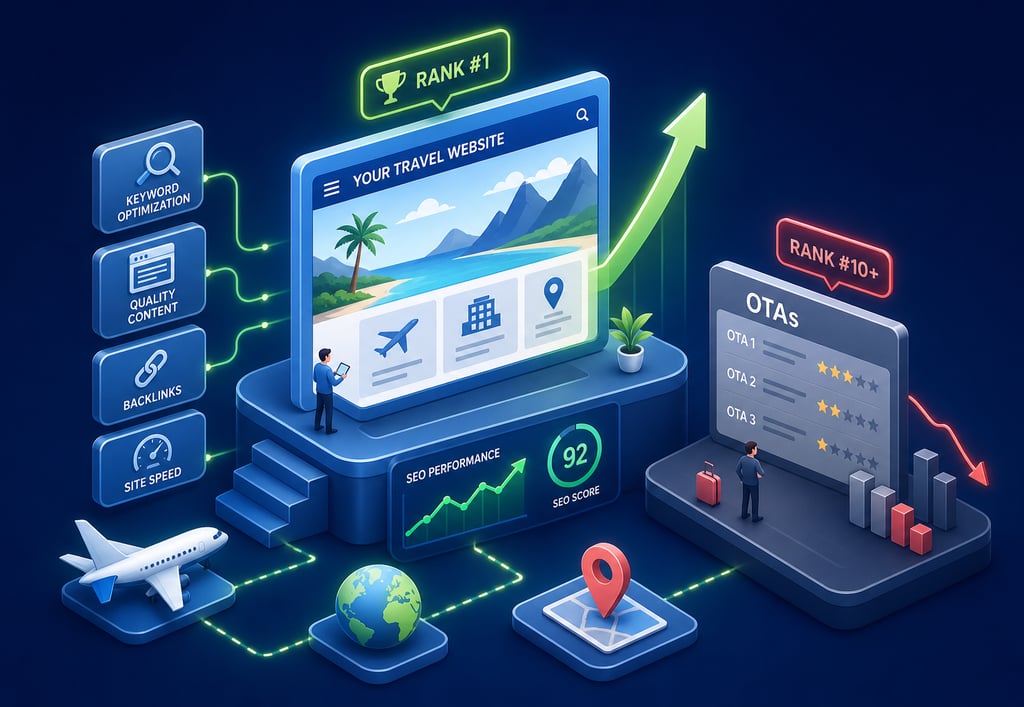
Travel Website SEO Tips to Beat OTAs in Search Results
If you're searching for travel website SEO tips to beat OTAs in search results, the first thing to understand is that you're not fighting a fair fight, and that's actually good news. Expedia and Booking.com invest heavily in SEO and paid media, backed by large engineering teams and content operations that most independent travel brands couldn't match at scale. So why are boutique hotels, tour operators, and specialty travel agencies still winning organic rankings against them on searches that actually convert to direct bookings?
The answer is structural. OTAs are built to win broad searches at scale, and that scale is exactly what makes them blind to the specific, intent-rich queries where independent travel brands quietly own the first page. Their templated property pages can't go deep on a single neighbourhood, a niche traveler experience, or a specific amenity combination. That's your lane, and it's wider than most travel businesses realise, particularly on the long-tail queries where booking intent is highest.
The SEO playbook below is built around that gap. It covers long-tail keyword targeting, content authority, technical fixes, schema markup, and booking engine optimisation, prioritised for travel brands that want to stop competing on OTAs' terms and start winning on their own. These travel website SEO tips focus on where independent operators have a genuine structural advantage, and how to press it before the window closes.
Why OTAs Can't Win Every Travel Search
OTA SEO is built around massive hub-and-spoke page hierarchies. Destination hubs target broad queries like "hotels in Miami" or "resorts in Cancun," then branch into property pages, room pages, and filtered variants, all canonicalised to concentrate authority on the highest-traffic URLs. This architecture lets them rank for thousands of generic queries simultaneously. It's an impressive engineering achievement, but it creates a hard ceiling on how specific any individual page can get.
A templated OTA property page has to serve millions of listings. It can't dedicate space to the story of a specific neighbourhood, the personality of a boutique property, or the exact use case of a particular traveler type. When a user searches "dog-friendly boutique hotel near Central Park with rooftop access," OTA pages typically don't satisfy that intent, the highly specific landing page rarely exists in their templated architecture, and that's precisely the opening a dedicated niche property page walks straight into.
Industry data consistently shows that OTAs dominate click share on generic hotel searches, with the majority of top-clicked results on broad queries going to OTAs or metasearch platforms. But on branded and niche-intent searches, the brand site or specialist property wins. The strategic play is not to fight OTAs on "boutique hotels in New York." The play is to win the specific, high-intent searches they structurally cannot serve well.
Travel Website SEO Tips: Long-Tail Keywords That Pull Direct-Booking Traffic
The keyword formula that converts best for direct bookings follows a consistent pattern: location plus property type plus differentiator plus booking intent. A search like "family-friendly hotel near Orlando theme parks with pool" has a fraction of the monthly search volume of "hotels in Orlando," but the person typing it knows exactly what they want and is ready to book. OTAs rank for the broad term; the independent hotel ranks for the specific one, and the specific one converts at a meaningfully higher rate.
The four keyword clusters worth targeting are neighbourhood and location terms ("near Hyde Park," "in SoHo"), amenity terms ("with rooftop pool," "with free parking"), audience and use-case terms ("pet-friendly," "romantic," "family suite"), and offer terms ("book direct discount," "best rate guarantee," "free breakfast"). These clusters reach searchers who are past the inspiration phase and actively choosing where to stay or which tour to book.
Each cluster should map to a dedicated, intent-matched landing page, not a generic homepage. A page built around "spa hotel in Charleston's French Quarter" outperforms a generic hotel page for that specific query. The keyword should appear in the page title, H1, and early body copy. A practical title format: "[Amenity/Use Case] Hotel in [City Neighborhood] | [Brand Name]". That structure signals intent alignment to both search engines and the traveler reading the result.
To illustrate: a boutique lodge in Montana that built out individual landing pages for queries like "adults-only cabin near Glacier National Park" and "fly-fishing lodge with guided access in Whitefish" can capture highly specific traffic that Expedia simply has no page to match. Each page targets one intent cluster, links to the booking engine, and earns organic clicks that go directly to the property, bypassing OTA commission entirely.
Content Depth and Local Authority OTAs Can't Scale Down To
OTAs have no financial incentive to create deeply local content. A neighborhood guide for the Pearl District in Portland, a seasonal hiking itinerary around a boutique Montana lodge, or a local dining guide tied to a Savannah bed and breakfast: none of those serve OTA business goals. But for an independent property or a regional tour operator, that content builds the kind of topical authority that signals to Google that your site is the genuine expert on that destination, not just a listing among thousands.
Local SEO for hotels benefits directly from this content depth. Detailed destination guides, local attraction pages, and experience-specific blog content reinforce the same geographic and topical signals that Google Business Profile optimization and local citation consistency send. When all those signals point in the same direction, local search rankings follow. A property that consistently publishes useful, specific content about its immediate destination is well-positioned to outrank the OTA listing that describes the same property in 200 templated words, particularly as Google continues to reward demonstrable expertise and local relevance. For a practical overview of how structured data benefits hotel local visibility, see how structured data can help your hotel's local SEO.
Internal linking ties this content strategy together. Every neighbourhood guide, local itinerary, or seasonal travel post should link directly to core booking pages, room type pages, and active offer pages. This is the same hub-and-spoke model OTAs use at massive scale, applied narrowly to one property or one destination cluster. Crawlers follow those links and understand the relationship between destination content and booking intent. Schema markup for hotels reinforces that structure at the technical level, which we'll cover next.
Technical SEO Fixes That Move the Ranking Needle
Schema markup is among the highest-leverage technical improvements many independent hotel and tour operator sites can still implement. The schema types that matter most for travel websites are Hotel, LocalBusiness, AggregateRating, Review, and Offer pricing markup. Together, they make property attributes machine-readable: star ratings, amenities, price ranges, and check-in details can all appear directly in Google search results as rich snippets, before the user ever clicks through. AggregateRating schema often produces a meaningful organic CTR lift for property pages because star ratings visually differentiate a SERP entry and build immediate trust at a glance. For a step-by-step implementation, consult this hotel schema markup guide.
The practical impact is worth understanding. According to data from Advanced Web Ranking, organic CTR for a position-one result typically ranges from 28% to 40%. A rich result with visible star ratings and pricing details can capture more of that click share even when sitting in position two or three. For an independent hotel competing against OTA listings at similar rankings, that visual differentiation directly impacts direct bookings. If you're building out a full hotel SEO program, this hotel SEO guide is a useful checklist for on-page and technical best practices.
Mobile performance is the other technical non-negotiable. Over half of travelers start accommodation searches on their phones, and Google uses the mobile version of your site for indexing. Core Web Vitals, image compression, responsive booking widgets, and clean mobile checkout flows all influence rankings and conversion rates for travel searches in 2026. NAP consistency across citations, descriptive image alt text, and a logical heading hierarchy are the supporting signals that reinforce what schema and content strategy build. Where individual OTA property pages served through third-party templates can struggle with speed and mobile UX, an independent site built with performance in mind has a real opportunity to gain an edge.
Using Competitor Intelligence to Find the Gaps OTAs Leave Open
Manually auditing which queries OTAs rank for but don't satisfy is slow work. The window between identifying a gap and a competitor closing it can be short, and a solo marketer working through that analysis by hand often arrives after the opportunity has moved. The travel brands gaining the most organic ground right now are using real-time competitor analysis tools to pinpoint high-intent queries where OTAs rank but answer poorly, then publishing pages specifically designed to fill those gaps before competition catches up.
In practice, this means tracking OTA content weaknesses on specific destination and property-type queries, monitoring SERP feature shifts as Google adjusts how it surfaces travel results, and identifying emerging long-tail keyword clusters before they become crowded. Acting in that window is how independent travel brands build durable organic positions. The difference between reacting to OTA dominance and proactively engineering around it comes down to how quickly you identify the gap and how precisely you build the content to fill it.
Powerful Digital Marketing operationalises this kind of competitor intelligence work for travel clients. As an AI-powered agency focused exclusively on the travel industry, the approach combines real-time SERP monitoring, automated keyword gap analysis, and sector-specific SEO strategy, so travel brands can move from identifying an opportunity to publishing optimised content faster than going it alone. AI-assisted tools handle the monitoring and pattern recognition at scale; human strategy determines which gaps are worth owning and how to structure content around them.
Turning Organic Visitors into Direct Bookings
Ranking above an OTA on a long-tail travel query is the goal, but it's only half the job. If the booking experience on your own site is slower, less trustworthy, or harder to complete than the OTA experience, the organic click converts to an OTA booking anyway. Booking engine optimisation starts with speed: a fast-loading booking widget, clean mobile checkout, and transparent pricing with no hidden fee surprises. The direct-booking value proposition, whether that's a price match guarantee, a free upgrade, early check-in, or complimentary breakfast, should sit directly adjacent to the CTA, not buried in a footer.
The trust gap is the harder problem for independent travel sites to solve. Travelers are familiar with OTA platforms, they've used them before, and that familiarity reduces purchase friction. Independent sites close that gap through verified guest reviews displayed on the booking page, AggregateRating schema that surfaces star ratings in search results, security badges near the checkout CTA, and real photography rather than stock imagery. Each element reduces the moment of hesitation between clicking through and completing the booking. For practical tactics you can apply to increase direct bookings, see this resource on proven tactics for more direct bookings.
Think of it as a chain: long-tail keyword targeting earns the impression, niche content authority earns the click, and trust architecture closes the booking. A weakness anywhere in that chain leaks revenue back to OTAs. The technical and content work described in this article builds the front end; the booking engine and trust layer close it.
The Playbook in Practice: Beating OTAs in Search Results
OTAs win the broad game. "Hotels in Chicago" and "resorts in the Maldives" are not fights worth taking on with an independent travel site's budget. The travel website SEO tips that actually grow direct bookings in 2026 point toward a narrower, deeper game: owning the specific queries that reflect real traveler intent, building destination content that earns genuine topical authority, applying schema markup that makes every listing visually compelling in search results, and running a booking engine that removes friction rather than creating it.
Long-tail targeting, local content authority, technical precision, and booking optimisation work together. Well-targeted effort in these areas is consistently more efficient than trying to compete with OTAs on broad terms and high ad spend. The brands that beat OTAs in organic search aren't outspending them, they're outspecialising them.
If you're ready to stop leaving direct bookings on the table, the fastest path forward is a focused strategy built around your specific destination and audience. Powerful Digital Marketing works exclusively with travel brands, that focus shapes every strategy we build. Reach out to start the conversation.
ADDRESS
The Powerful Group Limited
124 City Road
London
United Kingdom
EC1V 2NX
WORKING HOURS
Monday - Friday 9:00 AM - 6:00 PM
Saturday - Sunday 8:00 AM - 12:00 PM
Want to Call? Ask our Powerful Bot for the Number