

AI Marketing for Travel Brands: Cost, ROI & Fit 2026
How AI marketing stacks up against traditional channels for travel brands. Get a clear framework, five evaluation metrics, and a short pilot checklist.
AI IN TRAVEL
Powerful Digital Marketing
6/9/20268 min read
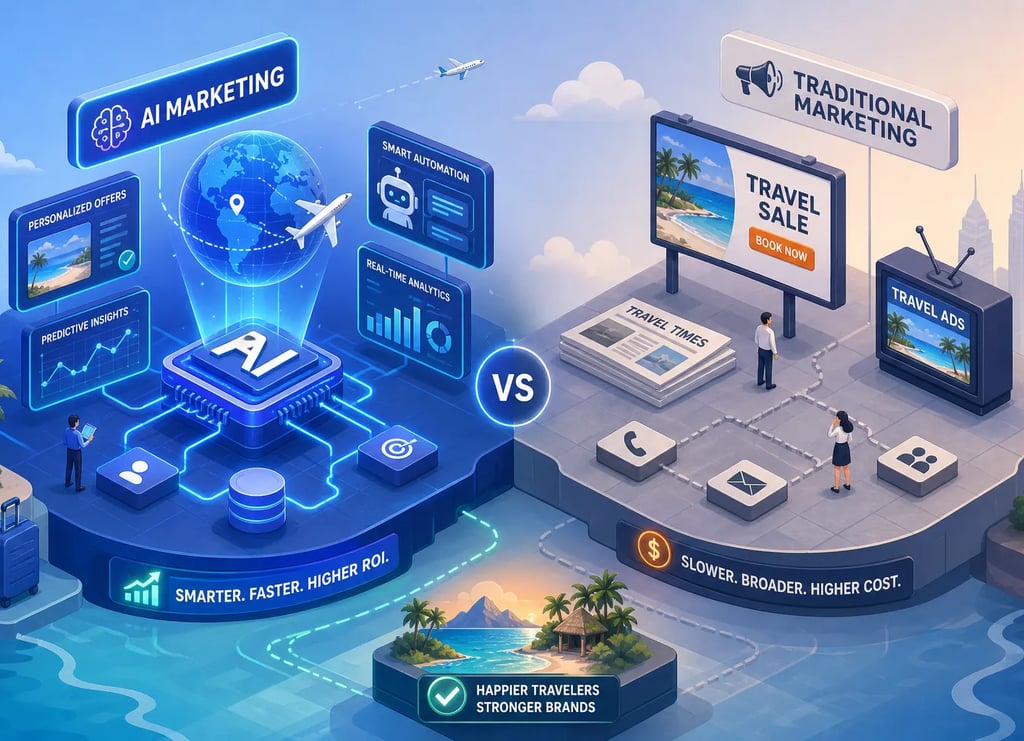
How AI Marketing Compares to Traditional Marketing for Travel Brands
OTA commissions are quietly bleeding independent travel brands. At 15, 25% per booking, the cost of distribution through major platforms adds up fast, and traditional marketing channels designed to compensate for that dependency are becoming harder to justify as ad costs climb and attribution grows murkier. Meanwhile, a wave of AI marketing tools promises to solve everything: better targeting, lower cost per acquisition, personalised offers at scale. The honest answer is that neither world is complete on its own, and when it comes to AI marketing vs traditional marketing for travel brands, the comparison is rarely straightforward.
The real question for any travel brand isn't "AI or traditional?" It's "which combination fits your audience, your budget, and your growth stage?" Travel brands already working with specialist agencies that pair AI tools with genuine sector knowledge, like Powerful Digital Marketing, are running exactly these kinds of hybrid tests right now, building evidence for what works and what doesn't in a market dominated by OTAs and shifting consumer expectations.
This article evaluates both approaches across five metrics: cost, targeting precision, personalisation, scalability, and ROI. By the end, you'll have a clear framework for choosing your approach and a short checklist to run your first pilot.
What traditional travel marketing is still costing brands in 2026
The cost of traditional travel marketing is less visible than it looks on a spreadsheet. OTA commissions typically run 15, 25%, with effective rates pushing higher when visibility programmes and promotional placements are included. Add print advertising, trade show attendance, and broad email campaigns with minimal segmentation, and the total spend on channels with limited feedback loops is considerable. For independent hotels and small tour operators, these costs represent a disproportionate burden compared with large chains and operators with negotiating power.
The deeper problem with broadcast-model marketing isn't the spend itself, it's the mismatch with how travel decisions actually happen. Booking intent in travel is seasonal, behaviour-driven, and personal: a family looking for a summer all-inclusive responds to completely different signals than a solo adventurer researching expedition cruises. Traditional channels serve one message to a wide audience and offer limited ability to adjust once a campaign is live. That structural inflexibility is where the wasted spend lives, and it's precisely the gap that AI marketing is built to close.
AI marketing vs traditional marketing for travel brands: where AI delivers a measurable edge
The clearest advantage of AI marketing in travel is targeting precision. AI-driven customer segmentation analyses booking intent signals, browsing behaviour, and past purchase data to serve personalised travel offers at the moments when conversion probability is highest. Programmatic advertising takes this further, allowing real-time bid adjustments based on user signals rather than fixed placements. According to Adobe's Digital Trends report, programmatic advertising can reduce customer acquisition costs by up to 30% compared with traditional media buying, with average programmatic CPMs typically running at one-quarter to one-half the cost of direct ad buys. For practitioner-focused context on AI-led travel marketing, see AI in travel marketing: personalisation, performance and the future of growth.
Personalisation at the email and content layer produces its own measurable returns. Virgin Holidays achieved a 2% increase in email open rates through AI-driven personalisation, which translated into millions in additional revenue across its programme. That figure deserves attention: a 2% improvement sounds marginal until you consider the volume of travel email marketing and the average booking value involved. Industry benchmarks for AI personalisation in travel point to booking conversion lifts of 10, 25%, alongside reported ROI improvements of 20, 30% among marketers deploying generative AI in travel contexts, though results vary considerably depending on data quality and campaign maturity. For an overview of generative AI use in travel specifically, read more about generative AI in travel. To explore how AI personalisation is changing brand-customer connections in travel, see How AI Personalisation is Changing the Way Travel Brands Connect with Customers.
Chatbots and virtual assistants represent a further category of measurable impact, particularly relevant for hotels and tour operators with high enquiry volumes. A luxury hotel chain deploying an AI-powered voice assistant reported 31% lower wait times, 87% higher guest satisfaction, and 42% lower front-desk burden. These are operational metrics rather than pure revenue ROI, but their downstream effect on booking conversion and repeat business is direct. Across all three use cases, the direction is consistent: AI narrows the distance between intent and booking. For further reading on tech-driven customer improvements in travel, see AI in Travel Improves Customer Experience Through Tech.
What traditional marketing still does better
Traditional marketing carries genuine strengths that AI tools don't replicate easily. Long-term trade relationships, consistent editorial brand presence, and the credibility of human-curated recommendations all operate on trust that accumulates over time rather than through algorithmic optimisation. For complex, high-value trips, honeymoons, multi-generational group tours, expedition cruises, travellers frequently want reassurance that goes beyond a personalised email or a chatbot interaction. That reassurance is harder to manufacture with automation.
UK consumer data reinforces this point. In 2025, only 20% of UK travellers were comfortable using AI for trip planning, up from 15% in 2024, and 31% still preferred not to use AI in the planning process at all. Among travellers aged 55 and over, comfort with AI travel planning dropped to just 10%. Women were more likely than men to report discomfort with AI-driven planning. These figures aren't an argument against AI, but they are a clear signal that brand voice and human oversight still carry weight, particularly for travel brands whose core audience sits above 45. For research on AI adoption and trust in the UK, see EY's UK AI adoption and trust report.
The other area where traditional channels hold their ground is brand visibility and contextual credibility. Premium editorial placements, trade media, and industry events build associations that are difficult to replicate through paid digital alone, especially for brands trying to establish positioning in a competitive category for the first time. The case for traditional marketing isn't that it's more efficient. It's that it builds the brand equity that makes digital campaigns more effective downstream.
Head-to-head: the five metrics that separate AI from traditional travel marketing
Across cost and scalability, the structural differences are significant. Traditional channels carry high fixed overheads with limited scale efficiency: a print campaign or trade show appearance costs roughly the same whether it reaches 1,000 people or 10,000. AI-driven channels, including content automation, programmatic ads, and chatbots, operate on variable-cost models that scale without proportional headcount growth. For a focused SME deployment covering one use case with clean data, implementation and training typically runs £2,000, £6,000 upfront. AI campaigns can also adjust targeting, creative, and spend in real time across multiple channels; traditional campaigns are largely locked once they go live.
On targeting precision, the gap is most visible in travel micro-segmentation. Solo adventurers, family summer bookers, and cruise-curious over-55s respond to entirely different messages at entirely different moments. AI-driven segmentation identifies and reaches these groups efficiently; broadcast channels cannot. For personalisation, AI enables dynamic creative and real-time offer adjustment at a scale no traditional approach can match. The tradeoff is data dependency: brands without clean, well-structured CRM data will see slower results from AI personalisation, regardless of the tool they choose.
For ROI, the travel-specific evidence consistently favours AI: industry benchmarks indicate booking conversion lifts of 10, 25% from personalisation, and reported marketing ROI improvements of 20, 30% from generative AI applications in travel marketing. Traditional channels produce harder-to-attribute ROI, particularly for brand-building investment that pays off over months rather than campaign cycles. Recent industry analysis of travellers' behaviour also highlights growing use of AI during booking research and shortlist stages, reinforcing the case for data-driven approaches in conversion-focused campaigns; see data on traveller use of AI for booking. The honest caveat applies across both sides: results vary based on data quality, campaign setup, audience maturity, and market context. Neither approach delivers guaranteed outcomes.
Why the hybrid model is becoming the smart play for travel brands
Choosing AI over traditional marketing, or traditional over AI, is a false binary. The travel brands pulling ahead right now are running both in complementary roles. AI handles the speed-sensitive, data-heavy tasks: audience segmentation, automated follow-up sequences, content scheduling, and bidding optimisation. Human expertise handles strategy, brand voice, complex itinerary advice, and the emotional intelligence required for high-value bookings. UK consumer research supports exactly this division: travellers want AI convenience for shortlisting, comparison, and recommendation, but human reassurance for final decisions and special requirements.
The gap between AI capability and real-world travel marketing results is usually a knowledge problem rather than a technology problem. Applying an AI segmentation tool without understanding seasonal demand patterns, look-to-book behaviour, or the specific psychology of a cruise-curious traveller produces mediocre results regardless of the platform. Powerful Digital Marketing's approach is built around precisely this challenge. The agency combines AI automation tools, smart chatbots, programmatic PPC, AI-driven social strategy, and real-time competitor insights with genuine travel industry expertise spanning hotels, tour operations, and cruising. The value isn't the AI in isolation; it's applying it with deep understanding of traveller behaviour and booking dynamics. Read more about their practical playbook in AI Travel Marketing: Tools, Tactics & Real ROI 2026.
Choosing your first AI marketing pilot: a practical starting point
For SME travel operators and independent hotels, the highest-impact starting points are the ones with the shortest feedback loops. Five use cases worth prioritising first are: AI-personalised email sequences triggered by browsing or enquiry behaviour; a chatbot handling FAQs and lead capture outside business hours; AI-assisted content creation for social media and destination pages; programmatic retargeting for past site visitors; and automated competitor pricing and availability monitoring. Score each by effort versus expected lift. Email personalisation and chatbot deployment typically offer the fastest payback for brands with a clean contact list and moderate enquiry volume. For tour operators looking for directly applicable examples, see this practical list of 5 tour operator use cases for AI automation.
A focused SME pilot covering one use case with clear KPIs can go live in two to four weeks at a budget of £2,000, £6,000 upfront, depending on the complexity of existing data infrastructure and the tool selected. The metrics to track are straightforward: booking conversion rate, cost per booking, email open and click rate, and customer satisfaction score where a chatbot is deployed. The goal of a first pilot isn't to transform the entire marketing function, it's to generate one measurable proof point that justifies the next investment decision.
Keep the implementation checklist short. Audit your existing data and identify gaps before selecting a tool. Define one clear KPI, not five. Select one use case from the list above. Set a 30-day review date and commit to measuring against the baseline you have now. Starting narrow and measuring rigorously produces more useful results than a broad deployment with ambiguous attribution.
The verdict on AI marketing vs traditional marketing for travel brands: and, not or
Neither AI marketing nor traditional marketing wins outright for travel brands. AI delivers clear, measurable advantages in targeting precision, personalisation, scalability, and ROI, and the data from travel-specific deployments backs that up consistently. Traditional channels still carry real weight in brand trust, relationship-driven business, and reaching audiences who remain cautious about AI-mediated experiences. The brands building momentum right now are treating this as an "and" question: AI for efficiency and precision, human expertise and traditional channels for trust and brand depth.
Pick one use case from the pilot list above, set a 30-day test with a single clear metric, and measure the result against your current baseline. If you want to run that test with a team that understands both the AI tooling and the travel industry dynamics behind it, Powerful Digital Marketing is built to deliver exactly that. The most sustainable growth for hotels, tour operators, and travel agencies competing against OTA dominance comes from combining AI capability with genuine sector expertise, not from choosing one or the other.
ADDRESS
The Powerful Group Limited
124 City Road
London
United Kingdom
EC1V 2NX
WORKING HOURS
Monday - Friday 9:00 AM - 6:00 PM
Saturday - Sunday 8:00 AM - 12:00 PM
Want to Call? Ask our Powerful Bot for the Number