
Can Artificial Intelligence Replace Human Intelligence We Explore the Question
Can artificial intelligence replace human intelligence We delve into this complex question with measured insight and intellectual curiosity
AI NEWS
Powerful Digital Marketing
6/27/202611 min read
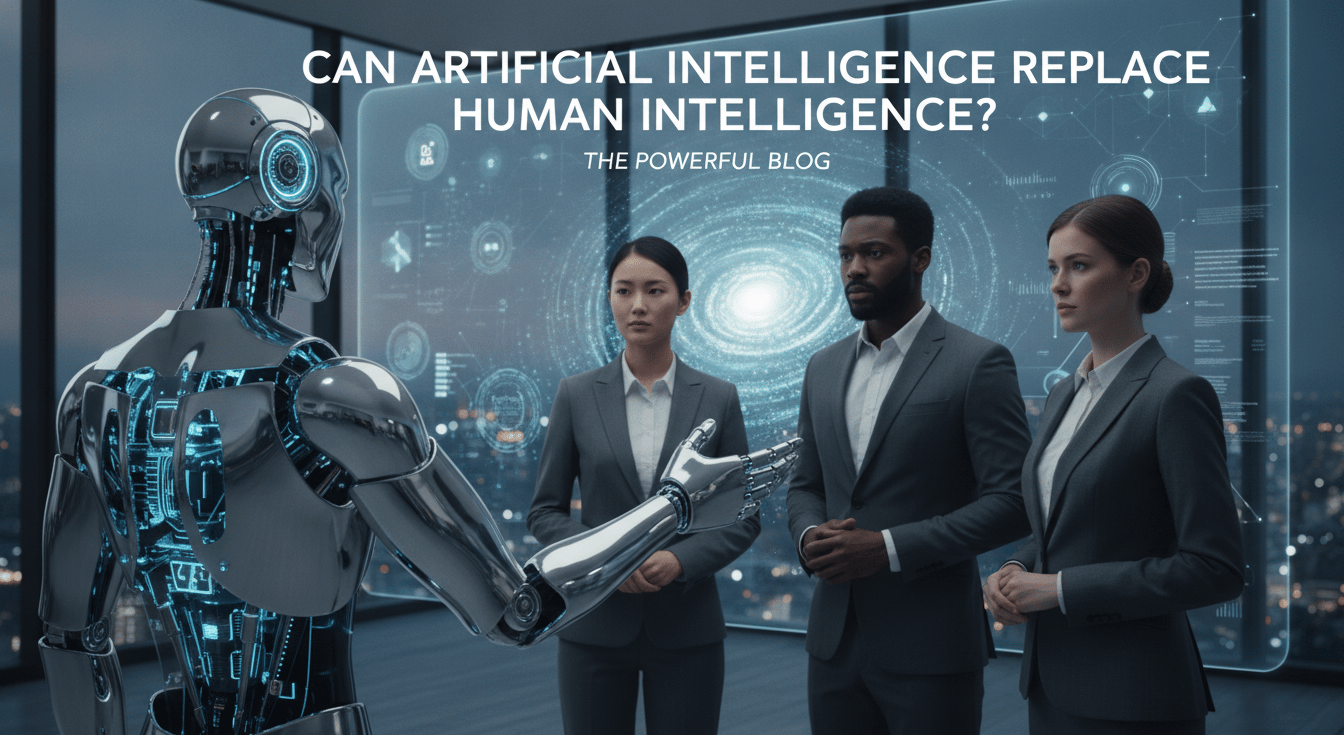
Can Artificial Intelligence Replace Human Intelligence? We Explore the Question
Recent studies show over 80% of global business leaders think automated systems will change their work in the next decade. This big number shows a big change in how we see the difference between machines and our brains. As we reach this tech turning point, we wonder what makes our choices special.
Let's explore this digital world together. We need to see if machines can really think like us. By looking into if can artificial intelligence replace human intelligence, we want to clear up the confusion. Knowing the difference is key for those looking into the future of work and new ideas.
Key Takeaways
Synthetic systems are good at handling data but don't truly feel emotions.
The main benefit of today's tech is to help us do better.
Important decisions still need the sharp thinking of experts.
Companies must focus on ethics when using automated tools.
Real innovation is about being creative and using our gut feelings.
The Growing Role of Artificial Intelligence in Society
To grasp the AI vs human intelligence debate, we must see how AI systems have grown. They've moved from simple code to complex neural networks. Now, the lines between machine logic and human thinking are getting fuzzy.
Evolution of AI Technology
Machine learning started with basic algorithms for simple tasks. Over time, these tools have become advanced. They can now handle huge amounts of data quickly.
Today's neural networks learn like living beings. They spot patterns we can't see. This change is a big step in the AI vs HI story. It moves us from following rules to finding things out on our own.
Current Applications of AI
Artificial intelligence is everywhere in our digital lives. It shapes what we see online and manages big tasks like logistics. These tools are everywhere.
"The real question is not whether machines can think, but whether we can adapt our societal structures to thrive alongside them."
AI is used in many important areas:
Personalised communication: Predictive text and language models that guess what we need.
Societal infrastructure: Smart grids that help cities use energy better.
Data synthesis: Tools that make sense of complex data to help us make decisions.
Impacts on Daily Life
These technologies have changed how we live. They help us get around, manage money, and even in creative work.
These changes bring us remarkable convenience. But they also make us think about our future. As we give more tasks to machines, we must keep human choices important.
Key Differences Between Human Intelligence and AI
Looking at the gap between human thought and machine precision shows why they can't be the same. When we compare AI and HI, we see more than just speed or storage. We see the big difference between machines' strict logic and our flexible minds.

Cognitive Abilities
At the heart of this debate is how we process information. Machines are great at finding patterns in big data. But this is different from how humans understand things.
Humans can use knowledge in many ways, something machines can't do yet. Our brains are made for learning and adapting, not just solving problems. This is why AI vs HI studies are so interesting.
Emotional Intelligence
Emotional understanding is a big challenge for machines. They can pretend to care by reading our words and faces. But they don't truly feel like we do. They can't share our personal experiences.
Subjective Experience: Humans see the world through our own stories and cultures.
Empathy: We understand others by feeling their unspoken needs.
Moral Reasoning: Our choices are often guided by our values, not just facts.
Creativity and Innovation
The debate often focuses on creativity. Machines can make art or music, but it's always based on what they've seen before. Humans create new things because we're driven by passion and a desire to change things.
Machines are great for getting things done fast, but they can't replace our unique talents. The future of tech is about working together, not replacing us. By understanding our differences, we can see what machines can do and what they can't.
Benefits of Artificial Intelligence
In today's world, the benefits of machine intelligence are clear. These systems help in many areas, from science to business strategy. They are better at tasks that need a lot of work and precision.
Efficiency and Speed
Machines are incredibly fast. They can handle huge amounts of data quickly. This is important in fast-paced environments.
Thanks to machines, companies can work faster. They can focus on big ideas, not just data entry. Efficiency is not just about speed; it's about doing things right every time.
Data Analysis Capabilities
Machines can find patterns in big data that humans can't. They make complex information clear. This helps in many fields.
AI is changing science and research. It gives insights that help in new discoveries. Machines do the hard work, and humans get to focus on the big ideas.
Cost Savings for Businesses
Using machines can save a lot of money. They reduce mistakes and make processes smoother. This saves money that can be used for growth.
AI also helps predict market trends. This lets companies plan better. Using these tools gives them an edge over others. It's a smart move in today's economy.
Limitations of Artificial Intelligence
Artificial intelligence has made huge strides, but it still has limits. These systems can do complex tasks fast, but they don't understand the world like we do. This makes us question if can AI surpass human intelligence in a real way.

Lack of Understanding and Context
AI mainly works by recognizing patterns, not truly understanding things. It can handle lots of data, but it misses the subtle social hints and unspoken meanings we pick up daily.
This lack of understanding leads to AI failing in unclear situations. Without real-life experiences, it can't get the true meaning behind our words. So, the idea that can AI surpass human intelligence is still far off, as technical skill doesn't equal wisdom.
Dependence on Data Quality
The quality of data is key for AI to work well. If the data is biased or wrong, so will the AI's output. This makes AI's decisions shaky.
When data is bad, AI's results can be wrong or even dangerous. Making sure the data is good and fair is a big challenge. As studies on algorithmic transparency show, the data's quality is crucial for AI's reliability.
Ethical Considerations
AI doesn't have a moral compass. It can't make tough decisions with empathy or ethics. This raises big questions, like how it handles complex moral choices.
We need to watch out for the dangers of AI making big moral decisions. The question of can AI surpass human intelligence isn't just about its abilities. It's also about our duty as creators. The biggest limit for AI is its lack of a conscience.
The Role of Human Intelligence in Collaboration with AI
Technology's true power is in helping us do better, not doing it all by itself. The best systems work when they see technology as a partner, not a replacement. By understanding how AI affects human smarts, we can work together better.
Augmenting Human Decision-Making
Machines are great at handling big data, but they can't make tough decisions like humans. Using AI in our work doesn't mean we lose control. It means we can focus more on big ideas and solving problems.
This way, we make sure humans are always in charge. We use AI to help us make better choices, not to make them for us. This mix of data and instinct leads to better progress. As research shows, we do best when we use each other's strengths.
Enhancing Customer Experience
When it comes to dealing with customers, nothing beats a real person. AI can answer questions fast, but it can't understand emotions like we do. Keeping humans in the loop is key for empathy and fairness.
AI can take over simple tasks, so people can focus on building real connections. This way, AI helps us be more caring, not less. It's all about keeping the service high-quality and personal.
Balancing AI and Human Input
For a good partnership, we need to balance AI's output with human insight. We must watch out so AI doesn't make us less critical thinkers. The goal is to improve both AI and human choices together.
In the end, how AI affects our smarts depends on us staying involved. By seeing technology as a tool, we keep our unique strengths leading the way.
Real-World Examples of AI Integration
Looking at how technology fits into our lives shows us the AI and HI comparison. These systems are now in real-world situations, not just labs. This helps us see how they work with us.
AI in Healthcare
In medicine, AI is a big help for doctors. It looks at many images to find things humans might miss. This lets doctors focus on making decisions and caring for patients.
AI doesn't replace doctors. It helps them work faster and more accurately. We're moving towards a future where AI and human care go hand in hand.
AI in Education
Schools are using AI to help students learn in different ways. It looks at how each student does and changes lessons on the fly. This means teachers can spend more time helping students.
AI takes care of the boring stuff, so teachers can connect with students better. It handles the data, while teachers offer the essential guidance and support students need.
AI in Customer Service
Today's customer service uses smart chatbots and tools to handle lots of questions. They answer simple things quickly, all day and night. This makes things easier for customers and helps human teams.
In this area, AI deals with the bulk, and humans handle the tricky stuff. Complex issues need a person's touch to handle them well.
Sector - AI Contribution - Human Contribution - Primary Benefit
Healthcare - Pattern Recognition - Clinical Judgement - Diagnostic Accuracy
Education - Adaptive Content - Mentorship - Personalised Growth
Customer Service - Instant Response - Empathy - Operational Efficiency
The Future of AI and Its Potential
Looking ahead, the future of artificial intelligence is exciting and uncertain. We must look at the future of AI and human intelligence with hope and caution. Our journey is filled with fast progress and big questions.
Predictions for AI Development
The future of artificial intelligence will see small but important steps forward. We expect AI to get better at complex tasks that need human help.
Enhanced integration of generative models into creative workflows.
Greater autonomy in complex problem-solving environments.
Improved energy efficiency in large-scale computational models.
The Concept of Superintelligence
One big idea is superintelligence. It's about whether can AI surpass human intelligence in all areas, not just simple tasks. This idea is still a topic of debate.
We need to think about the risks and benefits of superintelligence. Intellectual curiosity pushes us to explore these ideas. But we must also consider the ethical side of creating advanced AI.
Job Market Implications
Technology changes bring worries about jobs. We're moving from simple tasks to jobs that need empathy, strategy, and complex judgement.
While some jobs might disappear, new ones will appear. The real question is not if AI will replace us, but how we can work together. We think the best future is one where AI handles data and humans guide the vision.
Read more about what jobs could be lost by AI and what. you can do to prepare.
Public Perception of AI
People have mixed feelings about artificial intelligence. Some see the benefits of automated systems, while others are worried about change. It's important to find a balance for AI to fit well into our lives.

Trust in AI Technology
Trust is key for adopting new tech. Lack of transparency can make people suspicious. We think transparency is crucial for building trust in AI.
Showing how AI works can make users more comfortable. Studies on human-AI interaction show that understanding AI leads to trust. This is important for AI's impact on our work and personal lives.
Concerns Surrounding AI
People have valid worries about AI. They fear losing control or AI bias. These fears spark the AI vs human intelligence debate.
We should listen to these concerns. By doing so, we can have a better conversation. We need to focus on ethical safeguards to protect us while AI advances.
The role of Education in AI Awareness
Education is the best way to understand AI. When people know how AI works, fear decreases. We should make digital literacy a priority.
An educated public can help integrate AI ethically. By learning, people can make better choices about technology. Knowledge turns fear into informed engagement, helping us shape tech's future.
Conclusion: Can AI Truly Replace Human Intelligence?
We are at a critical point where machines and human experience meet. Our journey shows that AI can't fully replace human smarts. Machines are fast at data, but they don't have our life experiences that bring true wisdom.
Synthesising Our Collective Potential
The future of AI and human intelligence is about working together, not against each other. While machines do well in simple tasks, humans are key in making moral choices and creating new ideas. Our skill in handling complex situations keeps us at the heart of decision-making everywhere.
Charting a Path for Coexistence
We need to keep human control as we use these advanced tools every day. By improving our skills and watching over technology, we make sure it fits our values. This way, we can use new ideas without losing what makes us human.
Maintaining Our Essential Humanity
We must stay alert and interested in the technology we create. It's our duty to shape these systems to help everyone. Our gut feelings and caring nature are not old-fashioned. They are crucial for a bright, automated future.
FAQ
Can artificial intelligence replace human intelligence in the workplace?
Artificial intelligence is making tasks easier, but it can't replace human smarts. In fields like healthcare, AI tools like IBM Watson help with analysis. Yet, they can't match human emotions and ethics in making tough decisions. We see AI and human intelligence working together, not against each other.
What are the fundamental differences in an AI vs human intelligence debate?
The debate highlights how AI and humans differ. AI, like OpenAI’s GPT-4, is great at spotting patterns. But humans have a deeper understanding, thanks to their experiences and ability to handle uncertainty. While machines can calculate, humans create and think creatively.
Can AI surpass human intelligence in creative industries?
AI can create amazing work, but it lacks the spark of human creativity. Tools like Midjourney can make stunning images by mixing styles. But they don't have personal feelings or cultural depth. True creativity comes from human experiences and the need to share unique ideas.
What are the primary implications of AI on human intelligence regarding education?
AI is changing education, moving from just memorising to thinking critically. With tools like Google DeepMind, students can access lots of information. But, we must teach them to use this info wisely. This makes the role of teachers more important than ever in teaching independent thinking.
Why is an AI and HI comparison often considered a "category error"?
Comparing AI and human intelligence is misleading. AI works within set rules, while humans live in a world full of social nuances. A calculator might be better at math, but it doesn't understand the beauty of numbers like a human does.
What does the future of AI and human intelligence look like for social trust?
The future of AI and human intelligence depends on being open. As we use AI in customer service, like Salesforce Einstein, we must be transparent. Education is key to building trust in AI and ensuring it doesn't harm our social bonds.
Can artificial intelligence replace human intelligence in ethical decision-making?
No, because AI doesn't have a moral compass. AI is trained on data that may include biases. Relying only on AI for ethical decisions can lead to unfairness. We need a system where AI and human intelligence work together to ensure fairness.
Is the concept of superintelligence a genuine threat to humanity?
The idea of superintelligence is a serious topic of study. It suggests machines could be much smarter than humans. But, by focusing on ethical AI and regulation, we can guide AI to benefit humanity, not harm it.
How can businesses achieve a balance in the AI vs human intelligence debate?
Companies like Microsoft and Amazon use AI to free up human talent. AI handles routine tasks, so humans can focus on creativity and strategy. The best businesses see AI as a tool, not a replacement for human skills.
What is the definitive answer: can AI truly replace the depth of human thought?
AI can mimic some human skills, but it can't match the fullness of human thought. Our intelligence is more than algorithms; it's a lived experience. As we move forward, we must keep the human touch that makes our work and lives meaningful.
ADDRESS
The Powerful Group Limited
124 City Road
London
United Kingdom
EC1V 2NX
WORKING HOURS
Monday - Friday 9:00 AM - 6:00 PM
Saturday - Sunday 8:00 AM - 12:00 PM
Want to Call? Ask our Powerful Bot for the Number