
Chatbot for Travel: Choose the Right Solution in 2026
Learn how to choose the right chatbot for your travel business. Get practical guidance on types, key features, pitfalls, and a clear framework to decide.
POWERFUL BOTS
Powerful Bots
6/20/20269 min read
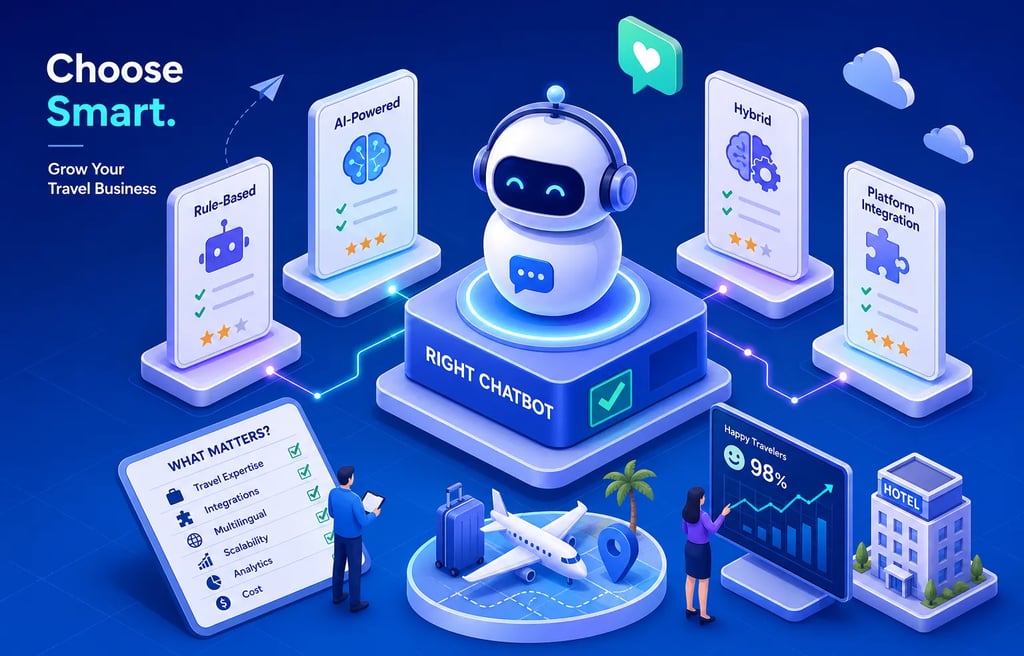
How to Choose the Right Chatbot for Your Travel Business
A traveller browsing your website at 11pm on a Tuesday has a question about availability. They type it into your contact form, wait, and hear nothing until the following afternoon. By that point, they've booked with someone who answered in seconds. That's not a hypothetical, it's happening to travel businesses every day, and the gap between expectation and reality is widening. Deploying the right chatbot for travel businesses is no longer a competitive advantage; it's the baseline cost of staying in the conversation.
This guide is written for travel business owners who are seriously evaluating conversational AI and need practical guidance rather than vendor marketing. Whether you run a boutique hotel, a tour operation, or a travel agency, the type of chatbot you need differs significantly, and choosing the wrong one can cost more in rework, lost bookings, and customer frustration than starting with a simpler solution. At Powerful Digital Marketing, we work exclusively with travel brands, and what follows is what we'd tell you in a strategy session: the types available, what real deployments actually deliver, the features that matter, the pitfalls most vendors won't mention, and a framework for making the right call.
Why a chatbot for travel is no longer optional in 2026
Travellers now research and book across multiple channels and time zones. They compare hotels on a flight, check tour availability on a lunch break, and make booking decisions at hours when your team is offline. The expectation is an immediate, accurate response, and a lean travel business team simply cannot staff for that manually without significant cost.
The expectation gap that AI travel assistants are closing
Sixty-four per cent of independent hotels have already adopted chatbot technology, and 82% of hospitality businesses expect AI use to increase across their organisation in the next twelve months. Lufthansa's AI system now handles over 16 million conversations per year. The scale of automation that large travel brands have deployed increasingly shapes customer expectations, and when a traveller gets an instant answer from a major OTA and then hits a static contact form on your website, the contrast makes the decision for them.
Where the measurable business value actually sits
The strongest commercial case for a travel chatbot rests on conversion momentum and cost reduction. Keeping enquiry momentum alive at the moment of peak intent, rather than letting it cool overnight, directly affects close rates. Support teams that automate routine queries through chatbots report reductions in customer service costs of up to 30%, freeing human staff for higher-value interactions. How AI Travel Chatbots Can Improve Your Customer Support provides practical examples and deployment tips for teams evaluating automation. Upsell performance adds a meaningful secondary gain: a well-configured booking chatbot can surface room upgrades, travel insurance, or activity add-ons at exactly the right moment in a booking conversation, without proportional increases in staffing cost.
The main types of chatbot for travel agencies, hotels, and tour operators
Understanding the distinct use cases shapes which solution fits your business type, because not all travel chatbots do the same job, and buying the wrong category is as costly as buying a poorly built one.
Hotel and hospitality bots: from booking to guest experience
Hotel chatbots typically serve two functions. Pre-arrival, they handle availability queries, room upgrade requests, package add-ons, and check-in logistics. In-stay, they field questions about amenities, process housekeeping requests, and handle the kind of repetitive front desk interactions that consume disproportionate staff time. Multilingual capability is non-negotiable given international guest demographics. One luxury hotel chain deployment produced a 31% reduction in wait times, an 87% uplift in guest satisfaction scores, and a 42% reduction in front desk burden. Those aren't marginal improvements; they represent a fundamental shift in how the property operates.
Tour operator and itinerary planning assistants
Tour enquiries are longer, more exploratory conversations. A prospective guest might ask about destination climate, group size options, activity availability, and itinerary customisation across a single session. A well-configured trip planning chatbot qualifies leads at scale, captures intent data, and hands a warm prospect to a human consultant with full context already recorded. Hopper's use of AI-powered personalised recommendations demonstrated that contextual suggestions convert three times better than standard search results. For tour operators, that kind of lead qualification and contextual matching translates directly into higher close rates without adding headcount. For further reading on AI chatbots in travel and practical benefits, see this industry overview: AI chatbots in travel: benefits and examples.
Travel agency lead capture and qualification bots
Travel agencies and DMCs often lose enquiries because their human team is stretched across existing clients. A lead capture bot sits on the website, asks the right qualification questions around destination, dates, budget, and group size, and routes the enquiry to the right consultant with everything already logged. The consultant picks up a warm, pre-qualified lead rather than starting a cold-start conversation. This shortens the sales cycle and improves close rates, which matters most when your team's time is the constraint.
What real-world results look like for travel brands
Vendor marketing tends toward the vague. The documented deployments below are specific, and the pattern they reveal is consistent.
Conversion and revenue outcomes from documented deployments
Luxury Escapes deployed a travel messenger chatbot and reported a conversion rate three times higher than their standard website, generating over $300,000 in sales revenue within three months. An airline dynamic pricing deployment using generative AI produced a 36% increase in conversions and 10% higher revenue per offer. Hopper's personalised destination pages drove a 4% increase in users searching and a 1.61% lift in conversion rate. Across all three, the pattern is the same: conversational AI for travel integrated directly into the booking flow, personalising in real time, consistently outperforms static web pages. Recent industry reporting also highlights rapid AI adoption across hospitality, reinforcing that these gains are becoming mainstream rather than experimental: hotel AI adoption surges with 82% expanding use.
Operational and satisfaction gains that compound
Air India's AI chatbot, AI.g, now resolves 97% of customer queries autonomously, dramatically reducing agent load across one of the world's busiest airline operations. United Airlines ran a proactive messaging campaign that communicated delay context to affected passengers and recorded a 6% increase in customer satisfaction from that single initiative. These operational gains matter because they free up human staff to handle complex, high-value conversations rather than answering repetitive questions about baggage allowances and check-in times.
The features that separate a useful chatbot from a costly one
The difference between a chatbot that drives bookings and one that frustrates guests comes down to the integrations underneath it and the conversational intelligence on top.
Backend integrations your chatbot must have
A chatbot without booking engine or PMS/CRS integration is essentially a glorified FAQ page. It can answer questions, but it cannot check real-time availability, process a booking, or pull a guest's reservation history. For a travel bot to close sales within the conversation, it also needs payment gateway support with PCI compliance.
CRM connectivity allows the bot to personalise interactions based on past bookings and loyalty data rather than treating every visitor as a stranger. Live agent handover is equally critical: when a conversation needs human judgement, the full chat history and customer context must transfer to the agent instantly. Requiring a guest to repeat their itinerary details to a human after explaining them to a bot is a reliable way to lose them.
Conversational capabilities that drive bookings
The capabilities that separate functional chatbots from effective ones start with contextual memory, the bot remembers what was discussed earlier in the conversation, so a guest who mentions they're travelling with children doesn't have to repeat that detail at every step. Omnichannel consistency allows a conversation that begins on WhatsApp to continue on your website, provided the platform supports session linking and user identification across channels. Generative AI capability allows the bot to handle open-ended destination and itinerary questions rather than defaulting to "I don't understand" when the phrasing doesn't match a keyword. For any brand serving international markets, multilingual NLP is not optional; it's a prerequisite. For practical examples of travel-focused conversational tools and recommended approaches, this service guide is a useful reference: travel chatbots and service AI guidance.
Implementation pitfalls that travel businesses regularly underestimate
Most chatbot deployments that fail don't fail at launch. They fail six months later, when the initial enthusiasm has worn off and the gaps in the build become visible.
Data privacy and GDPR obligations UK travel brands must plan for
Travel chatbots collect personal data: names, booking references, itineraries, payment details, and sometimes sensitive information such as dietary requirements or accessibility needs. This sits squarely within UK GDPR scope, and the ICO's guidance on automated processing should inform your architecture before a single line of code is written. Your lawful basis for each type of processing must be identified before the bot goes live. UK businesses should also be aware that the EU AI Act imposes transparency obligations on AI systems interacting with EU residents, so if your chatbot serves travellers from EU countries, those rules are relevant in addition to UK GDPR requirements. Users must be informed they are interacting with an AI system, regardless of which framework applies.
Data minimisation means the bot should collect only what the booking purpose requires, not everything it could technically ask. Retention periods for chat logs need to be defined, documented, and enforced. Supplier due diligence on where conversation data is stored and processed is equally important: if your chatbot vendor routes data through servers outside the UK, transfer safeguards must be in place. This architecture needs to be designed from the start, not retrofitted after launch when the cost and complexity are significantly higher. For practical compliance guidance specific to chatbots, consult this GDPR-focused resource: chatbot GDPR compliance guidance.
Integration gaps and the maintenance reality nobody talks about
The most common failure mode is a chatbot that launches well but degrades within six months because it isn't properly connected to live inventory systems, or because nobody owns the ongoing training and content updates. There is a meaningful difference between a plug-and-play SaaS bot (live in days, limited depth, typically under £100 per month) and a custom integrated solution (six to sixteen weeks to build, significantly more capable, with implementation costs ranging from £25,000 to well over £60,000 depending on integrations). These figures reflect typical market ranges and will vary by vendor and scope. Neither option is inherently right or wrong; the question is whether the capability matches your booking flow and customer complexity. A boutique hotel with straightforward availability queries has different needs from a multi-destination tour operator handling group itineraries.
A practical framework for choosing the right chatbot for travel businesses
Once you've mapped the options against your booking flow, the decision becomes a qualification exercise. Push every vendor on the following before committing.
Five questions to ask before committing to any vendor
Does your platform integrate natively with our booking engine or PMS? If the answer involves workarounds or "we can connect via Zapier," treat that as a warning sign.
Where is customer conversation data stored, and for how long? A vendor that cannot give a clear, documented answer to this question creates compliance risk for your business.
What does the live agent handover look like, and can our CRM receive that context? Test this in a demo, not just a slide deck.
What is the typical timeline and ongoing maintenance commitment after launch? Ask specifically who owns the retraining schedule and content updates.
Do you have documented case studies from travel businesses of our size and type? Generic chatbot ROI statistics do not substitute for evidence from a hotel or tour operator with comparable booking volumes.
These questions separate serious vendors from generic chatbot platforms dressed up with travel-themed landing pages.
Why travel-specific expertise changes the implementation outcome
Selecting the right platform is one problem. Configuring it correctly for your specific business model is another. The setup that works for a boutique hotel's pre-arrival flow is quite different from what a multi-day tour operator needs to qualify group enquiries, and both differ from what a travel agency needs to capture and route inbound leads. This is where working with a specialist changes the result. Powerful Digital Marketing works exclusively with travel brands, providing chatbot selection, implementation support, and ongoing optimisation as part of an integrated AI-powered marketing model. The outcome is a chatbot aligned with real traveller psychology, booking behaviour, and the seasonal demand patterns that make travel fundamentally different from every other industry. For a deeper perspective on AI's role across travel, see The Rise of AI and How the Travel Industry Can Benefit.
Making the right choice for your travel business
The chatbot decision is not one-size-fits-all. The right chatbot for travel will look different depending on whether you run a boutique hotel, a tour operation, or a travel agency, and the features, integrations, and compliance requirements differ accordingly. Use the five questions above as your starting checklist when evaluating vendors, and be sceptical of any platform that doesn't have documented travel industry deployments to reference.
Travel brands that invest in the right conversational AI setup now are building a direct booking engine that compounds over time. The evidence from documented deployments is strongest for conversion and operational gains: guests who receive fast, accurate, personalised responses convert at measurably higher rates and demand less reactive support. Those who delay hand more margin to OTAs with every month that passes. The technology is no longer experimental; it's operational infrastructure for any travel business that wants to grow on its own terms. If you want to read more specifically about chatbots designed to increase direct bookings, this piece explores practical tactics: Chatbot for Travel: Boost Direct Bookings & Engagement.
If you want to work through the right chatbot configuration for your specific business, Powerful Digital Marketing offers a focused strategy session for travel brands at any stage of the evaluation process. Reach out to arrange a strategy session, we'll assess your current booking flow and identify the chatbot configuration most likely to convert.
ADDRESS
The Powerful Group Limited
124 City Road
London
United Kingdom
EC1V 2NX
WORKING HOURS
Monday - Friday 9:00 AM - 6:00 PM
Saturday - Sunday 8:00 AM - 12:00 PM
Want to Call? Ask our Powerful Bot for the Number