
Digital Marketing Agency for Travel Businesses: Checklist
Avoid costly mistakes: learn how to vet a travel digital marketing agency, spot red flags, compare KPIs, and choose partners that drive direct bookings.
TRAVEL MARKETING
Powerful Digital Marketing
7/18/20269 min read
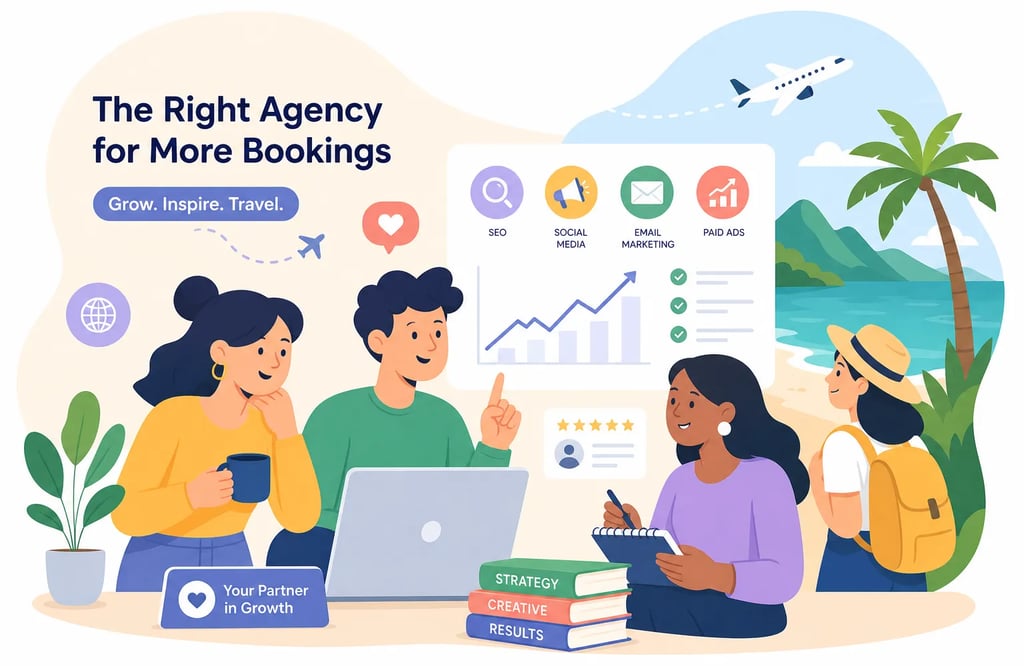
Choosing a Digital Marketing Agency for Your Travel Business
How do I choose a digital marketing agency for my travel business? It's a question many travel business owners ask after sitting through a pitch that felt convincing at the time, slick presentation, confident projections, a handful of recognisable brand logos. Then six months later, you're reviewing a report full of impressions and reach figures while your direct booking revenue sits exactly where it was. The agency had, as a hypothetical illust
rative scenario, never managed a shoulder-season campaign, couldn't explain the difference between a look-to-book ratio and a bounce rate, and had no idea what an OTA commission was costing you. This pattern is not unusual. It's a common outcome when travel brands hire generalist agencies, and it's why choosing a travel marketing agency demands a structured approach rather than gut feel.
The cost of that mistake is significant. A wasted retainer over a six-month engagement can run into tens of thousands of pounds, SME retainers typically range from £1,500 to £5,000 per month, whilst mid-market engagements regularly run from £5,000 to £15,000 per month, meaning a misaligned six-month contract could cost you between £9,000 and £90,000 before you've course-corrected. More damaging is what happens to your peak season momentum when the wrong strategy is in place during your highest-demand window. Rebuilding takes time, and in travel, time is bookings. Selecting the right travel digital marketing partner is therefore a process of verification, not instinct. The right questions, the right KPIs, and the right contract terms will protect you from a costly error.
Agencies built exclusively for the travel sector, as illustrated by specialists like Powerful Digital Marketing, bring frameworks, tools, and campaign logic already calibrated for traveller behaviour, booking cycles, and seasonal budget management. That's the benchmark to hold every shortlisted agency against. This guide gives you the criteria to do exactly that, functioning as a practical travel marketing agency checklist you can apply before signing anything.
Why generalist agencies consistently underperform for travel brands
The gap between travel marketing and everything else
Travel is structurally different from most industries that agencies serve. Booking windows stretch across weeks or months, not hours. Attribution spans multiple touchpoints before a reservation is confirmed. Budget demands swing dramatically between peak and shoulder seasons. A campaign that performs well in January for a ski operator needs an entirely different structure by April. Generalist agencies optimise for clicks and traffic because those are the metrics their frameworks are built around. Travel specialists optimise for booking intent, average booking value, and direct revenue share.
These are not interchangeable goals. A campaign that drives 40,000 impressions but zero incremental bookings is a failure dressed as a result. Travel marketing requires an understanding of how travellers move through the decision cycle: from initial inspiration to destination research, price comparison across OTAs, and finally conversion on your own booking engine. That journey takes weeks, and most generalist campaign structures are not designed to follow it.
What "travel experience" actually means in practice
When an agency claims travel experience, probe it. There is a significant difference between an agency that once managed a hotel's Facebook page and one that has a systematic understanding of OTA dependency, metasearch strategy, and RevPAR impact. The latter can speak fluently about how commission rates affect net revenue, why Google Hotel Ads requires a different bid strategy than standard search, and how to structure campaigns around a booking window rather than a sale date.
A specific red flag: if an agency cannot explain traveller personas in detail, cannot describe seasonal campaign pacing, and cannot articulate how their work connects to your booking funnel, they have not genuinely worked in the travel sector. That's not harsh; it's the standard every travel brand deserves to apply.
How do I choose a digital marketing agency for my travel business: verifying real sector experience
Reading a travel case study properly
A credible travel case study starts with a specific problem, not a general challenge. Look for language like "this hotel had 78% of bookings coming through OTAs" or "this tour operator had no attribution between their Meta ads and their FareHarbor booking data." The methodology section should name the channel used: Google Hotel Ads, geo-targeted paid social, or email retargeting. Crucially, the outcome must be expressed in revenue or bookings, not traffic, because bookings and revenue are the metrics that reflect genuine commercial impact for any travel business.
Strong campaigns produce results worth citing precisely. A 246% increase in direct bookings via Google Hotel Ads (as demonstrated by operators such as InTown Suites), a 6.75x ROAS from AI-driven ad targeting (comparable to results achieved by operators like Eagle Wing Tours), or a 20-point reduction in OTA dependency are the kinds of figures that indicate genuine competence. "We increased organic traffic by 18%" tells you almost nothing about whether the agency can grow your revenue. Traffic without conversion is not a travel marketing result; it's a vanity metric with a brochure attached.
The right questions to ask during an agency pitch
Your non-negotiable questions should include: Which booking engines have you integrated campaigns with? Can you show me a client whose direct booking share increased and OTA dependency decreased? How do you structure campaign spend across peak, shoulder, and off-peak seasons? What happens to our account access if we decide to end the engagement?
The quality of the answers tells you whether this agency understands the travel booking cycle or is improvising. An agency that cannot name a specific booking engine (Bókun, FareHarbor, Amadeus) or cannot describe how they adjust bidding strategies as demand shifts across the calendar is a significant warning sign that they may lack the depth of travel sector experience your business requires.
Checking references and live accounts
Ask to speak directly with a current travel client, not a past one, and not just a written testimonial. Current clients can tell you how the agency responds during a slow month, how quickly they act on a tracking issue, and whether the reporting reflects real booking data. Testimonials are curated; a phone call is honest.
Request read-only access to a live campaign dashboard before you sign anything. This shows you immediately whether the agency tracks booking revenue and conversion rates from its campaigns, or whether it measures impressions and reach. Agencies that track real outcomes have nothing to hide. Those that resist this request often do.
The KPIs every travel marketing agency should commit to from day one
Core metrics that connect campaigns to actual revenue
Five KPIs belong in every travel marketing agreement:
Direct booking revenue, the primary commercial output of all campaign activity
Booking conversion rate, reveals precisely where travellers are dropping out of your funnel
Customer acquisition cost (CAC), determines whether that revenue is profitable
Return on ad spend (ROAS), measures how efficiently ad spend generates revenue
Average booking value (ABV), tracks the quality and profitability of bookings generated
For paid channels such as Google Ads and Meta, meaningful ROAS and CAC data can emerge within two to six weeks. For SEO and mixed strategies, a clearer picture typically develops over 30 to 90 days, with organic results maturing over three to six months. Any agency that says they need six months before you can judge performance on any paid channel using revenue metrics is telling you their reporting framework is not built around commercial outcomes. Strong agencies set ROAS and CAC benchmarks in the first 30 days of paid activity and hold themselves accountable to them.
Secondary indicators that reveal campaign quality
Beyond the primary five, look for an agency that tracks repeat booking rate, cancellation rate, and direct booking share. These quality signals reveal whether the bookings being generated are valuable and sustainable, or whether you're attracting low-value, high-cancellation customers through discount-driven campaigns. Direct booking share, which measures what percentage of your reservations come through your own channels versus OTAs, is one of the most important long-term indicators of marketing health for any travel brand.
An agency focused purely on top-of-funnel metrics including impressions, reach, and follower count, without connecting that activity to booking outcomes, is a significant warning sign. Those metrics have a place in brand awareness reporting, but they should never be the headline result in a travel marketing engagement.
Tech integrations that determine whether campaigns can actually convert
Booking engines, CRMs, and attribution setup
A competent travel SEO and PPC agency must understand the technology stack your business already operates on. For tour operators, that typically means Bókun or FareHarbor. For full-service agencies handling complex itineraries, it might be Amadeus or Sabre. CRM-driven follow-up sequences often run through Zoho, Anolla, or Moonstride. If an agency does not ask about your booking engine and CRM setup in the first conversation, they are not thinking about attribution, which means they cannot optimise for what actually matters.
Without proper integration between your campaigns and your booking technology, you cannot attribute a reservation back to the channel that drove it. That gap makes campaign optimisation impossible. You are essentially spending money without knowing which portion of it is working.
Why attribution gaps destroy campaign ROI
The practical failure looks like this: an agency runs Meta ads, drives enquiry volume, but because the booking engine and CRM are not connected, nobody can confirm whether those enquiries converted, which campaign drove the most profitable travellers, or what the actual cost per booking was. The agency reports a cost per click. You need a cost per confirmed reservation.
Google Analytics, Google Tag Manager, and the Meta Pixel form the baseline attribution stack for any travel marketing campaign. Industry practice strongly supports verifying these tools before committing significant paid media budget, any agency that has not explicitly asked about these before launching campaigns should be considered a significant risk and removed from your shortlist.
Comparing fee models and contract terms without getting burned
How travel agencies price their services and what to expect
The four main pricing models you'll encounter are monthly retainers, project-based fees, hourly rates for specialist consulting, and percentage-of-media-spend structures for PPC-heavy campaigns. Monthly retainers are the most common for ongoing multi-channel work. For UK travel businesses, SME brands typically start at £1,500 to £5,000 per month for multi-channel retainers covering SEO, paid search, and content. Mid-market brands managing Google Ads, Meta, and content strategy regularly budget £5,000 to £15,000 per month. Performance-based structures typically layer a base fee with a bonus tied to bookings or revenue, which creates shared accountability from the outset.
Be cautious of unusually low fees. Travel marketing that actually drives bookings requires specialist expertise in seasonal bid management, travel search behaviour, and technical attribution. Generalist rates reflect generalist capability. The question is not which agency is cheapest; it's which agency delivers the strongest revenue return per pound of retainer.
Red flags hidden in agency contracts
The most damaging contractual traps are worth knowing in advance:
Lock-in periodsof six to twelve months with no performance exit clause
Ad account ownership sitting with the agency rather than with you as the client
Reporting structures that deliver a PDF summary once a month with no real-time access to campaign data
All three of these protect the agency's interests, not yours.
Watch for what might be called the "give it three more months" pattern. An agency that consistently defers accountability, without adjusting strategy or conceding that a channel is underperforming, is optimising for its retainer rather than your bookings. Strong agreements include a 90-day performance gate with a clear exit provision if agreed KPIs are not met. Many reputable travel agencies will accept those terms; any that refuse outright should give you pause.
How do I choose a digital marketing agency for my travel business: making your final shortlist decision
A practical scoring framework for comparing agencies
Evaluate each agency across five criteria: verified travel-sector case studies, booking revenue tracked from day one, booking engine and CRM integration capability, transparent fee structure with no hidden lock-ins, and real-time reporting access rather than monthly PDF summaries. Score each agency across these areas before any contract conversation begins.
Weight the criteria based on your current priority. A boutique hotel working to reduce OTA dependency should weight direct booking tracking and attribution setup most heavily. A tour operator launching paid search for the first time should prioritise ROAS management experience and seasonal budget flexibility. This travel marketing agency checklist is not one-size-fits-all; it should reflect where your business is right now.
Why a travel-specialist partner like Powerful Digital Marketing belongs on your shortlist
Powerful Digital Marketing is precisely what this evaluation process is designed to identify: an agency built exclusively for the travel sector, combining AI-driven campaign tools with experienced human strategy, pre-calibrated for travel search behaviour, seasonal booking cycles, and direct booking growth. Every service offered, from SEO and PPC management through to AI-powered social strategy and smart chatbot implementation, is designed around how travellers research, compare, and book, not adapted from an e-commerce or retail playbook.
The distinction matters. A generalist agency adapted for travel starts from a generic framework and tries to fit travel behaviour into it. A travel-specialist agency starts from traveller behaviour and builds the strategy around it. That difference shows in the results: the campaign structure, the KPIs tracked, the booking engine integrations, and the seasonal logic behind every budget decision.
If your business needs to grow direct bookings, reduce OTA dependency, or build stronger traveller relationships through smarter digital marketing, that conversation starts with a straightforward call. Contact Powerful Digital Marketing to discuss your situation with no obligation, and begin the same verification process this guide recommends. The right agency will welcome the scrutiny.
The bottom line on how to hire a digital agency for tourism and travel
Selecting a digital marketing agency for your travel business is not about finding the most impressive pitch deck or the lowest monthly fee. It is about finding a travel digital marketing partner who can verify their travel results with specific booking data, commit to the right KPIs from day one, integrate with your booking technology accurately, and structure a contract that keeps them accountable when results matter most.
Apply the criteria in this guide consistently: verified case studies with booking revenue outcomes, transparent attribution setup, seasonal campaign capability, and a contract that includes a performance exit clause. A genuinely specialist travel marketing agency will meet these standards without hesitation. Any agency that deflects, obfuscates, or asks you to trust the process rather than verify the results is telling you something important before you've signed anything.
You now have the framework to make this decision with confidence. Revisit the question that brought you here, how do I choose a digital marketing agency for my travel business, and you'll find the answer is systematic rather than speculative. The right agency is out there, and it will welcome every question in this guide as the mark of a serious travel business owner who knows what good marketing actually looks like.
ADDRESS
The Powerful Group Limited
124 City Road
London
United Kingdom
EC1V 2NX
WORKING HOURS
Monday - Friday 9:00 AM - 6:00 PM
Saturday - Sunday 8:00 AM - 12:00 PM
Want to Call? Ask our Powerful Bot for the Number