
Travel agency digital marketing: practical buyer's guide
Stop wasting budget on generic agencies. Learn which channels drive bookings, realistic KPIs, agency costs, and how to pick the right travel-specialist partner.
TRAVEL MARKETING
Powerful Digital Marketing
7/17/20267 min read
Travel agency digital marketing: a practical buyer's guide
Most travel brands have a travel agency digital marketing problem they haven't fully diagnosed yet. They're spending money every month on an agency that also handles local accountants, dental clinics, and e-commerce shops, and wondering why their booking enquiries aren't growing. The issue isn't the budget. It's the mismatch between a generic marketing framework and an industry that works nothing like any other.
Travel has its own logic. Booking windows stretch months. A single trip purchase involves dozens of touch points, from early inspiration on Instagram to late-stage price comparison on Google. Seasonality shifts demand overnight. The emotional weight of a holiday or cruise bears no comparison to buying a product online. No amount of general marketing expertise compensates for not understanding those dynamics at a fundamental level.
This guide gives you a clear decision framework for digital marketing for travel agencies. By the time you've finished reading, you'll know which services actually drive bookings, what realistic KPIs look like, what agencies in this space charge, and exactly how to evaluate a shortlist. A small number of agencies are built specifically around these realities, travel-exclusive specialists with genuine sector depth. Here's how to find the right one for your business.
Why a generalist agency is the wrong fit for travel brands
Generalist agencies apply the same playbook to every client. They run keyword research, build ad campaigns, post to social channels, and report on traffic. For most industries, this works reasonably well. For travel, it falls apart quickly because the buyer journey is radically different from anything a generalist has built campaigns around before.
Consider booking cycles. A traveller researching a luxury cruise in January may not book until April. During that time, they shift from inspiration to research to price comparison, moving through entirely different intent signals. A PPC or SEO strategy that doesn't account for those phases wastes spend on the wrong message at the wrong moment. Some generalist agencies never map campaigns to booking windows because they've never had to think about them, a gap that costs travel brands real money.
What travel-specific expertise actually looks like in practice is the difference between an agency that builds traveller personas from scratch over months and one that already knows how families search versus solo travellers, how cruise buyers behave differently from boutique hotel guests. It also means understanding how OTA competition on Google Travel directly affects bidding strategy. At Powerful Digital Marketing, every service, from SEO to paid social, is pre-calibrated for travel search behaviour and booking cycles, purpose-built for the way travellers actually search and book. (Read our AI Marketing for Travel Brands, Better Than Traditional?)
The commercial risk of choosing the wrong agency is real. If an agency spends six months learning your sector, that's six months of retainer fees on the learning curve. For travel brands with tight margins and seasonal revenue peaks, that's not a minor inconvenience. It's money directly out of your next season's performance.
Travel agency digital marketing channels every travel brand needs in 2026
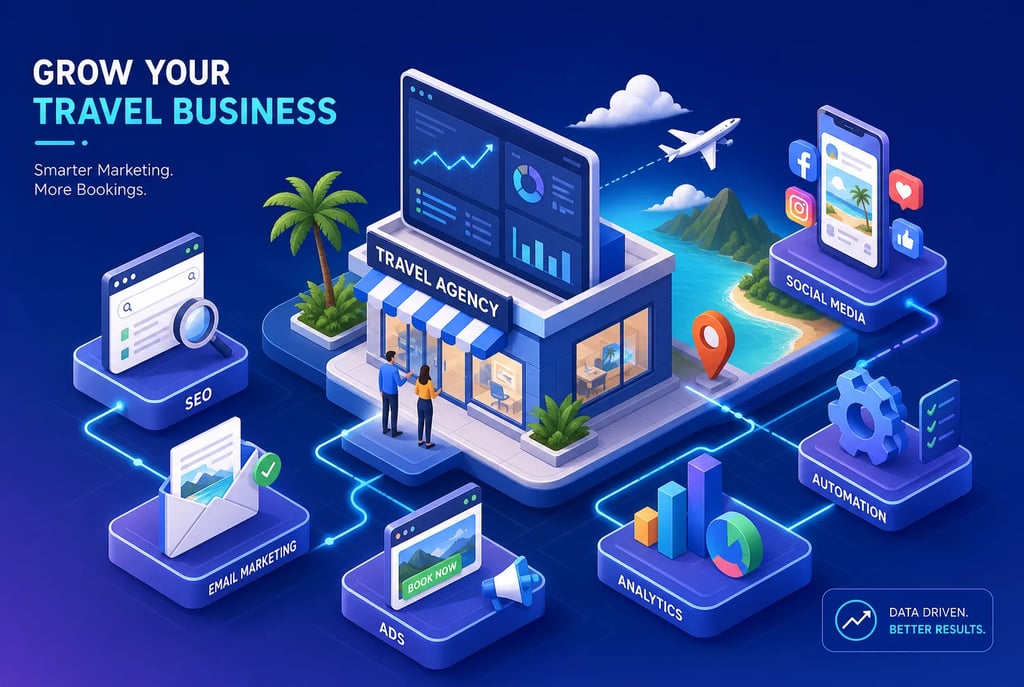
No single channel does everything. The travel brands generating consistent direct bookings run a coordinated mix of channels, with each one doing a specific job at a specific stage of the booking journey.
Organic search and content
Organic search is where most booking journeys begin. Travellers start with broad queries: "best small group tours Italy" or "boutique hotels Lake District." A strong travel SEO and content strategy positions your brand at that early stage, before price comparison enters the picture. Destination-specific guides, long-form itinerary content, and technically sound pages build authority that compounds over time. Expect four to six months before measurable traction, but the return on that investment grows every month you maintain it.
Paid search and social advertising
Paid search and social ads serve a different purpose: converting travellers who already know what they want. Google Search ads targeting specific dates and destinations can achieve strong click-through rates, one widely cited 2026 benchmark puts travel CTR at around 8.24% (click-through rate benchmarks), though figures vary across sub-sectors and campaign types, so your agency should be able to contextualise performance against the specific segment you're competing in. On Meta and Instagram, visually rich travel content drives strong engagement and, when paired with precise audience targeting, converts browsers into enquiries. PPC produces bookings almost immediately after launch, which is why it works best running alongside SEO rather than as a replacement for it.
Email marketing and automation
Email marketing consistently delivers strong return on investment across digital channels, yet it's often underinvested in travel agent marketing strategies. Conversion rates vary significantly by list type and definition, warm nurture sequences to interested prospects tend to outperform cold paid channels substantially, and outreach to past travellers can be particularly effective given the established relationship. Cart abandonment emails in travel achieve notably high open and click-through rates. When AI personalisation is layered on top, tailoring offers and timing to where each contact sits in their decision journey, results improve further still. Ask your agency to define exactly which conversion event they're measuring so you're comparing like with like.
Travel agency digital marketing KPIs and timelines
Your agency should be reporting on metrics that connect directly to bookings, not vanity numbers. Understanding the benchmarks gives you the context to evaluate whether what they're delivering is genuinely strong performance or a polished presentation of mediocre results.
Performance benchmarks by channel
For paid search, a travel site performing above the industry average will achieve a CTR above 4.7% and a conversion rate above 3.6%, though these figures vary by sub-sector, so confirm the relevant benchmark with your agency. Website-wide, a conversion rate above 2% places you in the top 20% of travel sites; above 3% puts you in the top 10%. Email click-through rates should sit between 2% and 5% for campaign sends, with significantly higher performance on automated sequences triggered by behaviour. These numbers give you a baseline. If your agency is reporting figures well below these and attributing it to "the market," push back with specifics.
Realistic timelines by channel
Timelines matter as much as benchmarks. PPC can produce bookings on the day a campaign launches. SEO takes four to six months for measurable ranking traction, with direct bookings typically attributable by months six to twelve. Content marketing follows a similar ramp. Email campaigns work fastest on warm, existing lists. The practical implication is straightforward: you need short-term channels (PPC) and long-term channels (SEO and content) running simultaneously from the start.
Watch out for these warning signs, they should prompt a serious conversation with your agency:
Reporting that focuses on impressions and sessions rather than booking enquiries and cost per acquisition
Campaign decisions made without any sector-specific reasoning
Keyword and audience strategies that could apply to any industry
These aren't minor issues. They signal that your account is being managed by someone who doesn't understand travel, and that the budget you're spending isn't working as hard as it should be.
What specialist travel marketing agencies charge in 2026
Fee structures across UK travel marketing agencies follow a fairly consistent pattern, with ad spend typically billed separately on top of the retainer, confirm this with any agency you're evaluating. Entry-level packages for smaller travel businesses, typically covering core SEO and social media management, start around £1,000 to £1,500 per month. Mid-range retainers sit around £2,500 per month and suit established travel businesses running multi-channel campaigns. Full-service strategies combining AI Marketing for Travel Brands: Cost, ROI & Fit 2026, PPC management, content, email, and competitor intelligence run from £5,000 to £10,000 or more per month for larger operators.
These figures reflect scope, not just agency prestige. A boutique hotel just starting out with digital marketing doesn't need a comprehensive enterprise retainer. But a cruise marketing team or a mid-size tour operator trying to compete across Google, Meta, and email, against OTAs with significantly larger budgets, does need a comprehensive strategy. Cutting budget in that scenario produces proportionally weaker results.
The ROI case for specialist tour operator marketing and travel-exclusive agencies is supported by published case studies. Reported outcomes include a 6.75x ROAS for a tour operator (AAMP), 300% booking increases in a single season (BuildUp Bookings), and 517% growth in direct revenue for properties that reduced OTA dependency through targeted campaigns. When measured against those outcomes, even a mid-to-high monthly retainer is straightforward to justify commercially. Sample sizes and baseline conditions vary across these studies, so treat them as directional evidence rather than guaranteed results. See the AAMP case studies for examples of published outcomes.
How to shortlist and choose the right agency for your travel brand
The shortlisting process should be structured and non-negotiable. Before you sign anything, get clear answers to five questions:
Do you work exclusively with travel brands, or do travel clients make up part of a broader mix?
Can you show me case studies with before-and-after booking or revenue metrics?
Which AI tools do you use, such as AI search optimisation, audience modelling, or personalisation technology, and how are they configured specifically for travel search behaviour? (See ourAI Marketing Tools for Travel Agencies, 2026 Shortlist.)
What does your reporting look like, and which KPIs do you track beyond traffic?
What does the first 90 days look like, and when should I expect measurable results?
Any agency that struggles to answer these with specifics is telling you something important. Vague answers about "a holistic approach" or reporting dashboards full of sessions and reach figures without booking attribution are reliable indicators of a generalist mindset dressed up in travel-adjacent language.
Use this checklist to evaluate every agency on your shortlist:
Confirmed travel-sector specialisation, not just travel clients among a broader mix
Transparent use of AI and data tools, with clear explanations of how they're configured for travel
KPI reporting tied directly to bookings, enquiries, and cost per acquisition
Realistic, clearly communicated timeline expectations by channel
A hybrid model combining AI automation with experienced human strategic oversight
You can also consult specialist directories such as the SEMrush travel agencies list (UK) when forming your initial shortlist.
Generic agencies can get you traffic. Travel-specialist agencies understand that traffic means nothing unless it converts into bookings. That distinction is the entire point. Powerful Digital Marketing is built around this precisely: deep travel sector knowledge combined with AI tools designed around traveller behaviour and booking cycles, purpose-built for the way travel buyers actually make decisions. For travel brands that want direct bookings, reduced OTA dependency, and a destination marketing agency partner that genuinely understands how their customers think, a travel-exclusive specialist isn't a luxury. It's a competitive necessity.
Making the right choice for your travel business
The decision framework is straightforward once you know what to look for. The right agency understands travel's unique buyer journey, how travellers move from inspiration through research to purchase. It runs the right mix of channels simultaneously, with short-term PPC driving immediate bookings while SEO and content build compounding long-term authority. And it reports on what actually matters to your business: bookings, revenue, and cost per acquisition rather than impressions.
Travel agency digital marketing delivered by an agency with genuine sector expertise and purpose-built AI consistently outperforms generic approaches on ROAS, booking volume, and long-term traveller loyalty, a thesis supported across multiple published case studies spanning tour operators, boutique hotels, and cruise marketing teams. The compounding cost of the wrong agency choice is real. The compounding benefit of the right one is just as real.
If you're ready to evaluate your current strategy or start building one that's actually calibrated for the travel industry, Powerful Digital Marketing offers a consultation and strategy review for travel brands at any stage. Get in touch to see what a travel-exclusive approach looks like in practice.
ADDRESS
The Powerful Group Limited
124 City Road
London
United Kingdom
EC1V 2NX
WORKING HOURS
Monday - Friday 9:00 AM - 6:00 PM
Saturday - Sunday 8:00 AM - 12:00 PM
Want to Call? Ask our Powerful Bot for the Number