
AI Marketing for Travel Brands — Better Than Traditional?
See why AI marketing outperforms traditional tactics for travel brands. Learn measured results, top AI use-cases, and how to test ROI before reallocating budget.
AI IN TRAVEL
Powerful Digital Marketing
6/19/20268 min read
Is AI Marketing More Effective Than Traditional for Travel Brands?
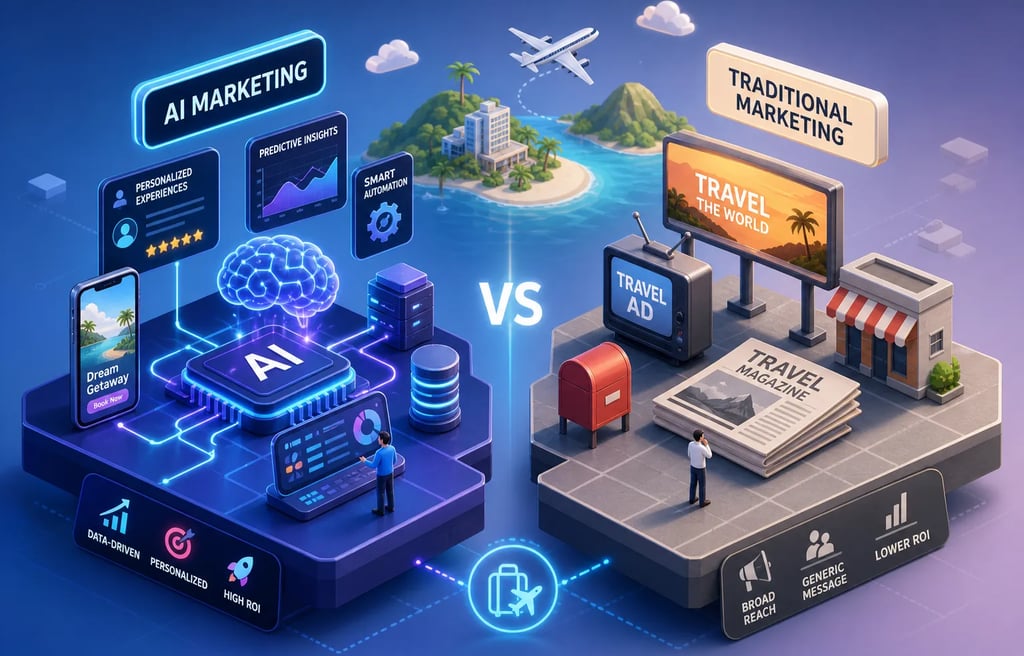
Is AI marketing more effective than traditional marketing for travel brands and hospitality businesses? It's a question that carries real financial weight, and travel and hospitality marketers are facing it right now. The pressure to shift budget toward AI-driven tools is genuine, but so is the accountability that comes with spending money you can't afford to waste. The answer isn't philosophical; it comes down to hard numbers: lower customer acquisition costs, better return on ad spend, and more direct bookings landing in your own channels rather than through an OTA.
At Powerful Digital Marketing, we work exclusively with travel and hospitality brands, and we've been tracking these outcomes across clients for years. The pattern in the data is now hard to ignore. This article walks through what the evidence actually shows, which AI use-cases deliver the strongest results, and how to measure success before committing fully to either approach.
What the data reveals about AI versus traditional marketing performance
The headline numbers are compelling, and they hold up across multiple independent sources. AI-driven personalisation campaigns have produced up to 25% higher bookings for travel brands, alongside 15 to 25% higher conversion rates for hotels that adopted advanced segmentation and hyper-personalised offers. These aren't vendor claims from a platform's own marketing materials; they come from brand-level case studies at properties including Hilton and mid-size independent hotels.
BCG's research on AI-activated next-best-action approaches puts efficiency gains at 10 to 20%, with incremental ROI improvements exceeding 20% in travel marketing contexts. Compare that to generic display advertising and untargeted email campaigns, which multiple industry analyses consistently identify as underperforming against personalised AI approaches. The gap exists because personalisation directly addresses booking intent at the moment it forms, rather than broadcasting a message to an audience that largely isn't ready to buy.
The advertising-specific numbers are even clearer. Google's Performance Max campaigns delivered 18% more incremental conversions at a comparable cost per action versus standard campaigns. AI-based contextual targeting and dynamic creative optimisation can produce up to 2x higher return on ad spend, with documented cases showing 56% lower cost per click when dynamic creative is properly deployed.
To make the comparison meaningful, it's worth defining what "traditional" means here: broad-match display without predictive targeting; static creative that doesn't adapt to the viewer; last-click attribution that rewards only the final touchpoint; and untargeted email blasts sent to the full list. That's the benchmark being beaten, and it remains the operating standard for a significant number of travel brands.
Is AI marketing more effective than traditional marketing for travel brands? What the use-case evidence says
Not every AI application carries the same weight of evidence. If you're deciding where to focus first, the following breakdown reflects the strength of proof behind each use-case rather than what's most talked about in marketing technology circles. For a deeper look at the tools, tactics and measured outcomes we recommend for travel, see our guide on AI Travel Marketing: Tools, Tactics & Real ROI 2026.
Dynamic pricing is the most mature and data-rich application in hospitality revenue management. Hotels using AI-driven rate management report 5 to 10% RevPAR increases, with some properties exceeding 15% within the first year. Hilton's use of AI to personalise pricing based on consumer travel patterns produced a 5 to 8% revenue increase. A mid-size hotel in New York City saw a 15% RevPAR rise within six months of adoption. Dynamic pricing works so well because AI analyses signals no human revenue manager could process simultaneously at scale: booking pace, competitor rates, local events, weather patterns, and historical demand curves, all recalibrating rates in real time. Google's case study on AI-powered personalization for hotel brands provides a useful example of how these systems are being deployed at scale.
AI chatbots represent the next strongest case, primarily through upselling and round-the-clock booking capture. A growing share of travellers, some surveys put it above 40%, now book based on AI-generated recommendations, and the revenue attribution is direct. Zoku Hotels generated over €11,500 per automated upselling campaign through their AI-powered guest engagement model. Marketing automation in hospitality settings also shows strong results through predictive advertising: one case study reported 109% return on ad spend and a 59% improvement in cost-per-click by using AI to forecast demand and reallocate budget proactively. For broader context on personalisation approaches in travel marketing, see independent analysis of AI personalization in travel marketing.
Personalised email and AI-generated content both contribute to engagement and operational efficiency, but their revenue attribution line is less direct than pricing and chatbots. These tools work best as layers within a broader system, amplifying the performance of higher-impact applications rather than driving bookings independently. In practice, they belong in your stack, but if direct booking growth is the primary goal, start your AI investment with pricing and chatbots first.
Where traditional marketing still earns its place in a travel brand's mix
AI marketing outperforming traditional approaches on efficiency metrics doesn't make traditional channels irrelevant. It means they serve a different function, and confusing that function is where most brands go wrong with budget allocation.
Upper-funnel awareness, destination storytelling, and trade press relationships remain areas where traditional marketing delivers genuine value. Travel decisions are deeply emotional. A traveller doesn't decide to book a safari or a river cruise because a retargeting ad found them at exactly the right moment; they decide because something planted the desire weeks or months earlier. Broad-reach brand campaigns, whether a well-placed travel feature, a magazine partnership, or a sponsored editorial piece, build the kind of aspiration that AI-optimised conversion channels can then capture and act on. Treating these channels as competitors to AI-driven approaches is the wrong framing entirely.
The practical model is a clean funnel split: traditional channels seed awareness and intent, while AI-driven tools capture, nurture, and convert that intent more efficiently. A boutique hotel that earns a feature in a well-regarded travel publication builds brand recognition across a relevant audience. The AI-powered remarketing campaign that follows captures every visitor who arrived from that feature at a fraction of what broad paid search would cost. The combination consistently outperforms either approach running in isolation. For most travel brands, the question isn't which one to choose; it's how much of each, and at what stage of the funnel.
Measuring whether AI marketing is actually working for your business
This is where most travel marketers have a blind spot, and it costs them in two directions: either they underestimate the value of AI campaigns because they're using the wrong metrics, or they overstate it because they're trusting attribution models that count bookings that would have happened anyway.
Standard attributed conversions overstate performance by design. Last-click attribution, which BCG notes many travel businesses still rely on, actively misleads budget decisions by inflating the apparent performance of bottom-funnel channels. The right metrics for evaluating AI campaign performance are incremental ROAS, incremental CPA, and incremental bookings: conversions that only occurred because of the campaign. For hospitality specifically, add RevPAR lift, direct booking rate change, and ancillary revenue attach rate as secondary indicators. These metrics tell you what actually changed in your business, not what the platform reported.
For testing methodology, the most reliable options depend on your scale. Holdout tests using randomised control groups are the gold standard for measuring causal impact, and platforms like Meta support them natively through their Experiments tool. Geo-based split tests work well for regional hotel and destination marketing when user-level holdouts are impractical; you assign comparable cities or DMAs to test and holdout groups and compare booking outcomes over a fixed period. Synthetic control methods suit larger multi-market campaigns where matched-market comparison needs to be modelled rather than randomised. For guidance on designing robust holdouts, see why many practitioners call holdout testing the gold standard. If you have specific questions about testing methods and tools, our FAQ on Common Questions About AI Marketing Tools for Travel Businesses is a helpful starting point.
The key principle is straightforward: use platform attribution to optimise campaigns in-flight, and use incrementality testing to make budget decisions. They are different tools serving different purposes, and conflating them is one of the most common measurement errors in travel marketing. Programmatic ads for travel brands add another layer of complexity here, because platform-reported ROAS can be especially misleading when audiences overlap across channels.
A 90-day pilot plan to test whether AI marketing is more effective than traditional marketing for your hospitality business
Reading the data is useful. Running a structured test against your own business is the only way to know what holds true for your specific properties and customer base in your market. Here's the framework that Powerful Digital Marketing uses with new travel clients before making any major budget recommendations.
In weeks one to four, establish your baseline and design the holdout. Capture current performance across the metrics that matter: customer acquisition cost by channel, ROAS, direct booking rate, and average booking value. Choose one AI-driven channel to test first. If you're running static room rates, dynamic pricing is the highest-leverage starting point. If acquisition cost is the primary concern, a predictive paid social campaign targeting high-intent travel audiences is the better initial test. Set up the holdout group before the campaign launches, not after. Define your success threshold before the campaign starts; a 10% improvement in efficiency or a measurable lift in direct bookings are both reasonable benchmarks for a first pilot.
In weeks five to twelve, run the campaign and use in-flight data to adjust creative, targeting, and budget allocation within the AI platform. At the 90-day mark, compare incremental ROAS, incremental CPA, and incremental bookings against both the baseline and the holdout group.
If the test channel shows 10% or greater efficiency improvement or measurable lift in direct bookings, you have the evidence you need to scale. If it doesn't, examine the holdout data carefully. The issue is typically the channel itself, the quality of the creative, or a weak audience model, three distinct and fixable problems. You need the holdout data to diagnose which one it is. This process removes guesswork from a decision that carries real financial weight, and it's the reason pilot design matters as much as campaign execution.
The verdict, and what to do next
So, is AI marketing more effective than traditional marketing for travel brands and hospitality businesses? When applied to the right use-cases and measured with the right metrics, yes, AI marketing consistently outperforms traditional approaches on efficiency, customer acquisition cost, and booking conversion. Dynamic pricing has the strongest and most consistent evidence base in hospitality. Predictive advertising and AI chatbots follow closely, with well-documented results across both independent properties and larger hotel groups. Traditional channels remain genuinely valuable for upper-funnel brand building, and the strongest overall performance consistently comes from combining both rather than replacing one with the other.
The practical step forward isn't to pick a side based on broad industry commentary. It's to run a structured 90-day test that produces data specific to your business, your bookings, and your market. The industry figures give you direction; your own holdout data gives you proof. That's the only benchmark that actually matters.
For travel and hospitality brands ready to make that shift with the backing of deep sector expertise and purpose-built AI tools, Powerful Digital Marketing offers a partnership that turns these benchmarks into results specific to your properties. Our team combines genuine travel industry experience with advanced AI marketing capabilities, because travel and hospitality demand a different approach to the frameworks built for e-commerce. We also publish thought leadership on AI-Powered Travel Marketing: Why Brands Are Switching. If you want to understand exactly where the performance gap exists in your business, get in touch with our team and we'll walk you through how we'd structure the test.
ADDRESS
The Powerful Group Limited
124 City Road
London
United Kingdom
EC1V 2NX
WORKING HOURS
Monday - Friday 9:00 AM - 6:00 PM
Saturday - Sunday 8:00 AM - 12:00 PM
Want to Call? Ask our Powerful Bot for the Number