
Google Ads for Travel: Complete Strategy Guide 2026
Build travel-specific Google Ads: pick campaign types, configure feeds, write booking-focused ads, apply Smart Bidding, and track revenue to measure true ROAS.
POWERFUL CLICKS - AFFORDABLE SEO AND PPC
Powerful clicks
6/18/20268 min read
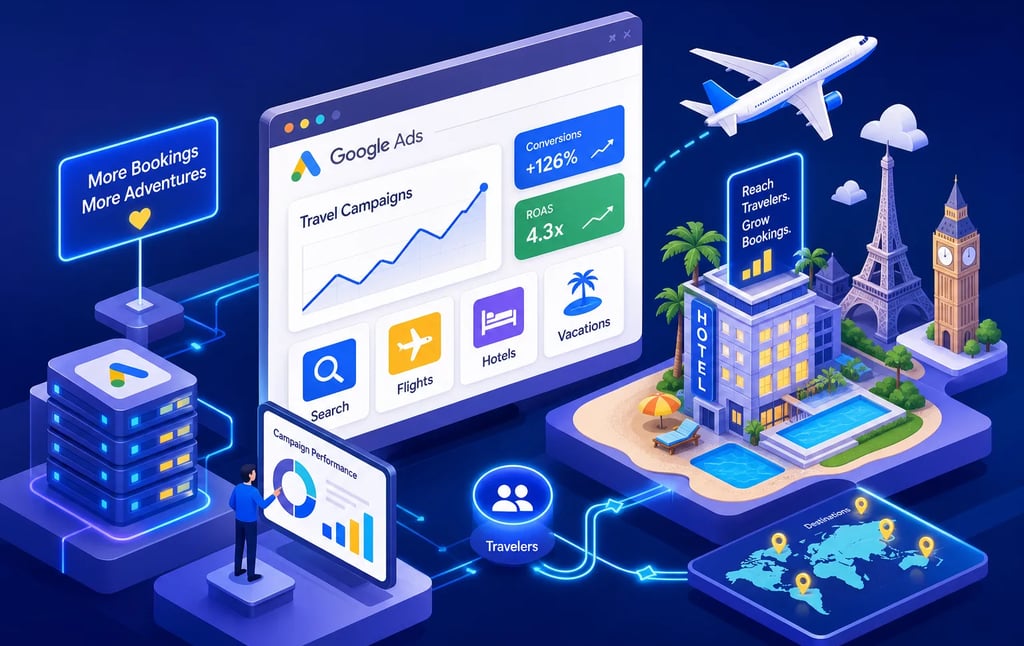
Google Ads for Travel: The Complete Strategy Guide
Travel businesses pour substantial budget into Google Ads every month and walk away with disappointing results. The platform looks identical whether you're advertising package holidays or plumbing services, but the mechanics underneath are entirely different. Build a travel campaign the same way a generic agency builds a retail or home services account, and you'll spend heavily while your competitors take the bookings. That's the core problem with most Google Ads for travel accounts: the buyer psychology, the conversion window, and the campaign architecture all work differently here, and strategies borrowed from other sectors simply don't translate.
At Powerful Digital Marketing, travel PPC is our entire focus. The pattern we see when brands come to us after months of generic agency management is consistent: high spend, thin returns, and campaigns that have never been set up to reflect how travellers actually search and book. This guide covers how to pick the right campaign type for your specific travel business, build your travel feeds correctly, write ad copy that targets booking intent, apply Smart Bidding at the right moment, and set up conversion tracking that passes real revenue values so your ROAS figures actually mean something.
Google Ads for Travel: Choosing the right campaign type for your business
Search campaigns: the starting point for most travel brands
Search campaigns remain the strongest entry point for high-intent travel queries. When someone types "book whale watching tour Vancouver" or "boutique hotel Lisbon city centre," they are ready to compare and commit. Search gives you full keyword and bid control, which matters enormously when you're competing against OTAs with seven-figure monthly budgets bidding on the same terms. Start here, prove your return on investment, then scale into automation once you have the conversion data to support it. For a practical playbook on structuring search campaigns for travel, see How to Run Google Ads for Travel That Actually Convert.
Google Hotel Ads and Property Promotion Ads for accommodation businesses
Hotel Ads are a dedicated format that surfaces live rates and availability directly within Google's accommodation surfaces, separate from standard Search results. This is not a standard Google Ads campaign type; it requires Hotel Center integration and a correctly configured feed before a single ad can serve. For an overview of the benefits and the technical requirements, review Google Hotel Ads benefits and requirements. Property Promotion Ads sit alongside Hotel Ads as a complementary format, helping accommodation businesses drive direct traffic to their property pages when travellers are actively comparing options; learn more about how Google Property Promotion Ads work.
If you run a hotel, vacation rental, or boutique property, Hotel Ads should be a central part of your Google Ads strategy. They put your rates in front of travellers at the exact moment they are comparing accommodation, and they do it without surrendering the booking to an OTA, making them consistently one of the strongest direct-booking channels available to accommodation businesses.
Performance Max and Travel campaigns for tours and activities
Performance Max earns its place once you have strong creative assets and enough conversion data to feed Google's algorithm. From a single campaign, it reaches travellers across Search, Display, YouTube, Maps, and Discover, finding demand you wouldn't reach through keyword targeting alone. For tours and activities specifically, Travel campaigns and Things to Do ads require a connected feed through Actions Center and run exclusively on Maximise Conversion Value with a Target ROAS. There are no keywords to manage; the feed drives eligibility. The practical rule: hotels start with Hotel Ads plus Search; tour operators start with Search, then layer in Performance Max once conversion volume is stable. For detail on how Things to Do ads operate and their feed requirements, see this guide to Google Things to Do ads.
Setting up travel feeds: what Google needs and how to connect them
Hotel Center vs Actions Center: which feed applies to you
The feed world splits cleanly by business type. Accommodation businesses, including hotels, boutique properties, and vacation rentals, use Hotel Center feeds. Tours, activities, and attractions use Things to Do through Actions Center. Both must be linked to your Google Ads account before travel-specific ad formats will serve.
Within Hotel Center, the feed stack typically includes three components: a Hotel List Feed containing your master property data, a Price and Availability Feed with current rates and inventory, and a Point of Sale Feed that handles redirect logic by country, currency, language, and device.
Required feed attributes and formatting principles
Regardless of feed type, Google needs a consistent set of attributes to display and serve your ads correctly. Every property or product requires a stable unique ID that doesn't change frequently, a clear name, location or destination data, current pricing, availability status, high-resolution images, ratings signals where available, and a clean booking URL.
Price accuracy is a hard requirement for Hotel Ads eligibility: if your rates are stale or mismatched, your ads won't serve. The Point of Sale feed must correctly handle country, currency, language, and device targeting to avoid sending users to a landing page that doesn't match what the ad showed them.
Connecting your feed and keeping it accurate
Once your feed exists in Hotel Center or Actions Center, link it to your Google Ads account and confirm that eligible campaign types are present: Search, Performance Max, or Travel campaigns, depending on your business type. After linking, eligible campaigns can automatically draw on feed assets within Search ads. Feed freshness is not optional. Stale rates or unavailable inventory break the user experience and can harm listing eligibility and overall campaign performance, wasting every click you pay for. Add URL parameters for click attribution at this stage so you have clean tracking from day one.
Google Ads for Travel: Keyword targeting and ad copy built around booking intent
Building a keyword strategy around the look-to-book window
Travel searches move through four stages: inspiration, research, comparison, and booking. Generic accounts target broad terms and burn budget on early-stage traffic that has no intention of converting in the near term. The right approach is to prioritise transaction-ready queries, such as "book five-day Tuscany tour," "all-inclusive resort Maldives deals," or "adults-only hotel Barcelona," while using audience layers and bid adjustments to separate researchers from buyers. Negative keyword management is not a one-time task in travel; it requires regular, disciplined review. Irrelevant modifier terms, competitor brand names in the wrong context, and informational queries can bleed budget fast if the search terms report isn't checked consistently.
Writing ad copy that converts travel searches into bookings
Travel ad copy fails when it describes the product rather than resolving the traveller's decision. Effective copy leads with a specific outcome: a destination detail, a price anchor, or a trust signal such as review counts or industry awards. Responsive Search Ads give Google the ingredients to test combinations; supply 15 headlines and 4 descriptions that each say something distinct, not slight variations of the same message. (Google's RSA specification outlines these requirements in full.) Callout extensions, sitelinks to specific departure dates or itineraries, and price extensions all expand your ad's footprint in the auction and push OTA listings further down the page.
Specific, intent-matched messaging consistently outperforms generic copy, and in travel, the cost of underperformance is measured in wasted clicks at £1.50 to £2.50 each, based on current UK Search benchmarks for travel campaigns.
Smart Bidding and seasonal budget management for travel campaigns
Which bidding strategy to use and when to switch
The Smart Bidding progression for travel follows a clear sequence. Start new campaigns on Maximise Conversions to gather data without imposing a cost-per-acquisition constraint. Once you have stable conversion volume, the practical threshold is around 15 conversions in the prior 30 days, move to Target ROAS so the algorithm can optimise for revenue rather than volume. Switching too early, before the bidder has enough conversion signal, is one of the most common reasons travel campaigns stall; the algorithm needs data before it can make intelligent decisions. Note that Travel campaigns for Activities use Maximise Conversion Value with a required ROAS target from the outset, as that is the only available bidding strategy for that campaign type.
Adjusting budgets around seasonal demand peaks
Travel demand is not linear, and flat monthly budgets miss the peaks that drive the most bookings. Industry data consistently shows that travellers book well in advance of their departure dates, which means budget must be front-loaded six to twelve weeks before peak travel dates, not during the travel season itself. If your peak travel period is July, the primary budget allocation belongs in April and May, when intent is high and CPCs are lower than they'll be in June when every competitor ramps up simultaneously.
Three budget postures are useful for planning. A market tracker approach uses conservative daily spend to maintain visibility without overcommitting. A market player approach balances investment across the booking window. A market leader approach deploys higher spend to maximise auction share during peak windows. Whichever posture you choose, Smart Bidding needs budget headroom to operate effectively; a constrained budget caps impressions before the algorithm can find your best conversion opportunities.
Conversion tracking and measuring ROAS from your travel campaigns
Setting up booking conversion tags correctly
The core setup requires three components working together. First, a Conversion Linker tag firing on all pages so Google Ads can persist click identifiers for attribution. Second, a Google Ads conversion tag firing on the booking confirmation step. Third, the actual revenue value passed dynamically through the data layer at the moment the tag fires. Passing a fixed conversion value defeats the entire purpose of ROAS bidding in travel, where booking values can range from a £50 activity to a £5,000 tour package; the algorithm needs real numbers to make real decisions.
Enable enhanced conversions where consent allows, as this improves measurement coverage and helps recover conversions that cookie restrictions would otherwise miss. Install GA4 alongside Google Ads tracking, mark the booking event as a key event, and use it to provide funnel analysis and cross-channel attribution context. For guidance on Google Ads conversion setup and troubleshooting, consult Google's conversion tracking documentation.
Linking GA4 and Google Ads for accurate ROAS reporting
The linking sequence is straightforward: connect GA4 to Google Ads, enable auto-tagging in the Google Ads account, and import the GA4 key events into Google Ads as conversions. The division of labour matters here. Google Ads conversion tags are the primary measurement layer that Smart Bidding optimises from; GA4 is for validation, audience analysis, and understanding the full path to booking.
ROAS in Google Ads is only meaningful when the conversion value passed at tag fire matches real revenue. Often, inconsistencies between GA4 and Google Ads ROAS figures stem from tagging or attribution settings rather than actual campaign performance, verify these before concluding that a campaign is underdelivering, and refer to Google's conversion tracking guidance when diagnosing discrepancies.
Put the five layers together and stop wasting budget
The approach laid out here is not complicated, but it is specific. Pick the campaign type that matches your business model. Build the travel feed correctly before running any ad format that depends on it. Target keywords at the booking intent stage, not the inspiration stage. Let Smart Bidding mature before optimising for ROAS. Set up conversion tracking that passes real revenue values, not proxy metrics. Each layer compounds the one before it, and skipping any one of them is precisely where travel budgets get wasted. For a tactical checklist that complements this guide, see Boost Your Travel Business with Effective PPC Strategies.
Running Google Ads for travel requires decisions that simply don't apply in other industries: feed architecture, Hotel Center integration, seasonal budget posture, look-to-book window targeting, and dynamic conversion values tied to packages that vary significantly in price. That is exactly why Powerful Digital Marketing works exclusively with travel brands. We don't apply recycled templates from other sectors; we bring sector-specific knowledge, from seasonality patterns to OTA competitive dynamics, that generic agencies consistently get wrong.
If you want a team that already understands your booking funnel, your seasonal demand curve, and the competitive dynamics of your specific travel market, get in touch with Powerful Digital Marketing. For travel brands serious about improving their Google Ads for travel results, we'd welcome the conversation. For a comprehensive overview of our approach, you can also read Google Ads for Travel: Run Profitable Campaigns.
ADDRESS
The Powerful Group Limited
124 City Road
London
United Kingdom
EC1V 2NX
WORKING HOURS
Monday - Friday 9:00 AM - 6:00 PM
Saturday - Sunday 8:00 AM - 12:00 PM
Want to Call? Ask our Powerful Bot for the Number