
Google AI Shift: What Travel Marketers Must Do Now
Google's AI shift is reshaping travel search. Learn why AI Overviews cut organic visibility and 3 priority moves travel marketers must take to protect bookings.
TRAVEL MARKETING
Powerful Digital Marketing
6/8/20268 min read
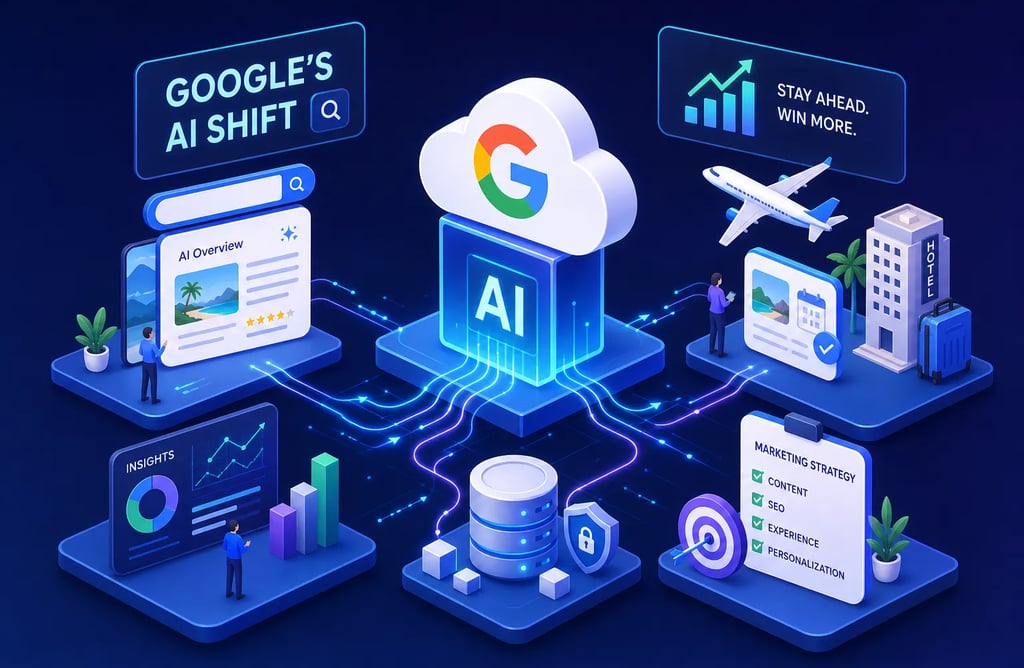
Google's AI Shift: What Travel Marketers Must Know Now
Google's AI shift in travel marketing is already disrupting visibility and direct bookings, and the disruption is moving faster than most brands have registered. Google AI Overviews now appear in roughly 34% of travel searches according to BrightEdge's 2025 travel data, up from essentially zero in 2024. That single statistic should stop every hotel owner, tour operator, and travel agency marketer in their tracks. The search results page that has quietly driven direct bookings across the travel industry for the past decade looks fundamentally different today. AI-generated summaries now occupy prime above-the-fold positions, and traditional organic listings have been compressed further down the page, further from the moment a traveller decides where to go and who to book with.
At Powerful Digital Marketing, we have been tracking this shift closely since the early SGE trials. What we are seeing with travel clients confirms this is not a gradual drift, it is a systemic change to how search works. Brands treating Google's AI shift as a future problem may find they feel the revenue impact before their analytics dashboards make the cause obvious. This article sets out exactly what has changed, where the data is pointing, and the three highest-priority moves your travel brand needs to make right now.
How Google's AI shift is changing the travel SERP
The journey from Search Generative Experience to AI Overviews was more than a rebrand. When Google moved its generative AI features out of Labs and into mainstream Search, it signalled that these were no longer experiments. Gemini's deeper integration has pushed this further still: the AI summary is now the default experience for a growing share of queries, not an occasional feature that appears on niche searches. Travel marketers who still think of this as something happening in a test environment are operating with a dangerous blind spot.
The pace of change is grounded in hard numbers. According to BrightEdge's industry tracking, AI Overviews rose from approximately 25% of all Google queries in August 2024 to 57% more recently, a figure that reflects broad query sets rather than travel-specific searches alone. For travel specifically, BrightEdge data shows the category moved from 0% AI Overview coverage in 2024 to around 34% by 2025, though other benchmarks tracking into 2026 place travel-specific prevalence closer to 11%, highlighting that estimates vary significantly by dataset and query selection. Skift Research has also reported that AI visibility in travel has grown sharply in recent months, a trend consistent across multiple trackers even where exact figures differ. These are not incremental gains. They represent a fundamental reordering of how the search results page is built, and the implications for generative-search marketing in travel are significant.
What the new SERP hierarchy means for traveller discovery
The new page hierarchy changes everything about how travellers discover destinations and suppliers. An AI-generated summary appears at or near the top, often accompanied by structured travel modules: hotel comparison panels, ratings cards, and links to booking platforms. Classic organic listings sit further down, compressed into a narrower band of visible screen space. A traveller researching "best boutique hotels in Charleston" or "10-day tour of Portugal" now encounters an AI answer before they ever reach your website. Whether your brand appears in that answer has become one of the most consequential visibility questions in travel SEO today.
The organic traffic reality most travel brands haven't measured yet
There is a paradox hidden in most travel brands' current analytics data, and it is creating a false sense of security. Impressions are rising as AI Overviews surface travel content more broadly: BrightEdge tracked a 49% increase in impressions across monitored queries over the past year, drawing on their broad keyword tracking dataset. Clicks, however, are moving in the opposite direction. Ahrefs' analysis of 300,000 keywords found that the presence of an AI Overview corresponded to a 34.5% lower average click-through rate for the top-ranking page. Impressions up, clicks down, the two metrics tell completely different stories about what is actually happening to your reach.
Where informational travel content is most exposed
For informational travel content, the impact is sharpest. Seer Interactive's study of 25.1 million impressions across informational queries found that organic CTR fell from 1.76% to 0.61% when an AI Overview was present, a 61% decline. Destination guides, itinerary content, "best hotels in X" articles, and accommodation comparison pages are precisely the content formats that trigger AI summaries, and they are precisely the formats that travel brands invest most heavily in producing. The overlap between "content we have built" and "content taking the biggest CTR hit" is not coincidental. You can read Seer Interactive's findings in more detail here.
Google's counter-argument is worth addressing directly: the company maintains that clicks to sources cited inside AI Overviews carry higher intent than standard organic clicks. There is genuine nuance here. Fewer clicks overall, but the clicks that do happen come from travellers who have already read a summary and want more. That reframes the challenge usefully, the goal is not simply to rank, it is to be cited. Being referenced inside an AI summary with lower click volume may still deliver better-qualified traffic than ranking third in a traditional list. Understanding this distinction is what separates a reactive response from a strategic one in AI-driven travel search. Several industry analyses that dig into the CTR impacts are worth reviewing for context, including a detailed take in Search Engine Land.
Google's AI shift: paid search impacts for travel brands
The visual layout of the paid search results page has changed alongside the organic side. Ads now appear within or adjacent to AI-powered search experiences, which means the placement of a paid listing relative to where a user is already reading has shifted. Travel advertisers drawing conclusions from campaign performance data without accounting for this layout change are likely misreading what their numbers mean. The page a user sees today is not the page your campaigns were built for.
AI Max: Google's claims versus advertiser-reported results
Google's own headline claim for AI Max, its AI-powered optimisation layer for Search campaigns, is compelling: 14 to 27% more conversions at a similar CPA or ROAS when the feature is activated, according to Google Ads documentation. For campaigns still relying heavily on exact and phrase match keywords, Google puts the potential uplift at the higher end of that range. Google also published an overview of AI Max for Search campaigns that summarises how it integrates with existing workflows; you can view Google's announcement here. The reality for some advertisers, however, is more mixed. Some advertiser-reported data has indicated roughly 35% lower ROAS versus traditional match types in certain account configurations, which conflicts sharply with Google's own benchmarks, a gap likely explained by differences in feed quality, account structure, and industry vertical. Travel advertisers running direct booking campaigns should treat AI Max as a structured test rather than a default assumption before committing significant budget.
Publicly available travel-specific CPC data following AI integration remains limited and, where it exists, conflicting, in part because major platforms have not published travel-vertical breakdowns consistently, and independent analyses have used differing query samples. The most reliable evidence for any travel advertiser right now is their own account data. Revisiting bidding strategies, match type configurations, and attribution models with fresh eyes is not optional; it is the minimum required to understand whether campaign performance figures reflect reality or a measurement system that has not caught up with how the results page now works. For a deeper exploration of how AI impacts paid search in travel, consider why Why AI PPC Travel Industry Campaigns Are Changing the Travel Advertising Game is increasingly relevant to advertisers.
Three content moves that earn a place in AI answers
The content types most frequently cited inside AI Overviews share a recognisable structure: they answer specific traveller questions clearly, use descriptive headings, and signal genuine expertise. Hotel Nomad's FAQ-led content approach, documented by Operto, is a clear example of this in practice. Organising content around the questions your guests actually ask, and answering those questions in a format that is easy for AI systems to extract and cite, improves AI search visibility alongside general user experience.
For tour operators and travel agencies, this means auditing existing content to find the gaps where traveller questions are left unanswered or buried inside long paragraphs that AI systems struggle to parse. Adding FAQ schema to these pages is a straightforward structural upgrade that pays dividends in both AI Overviews and standard featured snippets, making it one of the highest-return moves available in travel SEO right now. If you want quick answers to publisher and tool questions, see our piece on Common Questions About AI Marketing Tools for Travel Businesses which addresses many practical implementation concerns.
E-E-A-T signals carry more weight now than at any point in the last decade. Google's AI systems rely on Experience, Expertise, Authoritativeness, and Trustworthiness markers to decide what content is worth citing. Travel brands with thin author credentials, inconsistent NAP data across listings, or sparse review signals are at a deep-rooted disadvantage precisely when the stakes are highest. Tightening these signals is not a box-ticking exercise; it is the baseline required to compete for AI citation in a space where your traveller is making booking decisions before they ever visit your website.
Triumph Hotels' approach offers the clearest commercial signal for travel brands thinking about long-term resilience. According to Revinate's reporting on their direct-booking strategy, the group reduced OTA dependence by up to 20% by building guest relationships and direct-booking infrastructure explicitly designed for the AI era. The principle is straightforward: when AI-mediated search becomes one channel among several rather than the only route to visibility, you are no longer entirely dependent on whether Google chooses to cite you. Building traveller data, loyalty, and direct channels alongside AI-readiness is the architecture-level shift that separates adaptive brands from those waiting for conditions to return to normal.
A 30, 90-day plan to protect visibility and revenue before the next algorithm update
The first 30 days are about measurement, not tactics. Most travel brands' analytics dashboards are currently showing a misleading picture: impressions that look healthy while click volume and organic revenue quietly erode. The priority is to isolate AI Overview-triggered queries inside Google Search Console, segment them by query type (informational versus transactional), and build a baseline that reflects the new SERP reality. Without this audit, you cannot identify which content is actually under threat, and you cannot make defensible decisions about where to focus resources. This step is unglamorous but non-negotiable.
Days 31 to 60 are for restructuring your highest-traffic informational content. Take your destination guides, itinerary pages, and accommodation comparison content and reformat them around clear traveller questions with direct, citable answers. Add FAQ schema. Update or create author bios that demonstrate genuine travel expertise. Consolidate your review signals so they are visible and consistent across platforms. Travel brands working with a specialist partner at this stage can compress the process considerably, because the prioritisation decisions require both content expertise and a working knowledge of how AI Overviews surface travel-specific results. If you need a roadmap for tools, tactics and measurement to support this work, our guide AI Travel Marketing: Tools, Tactics & Real ROI 2026 outlines practical steps and expected outcomes.
Days 61 to 90 are about rebalancing paid strategy and building new visibility metrics. Test AI Max where budgets allow, but define your measurement criteria before scaling spend. Alongside paid search, begin tracking brand mentions and citations inside AI-generated answers as a distinct visibility metric, separate from traditional rank tracking. This kind of blended measurement framework, combining organic citation monitoring with paid performance data, is central to how Powerful Digital Marketing approaches AI-enabled travel advertising with clients. The goal is to ensure that no single channel shift goes undetected and that strategy decisions are based on what the new SERP is actually doing, not what last year's dashboard suggests. For insights into implementing AI-aware paid campaign strategies in travel, revisit our discussion of why Why AI PPC Travel Industry Campaigns Are Changing the Travel Advertising Game.
The advantage belongs to brands that act now
Google's AI shift in travel marketing is not arriving at some future date. For travel marketers, it is already the environment they are operating in, whether or not their measurement systems reflect that yet. The next phase of Gemini integration will push this further, and the brands that have already rebuilt their measurement, content, and paid strategy around the new SERP reality will hold a fundamental advantage over those still optimising for a results page that no longer exists.
The path forward runs through three clear actions: audit your measurement to understand what is genuinely at risk, restructure your informational content for AI citation, and rebalance your paid strategy with AI-era SERP layouts in mind. None of these steps require waiting to see how things develop. Higher impressions, lower CTRs, and eroding click revenue on AI Overview-triggering queries, the data already points clearly in one direction.
Travel brands that want to move through this transition with a clear plan rather than a series of reactive fixes are welcome to start a conversation with Powerful Digital Marketing. We have been building AI-ready travel marketing strategies before most agencies acknowledged the shift was happening, and we bring the travel industry depth to make those strategies work in the real world of seasonal demand, booking intent, and OTA competition.
ADDRESS
The Powerful Group Limited
124 City Road
London
United Kingdom
EC1V 2NX
WORKING HOURS
Monday - Friday 9:00 AM - 6:00 PM
Saturday - Sunday 8:00 AM - 12:00 PM
Want to Call? Ask our Powerful Bot for the Number