
Hotel Instagram Growth in 2026: 90-Day Action Plan
90-day plan to grow your hotel Instagram in 2026. Learn profile optimisation, Reels-led content, hashtag frameworks, influencer ROI and clear tracking.
POWERFUL SOCIAL
Powerful Social
6/15/20268 min read
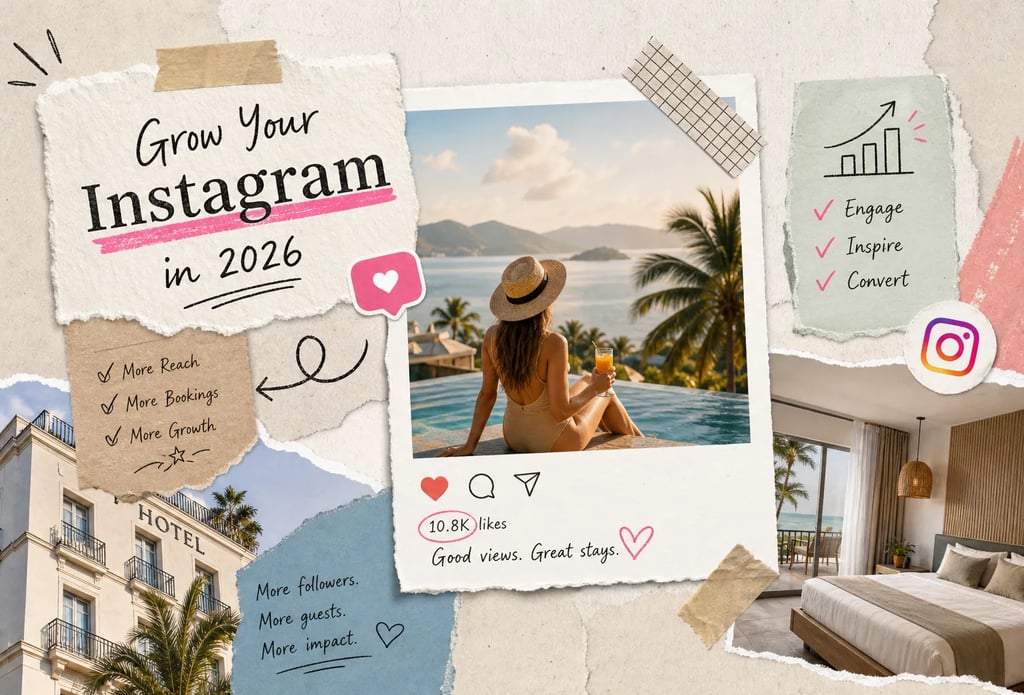
How to Grow Your Hotel's Instagram in 2026
Hotel Instagram growth in 2026 is not about chasing viral moments. It is about showing up consistently in front of the right travellers at exactly the right stage of their booking journey. Current hospitality benchmarks put average engagement rates around 3.1%, and that figure is attainable for many independent hotels with consistent, data-led strategies. Hotels winning on Instagram share one common trait: they treat the platform as a data-informed marketing channel rather than a digital mood board.
This article walks you through a practical 90-day plan for hotel Instagram growth. You will learn how to optimise your profile for discovery, build a content mix anchored by Reels, structure a hashtag framework that actually works, run influencer partnerships that drive measurable bookings, and track the results in a way that makes a business case for every hour your team invests.
Optimise your profile for discovery before you post anything else
Profile optimisation is the unglamorous work that determines whether all your future content actually gets seen. Without a properly structured profile, even your best Reels will struggle to surface in Instagram search or Google results. It is also the most efficient starting point, most hotels can implement all the core changes in a single focused session.
Why your bio and display name carry more weight than most hotels realise
Instagram's 2025 search indexing update changed the rules significantly for hospitality brands. Public posts from Business and Creator accounts are now eligible to appear in Google search results, which means your bio, display name, and username function more like a mini landing page than a casual social profile. The practical formula is straightforward: include your hotel type, location, and a key differentiator in plain language. Something like "Boutique Hotel in Edinburgh | Spa, Dining & Castle Views" tells both the algorithm and a potential guest exactly what you offer and where you are. Vague bios such as "a place to stay and remember" actively hurt discovery because they give search systems nothing to index against meaningful travel intent.
Alt text and captions as organic search tools
Descriptive alt text on every image gives both Instagram's algorithm and external search engines a text-based understanding of your visual content. Many hotel accounts omit alt text entirely, which is a consistently missed opportunity in hotel social media strategy. Compare a vague caption such as "Enjoying Sunday morning" with a keyword-rich alternative: "Breakfast at our rooftop restaurant in Bristol, overlooking the harbour." The second version is more likely to surface for users searching Bristol dining, Bristol hotels, or Bristol weekend breaks, and the same logic applies to alt text fields. These changes compound in value over months and cost nothing beyond a small amount of team time.
The content mix that drives hotel Instagram growth
Hotels that struggle on Instagram typically treat the feed as a single channel, when Instagram actually rewards using multiple formats across different stages of the follower journey. Think of it as a three-layer system: Reels carry the reach, Stories sustain the day-to-day relationship, and carousels deliver depth. Each format does a different job, and combining all three is what builds a sustainable audience of travellers who eventually book.
Why Reels should anchor your whole content strategy
Reels are the primary discovery engine for hotel Instagram accounts in 2026. They reach non-followers far more effectively than any other format, making them the core tool for growing your audience from scratch. Strong content angles include room arrival reveals, local neighbourhood walks, a chef's morning prep routine, and seasonal property moments such as a summer rooftop setup or an autumn fireplace scene. The most important thing to internalise here is that authenticity often outperforms high production value. A steady-hand iPhone Reel filmed in natural light regularly outperforms an over-produced clip that feels like a television advertisement, because travellers are looking for a genuine feel for your property before they commit to a booking.
For hotels weighing longer-form video strategy, see Why Travel Companies Should Rethink YouTube in 2025.
How Stories and carousels build the relationship after the follow
Reach content and retention content serve different purposes, and understanding that distinction changes how you plan your week. Stories are your daily touchpoint with existing followers: behind-the-scenes clips, limited-time offers, polls asking followers to choose between two room views, and FAQ-style Q&As that mirror the conversations a traveller has before booking. Carousels work well for multi-step storytelling, a local area guide, a room feature walkthrough, or a seasonal package breakdown. Saves and shares on carousels send strong engagement signals to the algorithm, extending organic reach well beyond your existing follower base.
Posting cadence and a hashtag framework that works in 2026
The two questions independent hotel teams ask most often are: how often should we post, and which hashtags should we use? The honest answer to both is that consistency beats volume every time. A predictable, sustainable schedule will outperform an erratic burst of posts followed by two weeks of silence.
How often independent hotels should post to stay visible
One workable approach for an independent hotel is three to four Reels per week, daily Stories, and three to four feed posts (carousels or single images) per week. Treat this as a starting point rather than a fixed rule, the right cadence is whichever one your team can maintain without burning out. The algorithm rewards accounts that show up regularly, not accounts that post heavily once a month. A single strong Reel with a compelling caption, descriptive alt text, and relevant audio often outperforms several weak static posts. If your team is stretched, protect the Reels and Stories cadence first, because those two formats do the most work for reach and day-to-day engagement respectively.
Building a layered hashtag strategy for your hotel
Chasing hashtags with tens of millions of posts is ineffective for an independent hotel account because the competition is simply too high for your content to surface meaningfully. A layered approach works far better. Start with one or two branded hashtags and three to four location-specific hashtags covering your city, neighbourhood, and nearest landmark. Add two to three niche descriptors, boutique hotel, spa retreat, adults-only hotel, alongside one or two experiential hashtags aligned with the specific post content, such as weekend getaway or city break. Cap the total at eight to twelve per post and review which hashtag clusters drive the most profile visits each month. Testing and iterating on that data is how you find the combinations that actually move the needle.
Reels best practices to drive hotel Instagram growth
Producing Reels consistently without a dedicated content team is a common concern for independent properties. In practice, the barrier is lower than many hotel marketers expect, provided you focus on a small number of high-performing formats rather than trying to do everything at once.
Content ideas that consistently perform for hospitality accounts
The Reel formats with the strongest track record for hospitality accounts are local storytelling content (hidden gems near the property, staff recommendations, neighbourhood guides), seasonal property moments, arrival and room-reveal clips, and guest experience content captured with permission. Local storytelling performs especially well because it targets travellers searching for destination-specific inspiration rather than just a place to sleep. A Reel showing your team's three favourite coffee shops within walking distance of the hotel serves both a discovery function and a genuine value-add for anyone planning a trip to that city. For practical tactics on boosting interactions and reach, see how to increase Instagram engagement.
Making effective Reels without a production budget
A strong Reel typically relies on four elements: a hook within the first few seconds to stop the scroll (a visual or text overlay), natural light and a steady hand, on-screen text captions for discoverability and accessibility, and trending audio used purposefully rather than arbitrarily. A behind-the-scenes Reel filmed on a phone can outperform a polished promotional video because travellers are drawn to content that feels real. Polish signals advertising; authenticity signals experience, and in travel, that distinction tends to determine whether someone saves a post or scrolls past it.
Influencer stays that generate measurable returns
Influencer partnerships are not a vanity exercise when structured correctly. Independent hotels have a genuine advantage in this space because they can offer a more personal, story-rich experience than chain properties. The key is selecting the right creators and building the collaboration around trackable outcomes rather than follower counts.
Choosing the right creator for your property
Prioritise nano creators (1,000 to 10,000 followers) and micro creators (10,000 to 100,000 followers) over larger accounts. These creators typically deliver higher engagement rates, nano influencers average around 6% on Instagram compared to 1.3% to 2.6% for macro accounts, have more geographically relevant audiences, and bring genuine interest in niche travel experiences. According to industry benchmarks for hospitality influencer marketing, well-matched campaigns can deliver strong returns on ad spend, though results vary significantly by property type, creator fit, and campaign structure. The filter that matters most is audience location and demonstrated travel intent, not follower count. A travel creator based in your target source market with 8,000 engaged followers will drive more relevant bookings than a lifestyle creator with 200,000 followers scattered across unrelated demographics.
Structuring the deal to track actual bookings
A well-structured partnership includes agreed deliverables (number of Reels, Stories, and static posts), a unique tracking link or promo code pointing to your direct booking page, and a timeline aligned with your peak booking window. Complimentary stays are standard for nano creators. Mid-tier campaigns typically run into four to five figures including the stay and creator fee, rising significantly for luxury and macro-influencer partnerships. The tracking link is non-negotiable: engagement metrics alone do not tell you whether the collaboration drove bookings, and without that data you cannot make an informed decision about whether to repeat the investment.
Converting Instagram followers into direct bookings
Everything above builds toward one outcome: travellers who discover your hotel on Instagram and book directly with you rather than through an OTA. That conversion does not happen by accident. It requires tracking the right metrics and structuring your content and bio to move people from discovery to booking intent.
The metrics that tell you if Instagram is actually working
Go beyond follower count and likes. The metrics that matter for a hotel are link clicks from the bio tracked via UTM parameters into your booking engine, saves (which signal high booking intent and extend post life in the algorithm), DMs from potential guests, and profile visits following a Reel. Use UTM parameters on every Instagram link that points to your booking page so GA4 can record the traffic source accurately. A standard tagged URL looks like: https://hotel.com/book?utm_source=instagram&utm_medium=social&utm_campaign=summer_offer&utm_content=bio_link. Track assisted conversions in Google Analytics 4 as well, because Instagram frequently plays a role earlier in the booking journey than last-click attribution reveals. A 3.1% engagement rate is a widely cited hospitality benchmark and a useful directional target, though it is worth pairing with conversion metrics, UTM-tagged bookings and assisted conversions, to assess real commercial impact rather than relying on engagement alone.
Why independent hotel teams are turning to AI-powered social management
Running a consistent Reels schedule, monitoring hashtag performance, responding to DMs, tracking UTM data, and iterating on content based on what actually converts is a significant operational commitment for a team that also runs a hotel. This is where the bandwidth problem becomes real, and it is where many independent properties stall despite having the right strategy in place. AI-powered social media management offers AI-driven content performance analysis with travel industry expertise, so the content that gets scheduled is informed by booking intent data rather than gut feel. For independent hotels, working with a specialist that understands traveller psychology, seasonal demand patterns, and the competitive dynamics of the hotel sector can make a meaningful difference to how a strategy translates into results.
Your 90-day action plan starts today
The path forward is clear and sequential. Spend week one on profile and Instagram SEO for hotels: update your display name, bio, and alt text practices before a single new post goes live. Weeks two to four are about establishing a Reels and Stories rhythm at a cadence your team can sustain. In month two, layer in your hashtag framework and run your first influencer collaboration, timed to your next peak booking window. In month three, pull your GA4 data, review which content drove link clicks and bookings, and double down on what is working.
A sustainable hotel Instagram growth strategy is a compounding one. Each optimised post, each consistent week of Stories, and each well-chosen creator partnership builds on the last. The hotels winning on Instagram are not the ones with the biggest budgets, they are the ones that show up consistently with content that feels real and is structured to get found. Prioritise hotel Instagram growth by starting with the profile today, because everything else builds from there. If you want a partner that understands both the AI side and the travel industry, Powerful Digital Marketing works with independent hotels to turn Instagram strategy into direct bookings.
ADDRESS
The Powerful Group Limited
124 City Road
London
United Kingdom
EC1V 2NX
WORKING HOURS
Monday - Friday 9:00 AM - 6:00 PM
Saturday - Sunday 8:00 AM - 12:00 PM
Want to Call? Ask our Powerful Bot for the Number