
PPC Strategies for Tour Operators to Win Bookings in 2026
Learn a practical PPC framework for tour operators to drive direct bookings: campaign types, seasonal bidding, audience layering, and conversion tracking.
POWERFUL CLICKS - AFFORDABLE SEO AND PPC
Powerful Digital Marketing
6/15/20269 min read
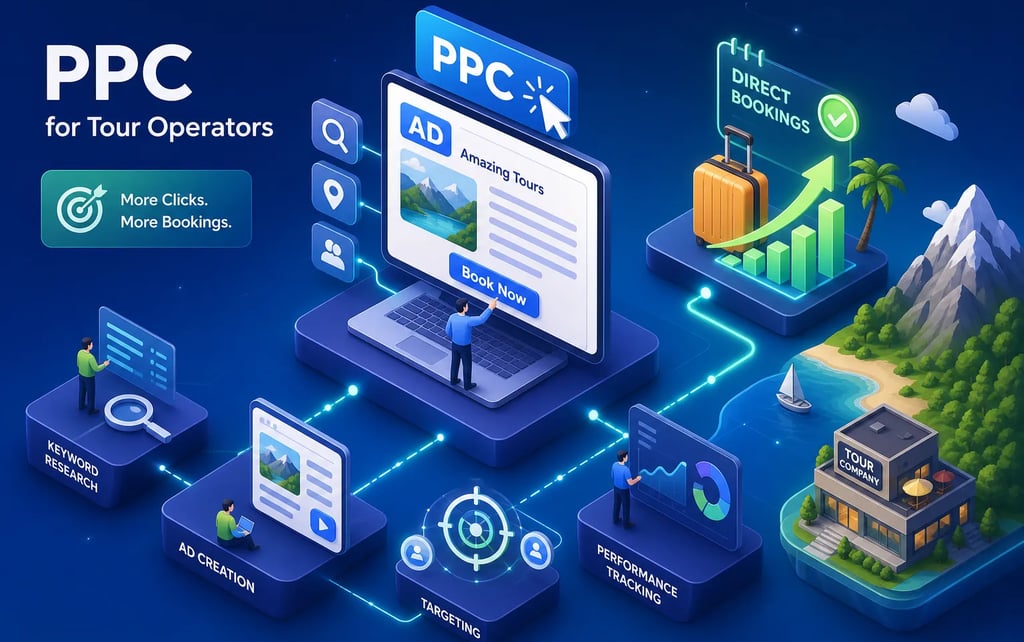
PPC Strategies Tour Operators Should Use to Win Direct Bookings in 2026
What is the most effective PPC strategy for tour operators trying to drive direct bookings? It starts with paid search built deliberately around direct-booking intent, not generic traffic acquisition and a hope for the best. Tour operators spend years refining their products, building their brand, and earning traveller trust. Then a booking comes in through Expedia or Booking.com, and a substantial slice of that revenue walks straight out the door in OTA commission, commonly a significant double-digit percentage, according to industry contract analyses. Paid search changes that equation, but only when the architecture is designed from the ground up to capture and convert booking intent.
This article lays out a practical PPC framework for tour operators: the campaign types that actually work, bidding strategies tied to how tours sell seasonally, the audience structure that recovers lost bookings, and the tracking setup that lets you measure real cost per acquisition rather than vanity metrics. Every recommendation here reflects the approach used at Powerful Digital Marketing, a London-based AI-powered travel marketing agency that works exclusively with travel brands competing in one of the most expensive ad auctions in digital marketing.
What is the most effective PPC strategy for tour operators trying to drive direct bookings?
The short answer: a joined-up system where campaign type, bidding strategy, audience layering, and conversion tracking are built to work together, not a collection of individual tactics pointing in slightly different directions. Understanding which campaign types form the backbone of that system is the logical starting point.
The campaign types that actually drive direct bookings
Not all campaign types are built equally for direct-booking intent, and spreading budget across every format Google offers is one of the fastest ways to waste it. For tour operators, the campaign hierarchy is clear.
Search campaigns are the foundation. When someone types "3-day safari Kenya" or "boat tour Barcelona" into Google, they are telling you exactly what they want and when they want it. That real-time intent signal is what makes Search the most reliable path to a confirmed booking. Travel and hospitality search campaigns average a 5.36% click-through rate, and conversion rates on well-optimised Search accounts typically sit at 5.75% for in-market audiences, figures drawn from aggregated travel industry benchmark data. No other campaign type matches that combination of intent and conversion probability.
When to use Performance Max
Performance Max belongs in the account, but not as the primary engine. It works as an incremental growth layer once your Search campaigns are converting consistently and you have enough conversion data for Google's machine learning to work properly. Operators who launch PMax before Search is stable often find the algorithm optimising toward the easiest conversions, frequently brand searches that would have converted anyway, rather than net-new direct bookings.
Branded search campaigns are non-negotiable and deserve their own dedicated budget. OTAs actively bid on tour operator brand names, which means a traveller who already knows your business and searches for it by name can end up clicking an Expedia ad and generating a commission cost on a booking that was already yours. A tightly structured branded campaign using exact match keywords recaptures that traffic at a cost that is typically far lower than the OTA commission you would otherwise pay.
Bidding strategies that match how tours actually sell
Smart Bidding works, but it needs data and a strategy matched to where the account sits in its maturity cycle. The data volume requirement is the critical limiting factor: Google's value-based bidding needs sufficient conversion signals before it can make reliable decisions. Launching Target ROAS on an account with limited conversion history, Google generally recommends a minimum of around 30 to 50 conversions per month for value-based strategies to function well, is a reliable way to stall performance before it starts.
New campaigns or accounts with limited conversion history should start on Maximise Conversions. This strategy feeds Google the booking signals it needs to learn without requiring you to commit to a precise CPA target upfront. Set a sensible daily budget, define your conversion actions correctly (more on that shortly), and let the account build its data foundation over four to six weeks, or until you have sufficient conversion volume, before changing strategy.
Which bidding strategy to use and when
Once conversion volume is stable, the shift to Target CPA or Target ROAS unlocks genuine efficiency gains. Target CPA works well during shoulder seasons when demand softens and the priority is controlling acquisition cost rather than chasing volume. Target ROAS suits multi-day or luxury tours where revenue per booking justifies a more aggressive return target. Industry benchmarks indicate that paid search ROAS typically runs between 4x and 8x for tour operators, while high-intent metasearch audiences can reach 8x to 13x. For further reading on the metasearch cost models that influence those returns, see the discussion on CPC or CPA on metasearch. A paid search CPA of approximately £40, £55 (USD $50, $70 by common benchmark) is realistic for many operators; on a tour priced at around £240 (USD $300), a sustainable ceiling for a 3:1 LTV ratio sits at roughly £80 (USD $100). These figures vary considerably by market, ticket price, and product type.
Seasonal pacing is where most tour operators leave money on the table. The instinct is to increase spend during peak booking periods, but CPC is also at its peak during those windows, driven up by competing operators and OTAs with much larger budgets. The smarter move is to raise bids and budgets in the weeks before search volume peaks, capturing intent earlier in the consideration window when competition is lower and the cost per click is more manageable.
The audience stack that recovers lost bookings
Most paid search accounts treat audiences as an afterthought. For tour operators, a layered audience strategy can meaningfully reduce CPA by concentrating spend on the people most likely to complete a booking, rather than treating every site visitor the same.
Cart abandoners are your highest-converting retargeting segment. These are travellers who selected a tour, started checkout, and left without completing the booking. They have already moved through consideration and into decision; all they need is a well-timed reminder with a clear call to action. Segmenting this audience separately and bidding more aggressively on it than general site visitors is one of the highest-return adjustments available in a mature account.
The next tier covers high-intent visitors: people who viewed specific tour detail pages, checked availability, or returned to the site more than once within a short window. Segment these audiences by the specific tours or destinations they viewed, and serve ads that reference what they looked at rather than generic brand messages. Customer match lists built from past guest email data add a further layer, enabling personalised messaging to travellers who have already trusted your brand once and are statistically more likely to book again.
Similar audiences sit at the top of the funnel, not the bottom. They are useful for reaching new prospects who resemble past bookers, but they should not be expected to convert at the same rate as your cart abandoner or intent visitor segments. Treat them as the mechanism for feeding new qualified traffic into the top of the funnel while your retargeting audiences handle conversion closer to the booking decision.
Tracking the bookings that actually matter
A PPC account is only as reliable as its tracking. The most common problem in tour operator accounts is optimising toward the wrong signal, such as "thank you page visits" or "form submissions", rather than confirmed, revenue-generating bookings.
GA4 should capture every meaningful step in the booking funnel: availability search, checkout start, payment initiation, and confirmed booking. Server-side tagging through Google Tag Manager improves data accuracy by reducing reliance on browser-side execution, an increasingly important consideration as ad blocker adoption now affects an estimated 40% of desktop sessions in key travel markets and cookie restrictions continue to tighten. The architecture involves routing web collection through a server container, which then forwards enriched event data downstream. For a practical introduction to implementing that architecture, see this introduction to server-side tagging with Google Tag Manager, and for a technical perspective on the same topic consult Simo Ahava's server-side tagging guide. This gives you cleaner data, better attribution, and a more reliable foundation for Smart Bidding.
The most important tracking upgrade for tour operators is offline conversion imports. When a booking completes or is later cancelled, that final status lives in your booking management system or CRM, not on the website. Importing that confirmed booking data back into Google Ads, matched via the stored click identifier from the original ad click, allows Smart Bidding to optimise toward actual confirmed revenue rather than sessions or form fills. For operators using FareHarbor, there are practical walkthroughs on how to track Google Ads conversions from FareHarbor reservations that can help with the mapping and import process. This is the structural difference between a campaign that looks efficient in the dashboard and one that genuinely is generating profitable direct bookings.
If your site converts below 2%, your CPA will appear artificially high regardless of bid strategy. To put this in concrete terms: at 1% conversion, you need 100 paid clicks to generate one booking; at 3%, you need roughly 33. The same spend produces three times the bookings simply by improving on-site conversion. Clear booking flows, fast mobile load times, and a frictionless checkout are prerequisites, not optional improvements.
Landing pages, seasonal planning, and building a system that compounds
A well-built PPC campaign that sends traffic to a generic homepage or a broad tours category page is a traffic acquisition exercise, not a booking engine. Tour-specific landing pages, matched tightly to the ad's message and keyword, remove the friction between click and confirmed booking.
The highest-impact elements on a tour booking landing page deserve individual attention. Start with a headline that mirrors the ad promise, this confirms to the visitor they have landed in the right place. Pair it with a compelling destination visual above the fold, transparent pricing or a clear "from" price, and a single specific CTA such as "Check Dates and Reserve." Trust signals, reviews, ratings, cancellation policy, should sit directly adjacent to the booking action, not buried in the footer. Removing navigation menus, minimising footer distractions, and keeping the page focused on one conversion goal consistently improves performance for paid traffic. For mobile, which carries a significant share of travel search, tap-friendly buttons and sub-three-second load times are baseline requirements.
Seasonal campaign planning is the final piece that turns individual tactics into a compounding system. Most tour bookings are planned weeks or months before departure, which means your campaign calendar should be built around the booking intent curve, not the travel dates. Awareness and consideration messaging should run in the early planning phase; retargeting and more specific offer-led messaging should intensify as the decision window approaches; and branded protection campaigns should run year-round, regardless of season, to prevent OTA commission leakage on demand you have already earned.
How Powerful Digital Marketing builds direct-booking PPC systems for tour operators
Building a PPC system that covers campaign structure, bidding strategy, audience layering, conversion tracking, and landing page alignment is not a one-time project. It requires ongoing optimisation rooted in a genuine understanding of travel booking psychology, OTA competitive dynamics, and the way seasonality distorts both demand and cost.
At Powerful Digital Marketing, we build paid search accounts for tour operators from the ground up with direct bookings as the primary objective, not an afterthought adapted from a generic e-commerce template. Our combination of AI-driven audience targeting and hands-on travel industry expertise means we understand why a traveller searches in January for a May departure, why branded search defence is a revenue protection strategy rather than a vanity spend, and how to structure conversion tracking in booking platforms like FareHarbor so that Smart Bidding is optimising toward real confirmed revenue. Read more about our approach in Travel PPC Advertising: Strategies to Drive Bookings.
If you want a direct-booking PPC strategy for tour operators built around your specific routes, seasons, and audience, the next step is a direct conversation. Reach out to Powerful Digital Marketing to discuss effective PPC strategies and what a direct-booking system would look like for your business.
The most effective PPC strategy for a tour operator is not a single tactic, it is a joined-up system where Search campaigns capture intent, Smart Bidding converts it efficiently, retargeting recovers what the funnel loses, accurate tracking makes the whole thing measurable, and landing pages close the gap between click and confirmed booking. When those elements are built together with the nuance that travel seasonality and OTA competition demand, paid search becomes one of the most cost-effective tools available for growing direct revenue.
Frequently asked questions
What is the most effective PPC strategy for tour operators trying to drive direct bookings?
The most effective approach is a joined-up system rather than a single tactic. Search campaigns capture high-intent traffic, Smart Bidding converts it efficiently once the account has sufficient data, a layered retargeting audience recovers abandoners, offline conversion imports give the bidding algorithm accurate signals, and tour-specific landing pages close the gap between click and confirmed booking. Each element reinforces the others.
How much should a tour operator spend on PPC before expecting results?
Budget thresholds depend on your average booking value and market, but the data-volume requirement for Smart Bidding is a useful guide. Aim to generate enough conversions within four to six weeks, or as quickly as volume allows, to move from Maximise Conversions into a Target CPA or Target ROAS strategy. For operators looking for lower-cost options or phased approaches, see guidance on affordable SEO & PPC for travel brands. Starting with a budget that cannot sustain meaningful click volume will slow the learning phase considerably.
Should tour operators use Performance Max or Search campaigns?
Both, but in a clear hierarchy. Search campaigns should be the primary driver of direct bookings. Performance Max works as an incremental growth layer once Search is converting consistently and you have the conversion data Google's machine learning needs to function properly. Launching PMax first risks the algorithm defaulting to brand searches that would have converted regardless.
How do OTAs affect a tour operator's PPC strategy?
OTAs bid on tour operator brand names, which means potential bookers who already know your brand can be intercepted and converted via an OTA, generating a commission cost on demand you had already earned. A dedicated branded search campaign with exact match keywords is the primary defence. It is also worth structuring your non-brand campaigns to win intent-based searches before travellers reach the OTA listing stage.
What conversion tracking setup do tour operators need for PPC?
At minimum: GA4 tracking across the full booking funnel (availability search, checkout start, payment, confirmed booking), server-side tagging via Google Tag Manager for accuracy, and offline conversion imports that bring confirmed booking status from your booking system back into Google Ads. This last step is what allows Smart Bidding to optimise toward real revenue rather than form fills or page visits.
ADDRESS
The Powerful Group Limited
124 City Road
London
United Kingdom
EC1V 2NX
WORKING HOURS
Monday - Friday 9:00 AM - 6:00 PM
Saturday - Sunday 8:00 AM - 12:00 PM
Want to Call? Ask our Powerful Bot for the Number