
SEO Agency: How to Choose the Right One for Your Business
Find the right SEO agency for your travel business. Learn which travel-specific questions to ask, contract traps to avoid, and realistic results timelines.
POWERFUL CLICKS - AFFORDABLE SEO AND PPC
Powerful Clicks
7/16/20269 min read
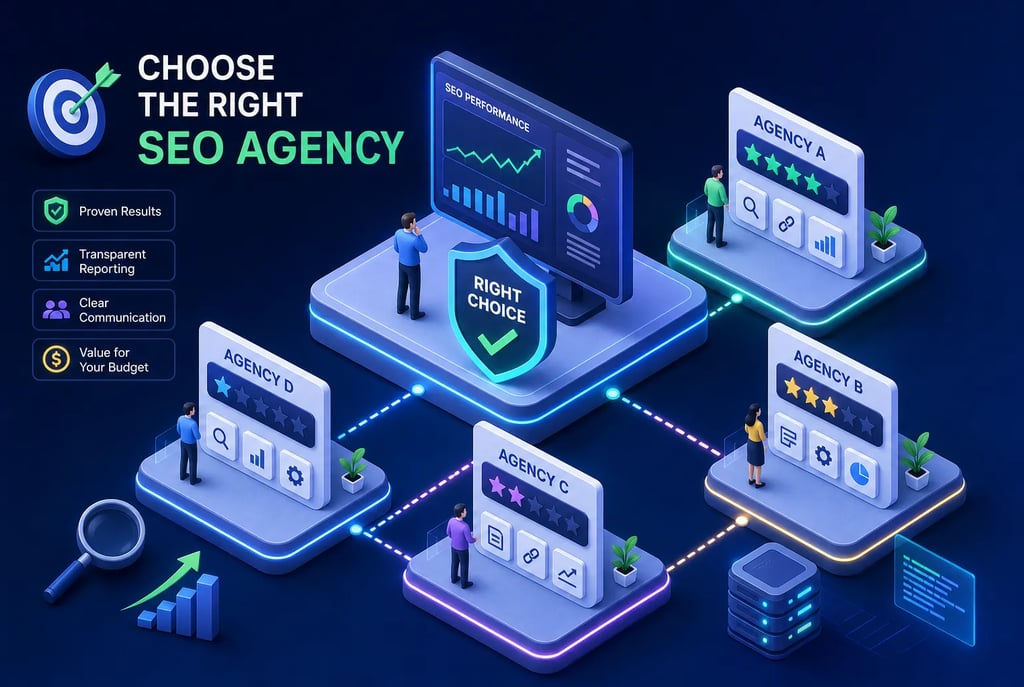
How to Choose the Right SEO Agency for Your Business
Many travel brands invest in an SEO agency and wait. Six months later, rankings have nudged up for keywords nobody actually books from. Industry agency reviews and post-mortems suggest this outcome is far more common than it should be. The problem is rarely the investment; it is the mismatch between a generalist agency and the very specific way travellers search, compare, and book. A travel-specialist SEO agency, such as London-based Powerful Digital Marketing, works from an entirely different playbook: one built around seasonal intent shifts, booking windows, and destination-level search behaviour rather than generic organic traffic goals.
This guide covers how to evaluate any SEO agency you are considering, the questions that separate serious candidates from order-takers, the contract traps to avoid, and the results timeline you should genuinely expect before you sign.
Why generalist SEO companies fall short for travel brands
Travel search behaviour doesn't follow standard SEO patterns
Travellers search in layered, non-linear ways: inspiration queries, destination comparisons, booking intent, and post-booking reassurance all happen across different sessions and devices, often weeks apart. Many SEO consultants whose experience is rooted in eCommerce or B2B SaaS have no established model for this funnel. They optimise for consistent volume, not for the emotional and practical stages a traveller moves through before parting with £2,000 on a family holiday.
Seasonal demand spikes add another layer of complexity. Summer holidays, half-term breaks, and winter sun searches require proactive keyword and content planning months in advance. A generalist organic search agency applying a flat monthly content calendar will structurally miss these peaks, publishing destination content after the booking window has already closed.
Booking cycles demand a different kind of organic strategy
For many travel categories, peak search activity runs several weeks to a few months before departure, meaning SEO work must be timed around booking cycles rather than search volume trends alone. When an SEO agency optimises for steady monthly traffic growth, it misses the fact that a piece of content needs to rank before the spike arrives, not during it. Forward planning, seasonal content refreshes, and a clear understanding of how travellers shift from research mode to purchase mode are all non-negotiable.
This is precisely why a travel-calibrated organic strategy produces different results to a generic retainer. When the agency already understands how booking windows work, content calendars align with them by design rather than by accident.
The content gap that generic agencies create
Destination pages, itinerary content, and trust-building editorial such as travel guides and reviews require genuine sector knowledge to execute well. Generic content production pipelines generate articles that could apply to any industry: technically correct, strategically empty. Google's Helpful Content updates have made this gap more costly than ever, with travel sites relying on thin, experience-free content seeing significant visibility drops. The algorithm specifically rewards demonstrated expertise and authentic first-hand knowledge in the travel category, and no amount of keyword density compensates for its absence.
The questions to ask any SEO agency before you commit
"Show me travel-specific case studies with booking or revenue data"
Traffic metrics alone are insufficient proof of capability. Any capable SEO firm should be able to show organic traffic growth tied to actual conversion outcomes: enquiry form completions, direct bookings, or measurable call volume for a travel client. A polished deck showing impressions and average positions tells you almost nothing about whether the agency understands the travel booking funnel. Ask for specific examples, specific clients, and specific results tied to revenue.
Credible evidence includes organic sessions up 80 to 154% year-on-year for a travel client, tied to a documented increase in direct booking conversions (see LOCALiQ travel case studies for published benchmarks). Vague references to "improved visibility" for unnamed clients in unnamed sectors should be treated as a pass.
"How do you handle seasonal keyword strategy and demand peaks?"
This single question filters out most generalist agencies immediately. A travel-literate SEO agency will discuss content calendars aligned to booking windows, destination page refreshes timed to peak search periods, and deliberate effort allocation between quiet and high-intent months. A generalist will describe a consistent monthly output schedule that takes no account of when your customers actually search.
If the agency cannot describe your specific peak booking windows without prompting, they are not ready to run your organic strategy.
"Who is actually working on my account?"
Account structure matters more than most travel brands realise before they sign. Ask whether they assign a dedicated strategist with travel sector experience, or rotate accounts across a junior team managing a large portfolio of unrelated clients. Find out how many accounts a single manager handles and what the escalation process looks like. Smaller specialist firms frequently outperform large generalist agencies on this metric: fewer clients per strategist, deeper sector knowledge, and no dilution of attention across unrelated industries.
Red flags that should stop you signing the contract
Guaranteed rankings promises
This is the clearest signal that an agency is either inexperienced or dishonest. No reputable SEO firm in the UK or anywhere else can guarantee specific search rankings. Google's own published guidelines explicitly state that no one can guarantee a number-one position, and any agency claiming otherwise is either setting you up for disappointment or using tactics that put your domain at risk of a penalty. Walk away from any pitch that includes guaranteed positions as a selling point.
Vague deliverables and no defined reporting cadence
There is a meaningful difference between a contract listing concrete monthly outputs and one promising to "improve your SEO." Standard UK retainer deliverables at a reputable SEO firm should include an initial technical audit, at least two optimised content pieces per month, 30 or more link outreach attempts, monthly performance reports, and quarterly strategy reviews. If the contract does not specify at this level of detail, the agency has given themselves licence to underdeliver without consequence.
The reporting cadence matters equally. Monthly reports should cover organic traffic, keyword rankings, conversion rates, crawl errors, Core Web Vitals, and link acquisition. Quarterly reviews should include roadmap updates aligned to actual performance data. Anything less is insufficient oversight for a retained engagement.
No evidence of travel industry knowledge in the pitch
If the agency's pitch deck contains no travel examples, uses language borrowed from another sector, or cannot explain what a booking conversion looks like in your specific business model, the conversation is over. The cost of re-doing poor SEO work always exceeds the cost of selecting the right specialist at the outset. Twelve months of misaligned effort produces content that doesn't convert, links that don't signal authority in travel, and rankings for terms your customers don't actually search.
What a proper travel SEO agency retainer actually includes
Technical SEO foundations built for travel sites
A legitimate retainer starts with a comprehensive technical audit covering site speed, Core Web Vitals, mobile performance, crawl errors, and structured data for travel-specific content including destinations, FAQs, and reviews. These foundations matter especially for travel sites because page speed directly affects conversion during high-intent booking moments on mobile. A traveller deciding between two tour operators on their phone will not wait for a slow page to load; they will simply book elsewhere.
Content and keyword strategy aligned to traveller intent
Ongoing content delivery should include destination landing pages, seasonal editorial, FAQ content targeting informational queries, and regular optimisation of existing high-traffic pages. The keyword strategy must map to actual booking intent rather than raw volume. A term like "things to do in Tuscany" attracts very different intent to "small group Tuscany tour 7 days"; a travel SEO specialist understands which one is closer to a booking and builds content accordingly. For brands with multiple locations or regional branches, local SEO considerations, including localised landing pages and Google Business Profile optimisation, should also feature in the retainer scope.
Reporting KPIs that reflect real travel business goals
Vanity metrics such as impressions and average position tell you very little about whether your organic strategy is producing bookings. Meaningful travel business KPIs include organic revenue contribution, assisted booking conversions, non-branded organic traffic growth, and share of voice against competitors. A serious travel SEO agency should be reporting at this level from month one, not switching to revenue metrics only after you ask.
SEO agency pricing, contracts and terms UK travel brands should know
What a realistic SEO retainer budget looks like in 2026
The UK SEO retainer pricing landscape is straightforward once you understand what each tier actually buys. Monthly retainers for small travel businesses typically run from £500 to £2,000, with some entry-level local packages starting lower. Growing SMBs should expect £2,000 to £5,000 for a comprehensive regional strategy including content creation and link building. National strategies with advanced technical work and dedicated account management sit from £5,000 upward, with enterprise-level campaigns often exceeding £10,000 per month. The cheapest option almost never delivers the travel-specific expertise that moves bookings: a race-to-the-bottom budget buys generic work from a team with no sector knowledge, and that false economy typically becomes apparent within the first few months. For independent pricing benchmarks and a clearer breakdown of what different retainer tiers buy, see this SEO pricing guide.
Contract clauses that can trap you
Before signing, scrutinise these specific terms. Minimum contract lengths of 6 to 12 months are standard and reasonable; anything beyond 12 months warrants caution. Notice periods of 30 days are fair; longer ones are a red flag. Auto-renewal clauses with narrow cancellation windows, sometimes as short as 14 days, can lock you into another full term before you realise the window has passed. Also watch for prepaid fee policies on early termination: confirm in writing whether fees for future periods are returned if you exit with proper notice.
Broad scope language is equally dangerous. Contracts promising to "boost SEO" without listing specific monthly deliverables give the agency too much latitude to underdeliver. Worth noting on the legal side: under the Unfair Contract Terms Act 1977, blanket liability caps in B2B contracts must be reasonable, but enforcing that after the fact is painful and expensive. (For practical help drafting or reviewing terms, an SEO contract template can be a useful reference.)
What good contract terms look like
A fair, transparent SEO retainer agreement should contain itemised monthly deliverables, clearly defined KPIs, a 6-month initial term with rolling monthly arrangements thereafter, a 30-day notice clause, and a data processing addendum compliant with UK GDPR. If you can see exactly what you are getting each month and exactly how performance will be measured, the agency has little room to hide underperformance behind ambiguity.
Realistic result timelines: what to expect at 3, 6, and 12 months
Month 3: foundations, not rankings
Set accurate expectations for the first quarter. Most legitimate SEO campaigns show progress in impressions and crawl health rather than dramatic ranking jumps this early. This phase is about fixing technical issues, establishing content infrastructure, and building the signals Google needs to reassess the site's authority. Any agency promising significant traffic gains by month three is either working on low-volume keywords your customers rarely search, or overpromising to win the business.
Month 6: the momentum shift
A well-run travel SEO campaign at the six-month mark should be delivering measurable growth in non-branded organic sessions, page-one rankings for mid-funnel destination queries, and the beginning of trackable conversion contribution from organic. For travel brands, this period is critical: the ranking equity built during months one to six becomes the foundation for capturing an upcoming peak booking season. Missing this window means waiting another full cycle before the content can perform.
Month 12 and beyond: where revenue shows up
The 12-month mark is when a properly executed organic search strategy should produce clear revenue attribution. Organic traffic contributing to direct bookings, reduced OTA dependency, and compounding returns from the content built in months one to six all become measurable. Ahrefs data shows that only around 5.7% of new pages reach the top ten within a year, which is precisely why the quality of the work done in months one through six determines outcomes at month twelve.
The cost of switching agencies at month eight is not just financial. It is the wasted compounding value of work that should have been done correctly from day one: the content signals, the link authority, the technical credibility. Choosing the right SEO partner at the outset matters because the alternative is starting the clock again.
Make the right choice before you sign
Choosing an SEO agency is one of the highest-leverage decisions a travel business makes. The wrong choice means 12 months of effort optimised for the wrong signals, generic content that doesn't convert travellers, and reporting that looks impressive on slides but doesn't show up in your booking system. The right choice is a firm that already understands how your customers search, when they book, and what they need to see before they commit.
For travel brands specifically, that means looking beyond general SEO credentials and asking the harder questions: about travel case studies, seasonal strategy, booking-focused KPIs, and the people actually doing the work. Powerful Digital Marketing is built entirely around this challenge, combining travel sector depth with AI-driven campaign intelligence so that every piece of organic search work is calibrated to the way real travellers behave online. Learn more about the importance of SEO strategy for travel companies.
The checklist from this guide gives you everything you need to run a rigorous evaluation, identify the red flags early, and invest with confidence in an SEO partner that actually understands your market. If you would like to discuss how a travel-specialist approach could work for your brand, speak to Powerful Digital Marketing directly, book a free consultation to get started. For a forward-looking strategy framework and trends to watch, see Travel SEO 2026: Master SEO for Travel Brands & Tours.
ADDRESS
The Powerful Group Limited
124 City Road
London
United Kingdom
EC1V 2NX
WORKING HOURS
Monday - Friday 9:00 AM - 6:00 PM
Saturday - Sunday 8:00 AM - 12:00 PM
Want to Call? Ask our Powerful Bot for the Number