
Small Tour Operators: Compete with OTAs Using AI - 90 Days
Learn how small tour operators use AI to beat OTAs and win direct bookings. Get chatbots, personalisation, pricing tactics, and a 90-day roadmap.
AI IN TRAVELTRAVEL MARKETING
Powerful Digital Marketing
6/13/20268 min read
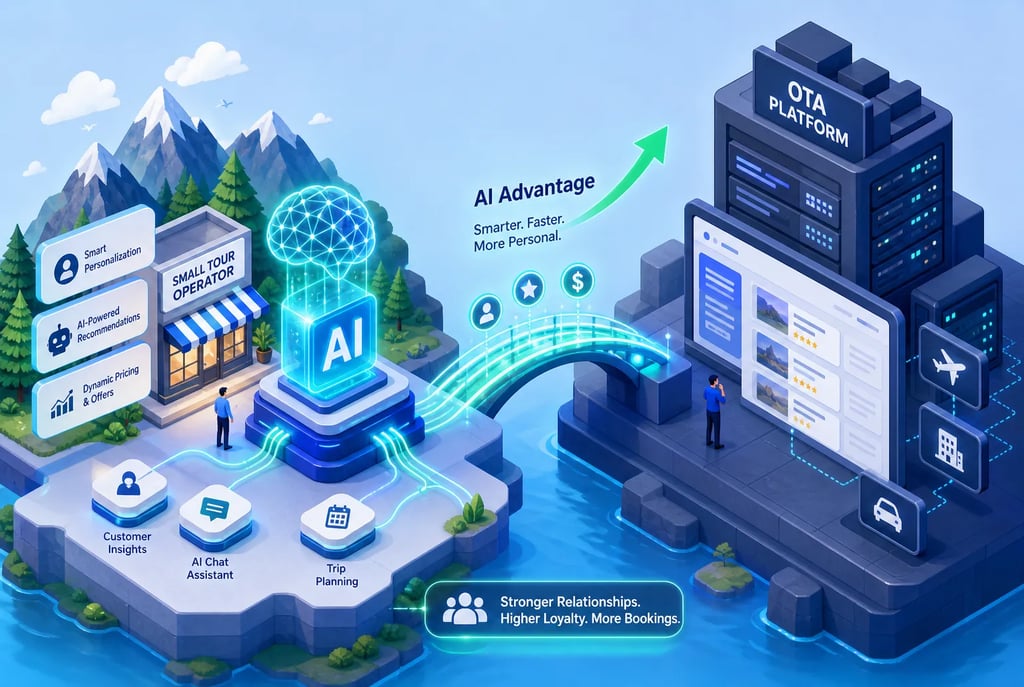
How Small Tour Operators Can Compete with OTAs Using AI
How can small tour operators use AI to compete with major OTAs and win more direct bookings? It is a question that feels daunting when you consider the firepower on the other side. Expedia and Booking.com invest heavily to make their platforms the first and last stop in every traveller's booking journey. They deploy AI across search discovery, dynamic packaging, and conversational assistants, pulling the decision point further upstream so that by the time a traveller is ready to book, they may not even need to visit a tour operator's website. For a small operator running lean with a tight budget and a small team, that sounds like a fight you cannot win.
It isn't. AI tooling has become genuinely affordable, and the personalised, high-intent experience that small operators can deliver is something OTAs struggle to replicate at scale, their strength is breadth, not depth. According to a 2025 Arival survey, OTAs currently account for around 37% of tours and experiences bookings globally, with 25% booked direct through operator websites; every percentage point you shift back to direct means real margin recovered. This article gives you a concrete strategy, a practical toolstack, and a 90-day roadmap to start doing exactly that. At Powerful Digital Marketing , we work exclusively with travel brands to help them access the same AI-powered edge the major OTAs already have, without the enterprise price tag.
What the OTA AI machine is actually doing to your direct bookings
The threat from OTA AI is not abstract. Expedia's Romie assistant, launched in 2024 and now integrated across the Expedia app, can ingest a traveller's emails and SMS conversations, pull trip preferences, and feed everything into a seamless Expedia booking experience without the user ever typing a search query. Booking.com's Smart Filter and AI-generated Review Summaries compress the research phase, making it faster and stickier inside their funnel. Dynamic pricing and packaging tools bundle flights, hotels, and activities into personalised offers in real time, raising conversion at every step and leaving little reason for a traveller to look elsewhere.
The most significant emerging threat is agentic AI. When a traveller delegates trip planning to an AI assistant and that assistant researches, compares, and completes the booking on their behalf, your website simply never enters the picture. Consumer AI assistants capable of completing purchases end-to-end are already in early adoption, and industry analysts widely expect agentic booking to become mainstream behaviour within the next two to three years. Most small operators are entirely unprepared for this upstream shift. Large operators have brand recognition, direct CRM relationships, and marketing budgets to fight back. Small operators have none of those defences yet, which is precisely why deploying AI-driven direct booking strategies now, before agentic AI becomes mainstream consumer behaviour, is your strategic window.
How small tour operators can use AI to compete with OTAs and win direct bookings
Conversational booking bots are the highest-impact tactic for small operators, and the logic is straightforward: your traffic volumes are lower than an OTA's, so every active visitor represents meaningful revenue. When a prospective guest lands on your site with a question about group sizes, itinerary flexibility, or departure dates and finds no immediate answer, they leave. An AI chat assistant, such as Tidio or HubSpot's chatbot, removes that friction in real time. Zoover reported a 3 to 5 times higher conversion rate among travellers who interacted with their AI agent (Zoover case study, 2024), and Travelbase achieved up to 30% more bookings after deploying AI-powered chat and email personalisation, results worth noting as directional benchmarks rather than guaranteed outcomes for every operator. For practical industry examples, Arival publish several useful tour operator use cases for AI automation that illustrate tactics you can adapt to your operation (tour operator use cases for AI automation).
On-site personalisation does not require a custom AI build. Lightweight tools built on HubSpot or Make.com workflows can surface the right tour or package based on a visitor's browsing behaviour, referral source, or previous interactions. According to research by Barilliance, AI-driven on-site product recommendations typically lift conversion rates in the 10 to 30% range, and for a small operator that can represent a meaningful revenue shift without requiring additional traffic. The goal is relevance at the moment of intent, not clever technology for its own sake, and there is growing guidance on how AI can improve direct booking experiences for operators and short-term rental sites (how AI is transforming direct booking websites).
Email personalisation is the secondary lever, strongest for reactivating past guests and nurturing warm enquiries that did not convert immediately. According to Mailchimp's Email Marketing Benchmarks, AI-optimised send times and subject lines can deliver substantially higher click and open rates compared with untargeted broadcasts, the gains depend on your list quality and segmentation, but the directional improvement is consistent. Email rarely replaces in-session conversion as a direct booking driver, but it keeps your brand in the consideration set between someone's first enquiry and their booking decision.
Closing the discovery gap with AI-driven SEO and OTA displacement tactics
Travel search behaviour is layered with intent signals that standard SEO approaches miss entirely. A traveller searching "small group tours Patagonia October" is considerably closer to booking than one searching "Patagonia travel ideas." AI-powered keyword research tools can identify high-intent, lower-competition clusters that OTA-dominated broad searches leave exposed, giving small operators a genuine opportunity to rank where it matters. Semantic search optimisation and AI content tooling make this scalable without requiring a full in-house content team. These are deliberate OTA displacement tactics, targeting the intent gaps where OTAs are weakest and your local knowledge is strongest (see industry discussion on balancing OTA vs direct distribution for context: balance the booking equation: OTA vs direct).
Smart PPC is where small operators can punch well above their weight. AI-powered paid search adjusts bids in real time based on booking intent signals, device type, time of day, and competitor activity. For operators with limited PPC budgets, that precision is not a luxury: it is the difference between a sustainable paid channel and one that consistently burns money on low-intent traffic. The seasonal nature of tour bookings, the look-to-book window, and the specific demand patterns of your destination all inform how campaigns should be structured, and generic agencies rarely understand those dynamics.
This is where Powerful Digital Marketing directly fills the gap. Small operators do not need to hire a full marketing team or learn PPC from scratch. Our team combines deep travel industry knowledge with AI-driven SEO and PPC execution, so you compete on search without diverting your attention from actually running tours. Sector-specific expertise is not a premium add-on; for travel, it is the baseline requirement for campaigns that perform.
First-party data and GDPR: building your personalisation foundation safely
When a traveller books through an OTA, that platform owns the customer relationship. The tour operator typically receives limited guest data, and what they do receive cannot be used to build ongoing personalised marketing. First-party data collected directly through your website, booking engine, chatbot, and post-trip communications belongs to you and compounds in value with every interaction. A well-maintained CRM like HubSpot allows you to build segmented guest profiles that power increasingly relevant campaigns over time. This is a long-term advantage that OTAs cannot take from you, and one that grows more valuable as you accumulate booking history and guest preferences.
UK GDPR compliance for AI personalisation requires a handful of practical steps, none of which are barriers if approached systematically. You need a clear lawful basis for every data use: typically consent or legitimate interests for personalisation, with consent requiring a freely given, specific, and unambiguous opt-in (as defined under GDPR Article 4(11)). Your privacy notice must explain what data your chatbot collects, how it is used for personalisation, whether AI profiling is involved, and how guests can opt out.
Data minimisation applies: collect only what you need for the stated purpose. If your AI personalisation involves behavioural profiling at scale, a Data Protection Impact Assessment is prudent before you launch. The key distinction is between having a GDPR toggle switched on in HubSpot and actually operating a compliant data collection process; the former is a platform setting, the latter is an operational commitment.
Building an affordable AI stack on a small operator's budget
A genuinely effective AI stack for a small tour operator does not require enterprise pricing. The tools worth prioritising break down by use case:
Chatbot and CRM: Tidio is purpose-built for small and mid-size businesses handling customer-facing travel enquiries. HubSpot bundles chatbot, CRM, and email personalisation from around £15 per month, making it the most cost-efficient all-in-one option for operators who want everything in one system.
Workflow automation: Make.com handles review monitoring, lead routing, and automated follow-up sequences without requiring technical expertise. n8n is cheaper but has a steeper learning curve; it suits operators who have some digital resource in-house.
Content and communications: ChatGPT or Claude at around $20 per month (billed in USD by the vendor) covers itinerary drafting, reply templates, and marketing copy. Grammarly (free to £12 per month Pro) keeps customer communications polished and consistent.
Video and social content: HeyGen (free to $29 per month, billed in USD) is practical for destination promos and multilingual clips, particularly useful for operators targeting international markets.
A no-code starter stack combining Tidio or HubSpot, Make.com for automation, ChatGPT for content, and Grammarly for communications quality can often be run for under £100 per month depending on the plans chosen, with basic setups typically deployable without a developer and operational within days, though more complex integrations may require additional configuration time. The real barrier most operators face is not the cost or the technical complexity; it is deciding to commit and starting systematically rather than waiting for a perfect moment that rarely arrives. For an actionable low-cost playbook, see our AI Marketing Strategy for Tour Operators on a Budget.
A 90-day roadmap to use AI to win direct bookings back from OTAs
In the first 30 days, focus entirely on quick wins. Deploy a chatbot on your highest-traffic pages and set up a simple lead-capture flow for enquiries. Audit your Google Business Profile and ensure your site copy addresses the booking-intent keywords that matter most for your tours. Put a clear consent mechanism in place before you start collecting first-party data; getting the compliance foundation right now prevents costly rework later.
Between days 31 and 90, move from setup to automation and measurement. Connect your chatbot to your CRM and build an automated email follow-up sequence for enquiries that do not convert immediately. Launch one AI-assisted PPC campaign targeting your highest-intent tour pages. Set baseline KPIs at this stage: direct booking conversion rate, cost per lead, and email open and click rates. Without these baselines, you cannot make informed decisions about where to invest next.
From month four onwards, scale what the data tells you is working. Review which tactics have moved your direct booking rate and shift budget towards the channels delivering the lowest cost per booking. Build guest segments in your CRM for personalised campaigns targeting past travellers and warm leads. At this stage, the operators who move fastest are typically those working with a specialist travel marketing partner. Powerful Digital Marketing exists precisely for this moment: when in-house capacity has reached its ceiling and you need AI-driven SEO, paid advertising, and personalisation managed by people who understand travel booking behaviour, not just marketing theory.
The gap is a strategy gap, not a budget gap
OTAs have scale and spend, but they do not have your knowledge of your guests, your destinations, or your product. The tools that allow small tour operators to use AI to compete with major OTAs and win more direct bookings are genuinely affordable; the difference between operators who keep paying 15 to 30% OTA commission and those who drive meaningful direct booking growth is a willingness to deploy those tools deliberately and consistently.
Start with conversational booking automation to convert in-session visitors. Build your first-party data foundation with GDPR compliance baked in from day one. Run SEO and PPC campaigns tuned to booking intent, targeting the gaps where OTAs are weakest. Measure everything from the beginning, and let the data shape where you invest next. For operators who want to move faster without building this expertise internally, Powerful Digital Marketing gives travel brands the same AI-powered advantage the major OTAs already have, with the travel industry knowledge to deploy it where it actually converts. Learn more tactical steps in AI Tour Bookings: 3 Tactics to Boost Direct Bookings 2026. Book a free audit today and start your 90-day plan.
ADDRESS
The Powerful Group Limited
124 City Road
London
United Kingdom
EC1V 2NX
WORKING HOURS
Monday - Friday 9:00 AM - 6:00 PM
Saturday - Sunday 8:00 AM - 12:00 PM
Want to Call? Ask our Powerful Bot for the Number