
AI Marketing vs Traditional for Hotels & Tour Operators
Compare AI marketing and traditional methods for hotels and tour operators. Learn how AI shifts budget, boosts personalisation, and lifts direct-booking rates.
AI IN TRAVEL
Powerful Digital Marketing
6/20/20268 min read
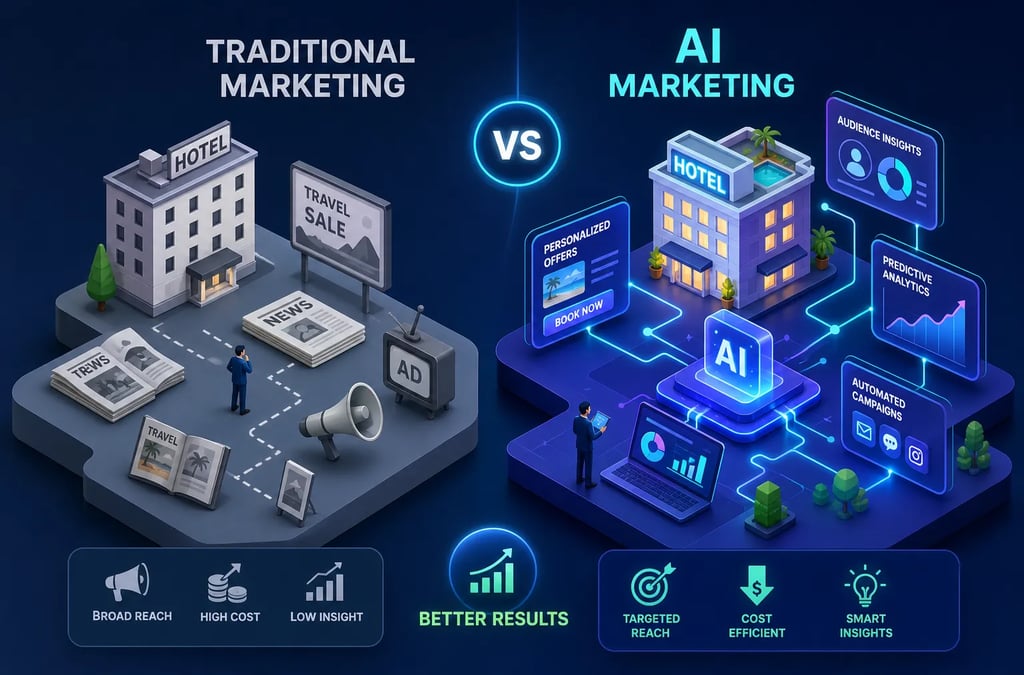
How AI Marketing Compares to Traditional for Hotels and Tour Operators
AI marketing vs traditional marketing for hotels and tour operators, compared honestly, reveals structural differences in cost, personalisation depth, and booking conversion that are increasingly difficult to ignore. Hotels and tour operators have built reliable businesses on traditional marketing for decades: OTA listings, print campaigns, travel fair budgets, and batch email sends to past guests. These methods work. They have always worked. But the cost-to-return ratio has been quietly deteriorating, and many operators running the same playbook are feeling it in their margins. OTA commissions running at 15, 25% of room revenue, agency retainers that don't flex with seasonality, and generic campaigns that treat every guest the same way, these are structural drains that compound year after year.
AI-driven hospitality marketing is no longer an experiment. Hotels using AI-powered pricing optimisation have reported RevPAR improvements of up to 35% in some vendor case studies, and chatbot-led direct booking channels have converted at rates four times higher than standard website enquiry flows. The question for most hotel owners and tour operators is not whether AI performs better in isolation, it is which traditional activities AI should replace, which it should augment, and how to make that transition without breaking what already works. At Powerful Digital Marketing , a London-based AI marketing specialist working exclusively with hotels and tour operators, we run this evaluation with clients regularly. What follows is an honest, evidence-based comparison.
AI marketing vs traditional marketing: budget efficiency for hotels and tour operators
The average independent hotel pays between 15% and 25% in OTA commission per booking, with many properties sitting closer to 20% once promotional programmes and visibility upgrades are included. On a £150 room night, that is £22.50, £37.50 handed to a third-party platform per booking, every booking, without any accumulated brand equity or guest data in return. When you add agency retainers, print production, and generic display advertising, the total traditional marketing spend for smaller properties can comfortably exceed 20, 30% of room revenue, a figure widely observed across independent hospitality operators, though it varies by property size and channel mix.
AI-driven direct booking campaigns change that cost structure fundamentally. All-in acquisition costs for direct bookings, covering payment processing, email automation, paid search, and retargeting, typically sit between 4% and 6% of booking value for well-run AI campaigns, based on figures commonly cited in vendor and industry literature, though actual costs vary by channel and scale. That gap of roughly 10, 15 percentage points, compounded across a season's bookings, is the financial argument for AI marketing in a single number. Spend shifts from fixed placements to performance-led channels: real-time bidding, dynamic audience targeting, and automated creative testing push budget toward the moments and segments most likely to convert.
For boutique hotels and independent tour operators without the scale of major chains, this efficiency gap matters most. Entry-level AI marketing tools start at relatively modest monthly costs, which means smaller operators can compete on targeting precision without matching OTA-level budgets. The structural advantage of data-driven spend allocation is available to any property willing to make the shift.
Personalisation, AI marketing vs traditional marketing for hotels and tour operators
Traditional hotel marketing segments guests into broad categories: leisure versus business, domestic versus international, newsletter subscribers versus cold prospects. These segments produce relevant-enough campaigns at scale, but they miss the behavioural signals that indicate booking readiness, repeat intent, or high lifetime value. A batch email to "past guests" treats a returning honeymooner and a solo business traveller identically, serving both a generic offer that is perfectly relevant to neither.
How AI builds individual-level offers
AI hospitality marketing builds individual-level offers using browsing behaviour, booking history, real-time search intent, and contextual signals such as travel dates and group composition. The performance difference is measurable: personalised AI-driven emails have shown open rate improvements of 29, 82% above generic sends across multiple industry studies, and personalised offers can generate up to six times higher transaction rates compared with traditional segmented campaigns, according to figures cited in sales and e-commerce benchmarking research. For further practical examples of email automation and personalisation, see AI in email marketing. For tour operators specifically, this means surfacing the right itinerary to the right traveller at the right moment in their research window, rather than relying on a single campaign moment to do all the work.
Downstream effects on booking behaviour
The downstream effect on booking behaviour is equally clear. Signal-based AI personalisation has been associated with booked engagement rates rising from approximately 2% to 10% in sales and outreach experiments, a lift that has been observed across both hospitality and travel contexts, though operators should note this data originates partly from outreach-channel studies rather than hotel booking A/B tests exclusively. This is not a marginal improvement in open rates; it is a structural change in how many browsers become bookers.
Campaign speed: from brief to live in hours, not weeks
A conventional hotel campaign cycle typically runs two to six weeks from strategy to publication: brief the creative team, write copy, secure approvals, book media, traffic the assets. For seasonal promotions or last-minute availability campaigns, that lag is a genuine commercial liability. By the time the campaign is live, the optimal booking window may already be closing.
Generative AI content tools can produce ad copy, email subject lines, and social creative in hours. When combined with automated A/B testing and programmatic placement, a hotel or tour operator can move from a brief to a live, optimised campaign within the same working day for lightweight executions, a category of responsiveness that traditional production timelines simply cannot match.
Beyond speed of creation, AI marketing adjusts bids and creative variations in real time based on performance signals. A traditional campaign runs the same creative for its scheduled duration regardless of what the data shows. An AI-driven campaign can shift budget toward the highest-converting audience segment, swap in a better-performing headline, and adjust bids based on competitor availability, all without manual intervention. The campaign is continuously optimising rather than executing a fixed plan.
Booking impact: what the evidence actually shows
The strongest evidence for AI marketing in hospitality comes from operators who have published hard numbers. The Luxury Escapes chatbot produced a conversion rate three times higher than the standard website and generated over $300,000 in revenue within three months of launch. Switchfly's AI destination-page feature increased conversion by 1.61% alongside a 4% rise in search-after-viewing behaviour. Hotels adopting AI-powered pricing optimisation have seen RevPAR improvements of up to 15% according to BCG research cited by STR, with some vendor case studies reporting upward of 35% gains across independent hotel portfolios. For practical vendor comparisons see the automated hotel pricing solutions guide.
One of the clearest strategic arguments for AI marketing in hotels is the direct-booking shift it enables. AI personalisation and retargeting re-engage past guests and high-intent browsers before they complete their booking on a commission-generating OTA listing. Over time, this improves both RevPAR and net margin, since direct bookings carry no commission cost and build a proprietary guest data asset that compounds in value with each stay.
Tour operators face a slightly different challenge: their products are complex, high-consideration purchases with research windows that often stretch weeks or months. Machine learning travel marketing tools address this by maintaining personalised touchpoints across the entire consideration journey, from initial search intent through to booking confirmation. For operators on tighter budgets, see our practical AI marketing strategy for tour operators on a budget. The ability to stay relevant throughout a traveller's research process is where AI marketing creates its most durable competitive advantage for operators.
Risks and compliance: what to get right before you switch
AI marketing in the UK operates under UK GDPR, and operators targeting EU guests face EU GDPR requirements as well. AI personalisation, behavioural retargeting, and lookalike audience building all involve personal data and require a clear lawful basis, transparent privacy notices, and in many cases explicit opt-in consent for marketing uses. Hotels and tour operators must conduct thorough data mapping across booking engines, CRMs, email platforms, and chatbots before deploying AI marketing tools. A Data Protection Impact Assessment is mandatory for high-risk profiling activities, and behavioural retargeting programmes commonly trigger that threshold. For a UK-specific briefing on compliance, consult guidance on GDPR compliance for UK hotels.
AI personalisation models are only as accurate as the guest data used to train them, and hospitality data is frequently incomplete. If a hotel's historical booking data over-represents a narrow guest profile, the AI will optimise toward that profile and potentially overlook high-value emerging segments. Poor data quality, inconsistent CRM records, or insufficient conversion data volume can produce AI recommendations that are confidently wrong. These are not reasons to avoid AI marketing; they are reasons to audit your data foundations before you start, and to treat a clean, well-structured guest database as a core business asset rather than an IT back-office concern.
The practical answer for most hotels and tour operators is augmentation rather than replacement. AI excels at speed, scale, personalisation, and bid optimisation. Human expertise remains essential for brand positioning, complex itinerary storytelling, relationship-based sales, and the strategic nuance that AI systems can miss. Industry commentary on how AI is redefining hotel marketing argues similar. The strongest outcomes come from combining both: AI handles the data-driven execution layer while experienced marketers direct the strategy.
A practical adoption path for hotels and tour operators
Early wins from AI marketing typically arrive through three entry points, each with a different time-to-value profile:
AI chatbots, visible value often within days through 24/7 lead capture and automated response handling.
AI content tools for ad and email copy, same-day deployment, with measurable creative performance emerging within weeks.
AI-powered email personalisation, measurable booking lift typically within two to four weeks when applied to re-engagement and pre-arrival upsell sequences, with meaningful ROI often consolidating within one to three months.
These entry points allow hotels and tour operators to build confidence with AI marketing before committing to deeper integrations such as CRM-level micro-segmentation or dynamic pricing engines.
A structured one-to-two-month pilot, with pre-defined KPIs including conversion rate, response time, cost-per-booking, and direct-booking share, gives hospitality operators a clean basis for evaluating AI marketing against their existing traditional baseline. If you're unsure whether to start, see Signs Your Travel Business Needs AI Marketing Solutions. The pilot should run on a specific channel or campaign type rather than attempting to replace the entire marketing stack at once. Boutique hotel implementations with clean guest data and clear automation workflows have reported measurable ROI within 30, 90 days; operators with less structured data typically see meaningful results within three to six months.
The most common adoption mistake is purchasing AI marketing tools and expecting them to self-configure for hospitality. Travel-industry-specific knowledge, understanding booking windows, seasonality signals, RevPAR sensitivity, and the psychology of high-consideration travel purchases, is what makes AI marketing genuinely effective rather than just technically active. Powerful Digital Marketing works exclusively with hotels and tour operators, combining purpose-built AI tools with deep travel industry expertise to deliver measurable booking results that generic AI deployments frequently fail to achieve. For operators ready to move from evaluation to execution, that combination of sector knowledge and AI capability is what closes the gap between running a pilot and scaling a strategy that performs.
The honest conclusion: augment first, replace later
When AI marketing vs traditional marketing for hotels and tour operators is compared across the evidence, AI outperforms on budget efficiency, personalisation depth, campaign speed, and booking conversion. The case is consistent and, in several key areas, substantial: direct booking cost advantages of 10, 15 percentage points over OTA commissions, personalisation lifts of up to 6x on transaction rates in benchmark studies, and RevPAR improvements in the 15, 35% range for operators using AI-powered pricing alongside their marketing campaigns.
The transition requires clean data, GDPR-compliant processes, and the right tools applied to the right channels. It also requires realistic expectations about timeline: many operators see early signals within weeks and meaningful ROI within one quarter, but building a fully AI-optimised marketing stack is a multi-stage process. For most hotels and tour operators, the prudent move is to augment rather than wholesale replace, starting with high-impact, low-risk tools and building from a foundation of measurable results.
If you are ready to run that evaluation properly, with real KPIs, sector-specific strategy, and AI tools built for travel rather than adapted from another industry, Powerful Digital Marketing provides the sector expertise, purpose-built tools, and honest benchmarking to make that shift count. Read more about our approach to AI-powered travel marketing and get in touch to start with a focused audit of where AI can close the biggest performance gap in your current marketing mix.
ADDRESS
The Powerful Group Limited
124 City Road
London
United Kingdom
EC1V 2NX
WORKING HOURS
Monday - Friday 9:00 AM - 6:00 PM
Saturday - Sunday 8:00 AM - 12:00 PM
Want to Call? Ask our Powerful Bot for the Number