
AI Travel Marketing: Outperforming Traditional Tactics
Discover how AI travel marketing beats legacy tactics: personalise at scale, optimise budgets dynamically, boost conversions, and run a 60–90 day pilot with KPIs.
AI IN TRAVEL
Powerful Digital Marketing
6/17/20269 min read
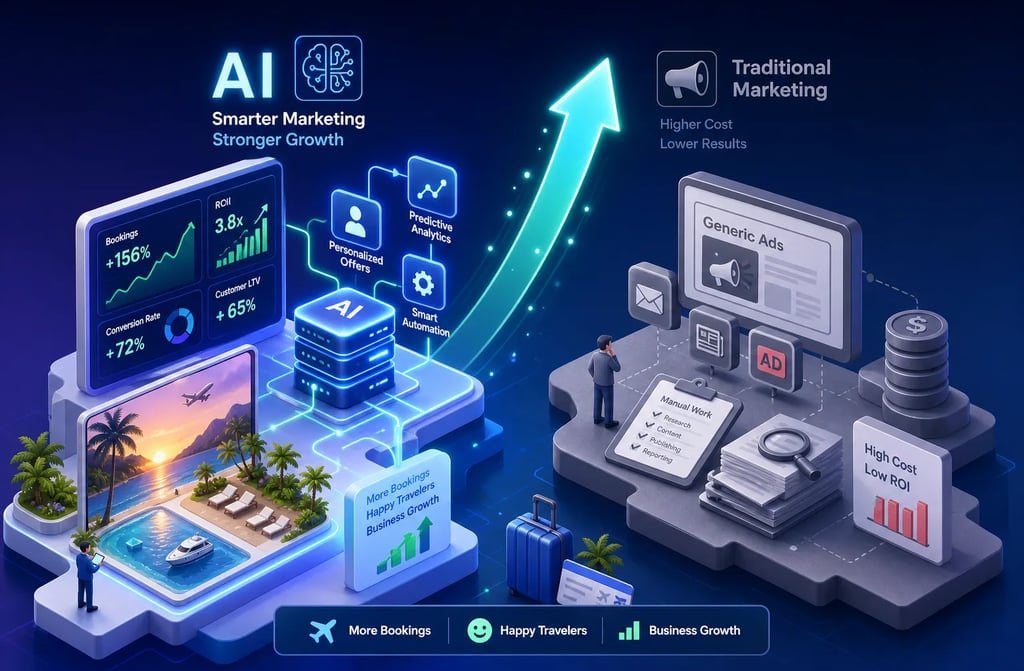
How AI Outperforms Traditional Marketing for Travel Business Growth
Most travel businesses aren't losing to better competitors, they're losing to faster, smarter marketing systems. Understanding how AI outperforms traditional marketing for travel business growth is no longer optional: AI continuously optimises spend, personalises messaging, and engages travellers around the clock, while traditional approaches burn budget on broad audiences and fixed schedules. At Powerful Digital Marketing , we work exclusively with travel brands across hotels, tour operators, and cruise lines, and we see the same pattern repeat itself constantly. Evidence from documented deployments shows the advantage is growing, and it's measurable.
This article covers five specific areas where AI travel marketing consistently outperforms legacy approaches, anchored in documented case outcomes rather than vendor promises. It closes with a practical 60 to 90 day pilot plan and the KPIs to prove it's working, so you can take something actionable away regardless of your budget or team size.
1. How AI outperforms traditional marketing for travel business growth through personalisation at scale
Traditional travel marketing segments audiences by age bracket, geography, and broad interest categories. Campaigns get batched, blasted, and the results measured in weeks. Machine learning travel marketing works differently: it analyses search intent, past booking behaviour, price sensitivity, and trip type in real time, then serves each traveller the version of a message most likely to convert them at that specific moment in their booking window.
The documented outcomes are not outliers. McKinsey research on AI-driven personalisation shows ROI improvements of 10 to 30% and revenue lifts of 5 to 15% for travel brands. Hopper's AI-based trip recommendations converted at three times the rate of standard in-app search. Luxury Escapes' travel chatbot delivered a 3x higher conversion rate and over $300,000 (USD) in sales revenue within three months compared with the website alone. These results share a common mechanism: the right message reached the right traveller at the right moment in the booking cycle.
Why batch-and-blast campaigns underperform for travel
A broadcast email treats a honeymooner planning a Maldives trip the same as a family researching European half-term breaks. The result is generic creative, low click-through rates, and high unsubscribe rates. Every pound spent on that broadcast is partially wasted on audiences whose intent, timing, and price threshold don't match the offer. AI-led personalisation solves this by matching offer to intent rather than offer to demographic, and conversion uplifts of 20 to 30% over broadcast campaigns are well documented in the travel sector.
How AI micro-segmentation turns browsers into bookings
AI-driven micro-segmentation uses behavioural signals, pages visited, searches made, time spent on pricing pages, and abandonment points, to build dynamic audience clusters. Each cluster receives creative and messaging calibrated to their specific trip type, budget range, and booking urgency. The result is smaller, sharper audiences that convert at significantly higher rates with a lower cost per booking. AI-personalised emails outperform broadcast sends by roughly 10 percentage points on open rate and deliver a CTR of 3.67% versus 1.41% for non-segmented campaigns, a difference that compounds quickly across a full year of activity.
For practitioners building this capability, there are industry guides that examine how to operationalise hyper-personalisation in travel marketing; see how to enable hyper-personalization in travel marketing for one practical overview.
2. Real-time budget optimisation versus fixed ad spend
Traditional travel PPC runs on weekly or monthly budget cycles. A marketing manager sets bids on Monday, the market shifts by Wednesday, and budget continues spending inefficiently until the next manual review. Marketing automation for tour operators and hotel brands replaces that lag with continuous, real-time adjustments based on live booking intent signals, competitor pricing, and demand fluctuations. The practical result is a lower cost per acquisition and a higher return on every pound of ad spend.
Programmatic advertising for travel takes this further by bidding for individual impressions in real time, assessing the value of each user at the moment they're about to see the ad. Budget concentrates on high-intent travellers during the look-to-book window and retreats from low-intent traffic automatically. Case evidence from travel deployments backs this up: brands using programmatic strategies have documented a 37% increase in bookings and a 168% increase in site visits (figures drawn from the MANGIA deployment case study). Google's own Target CPA data shows AI bidding campaigns generating 41% more total conversions than less automated approaches.
Where traditional travel PPC bleeds money
Fixed bidding strategies don't account for time-of-day intent patterns, competitor promotions, or seasonal demand spikes. A tour operator running a flat-bid Google Ads campaign during a competitor's flash sale is paying the same cost per click for a traveller who has already decided to book elsewhere. That waste compounds weekly, and it's exactly the kind of inefficiency that AI bidding eliminates by design rather than by exception.
How programmatic advertising and AI bidding reclaim that budget
AI bidding engines analyse thousands of data points per impression: device type, search history, competitor pricing, time to departure, and browsing behaviour. They adjust bids upward for high-conversion signals and pull back on low-value traffic in milliseconds. For travel brands, this means ad spend concentrates where it actually drives bookings rather than where it simply delivers impressions. The practical KPI to watch is cost per booking, and documented deployments consistently show this figure moving downward when AI bidding replaces manual approaches.
3. 24/7 customer engagement during the booking window
Travel decisions are non-linear and irregular. A couple researching a cruise at 11pm on a Tuesday doesn't fit office hours. A family comparing tour packages on a Saturday morning won't wait until Monday for a response. Traditional marketing generates enquiries; it rarely closes them outside business hours. AI-powered chatbots and conversational tools change this dynamic entirely, and the conversion evidence is direct.
Luxury Escapes' AI chatbot delivered a 3x higher conversion rate than the standard website. The mechanism is straightforward: a chatbot qualifies the lead, answers specific itinerary questions, and surfaces the right offer, guiding the traveller toward a booking or call-back request. All of this happens while the sales team is offline. Traditional website contact forms convert at roughly 2 to 5% for travel enquiries; AI-assisted conversational flows push that figure to 8 to 25% depending on the segment and the quality of the flow. That uplift represents a structural advantage, not an incremental one.
Why the enquiry-to-response gap is a travel-specific conversion killer
In travel, urgency is real. Travellers researching a specific departure date have a finite window of intent, and when that window closes without a response, they move to the next option. For boutique hotels and small tour operators competing against OTAs with instant-booking infrastructure, the gap between enquiry and response is where most leads are lost. A 12-hour response delay during a high-intent browsing session is, in practical terms, a lost booking.
What conversational AI does that static contact forms can't
AI-powered chat engages the traveller in real time, asks qualifying questions, surfaces relevant packages, handles FAQs, and captures contact details with context. It doesn't replace the human sales conversation; it keeps the lead warm until that conversation can happen. For travel businesses without a large in-house team, this 24/7 engagement capability levels the playing field against well-resourced OTAs without requiring a corresponding headcount increase.
4. Predictive analytics and demand-led campaign timing
Traditional travel marketing plans campaigns around the calendar: January sale, half-term push, summer deals. The problem is that traveller demand doesn't follow a fixed schedule. Booking intent shifts based on competitor activity, economic signals, weather events, and trend cycles that no spreadsheet can reliably predict. Predictive analytics for travel replaces calendar guesswork with data-driven campaign timing, and the revenue impact is documented.
AI-driven dynamic pricing has been shown to generate 36% higher conversions and 10% higher revenue per offer compared with static pricing structures, based on published travel sector deployments. Tour operators using predictive demand forecasting know when to increase ad spend two weeks before search volume peaks, rather than reacting once the peak is already driving up auction costs across every competing brand. Machine learning models built on travel booking data identify the specific search queries that precede a booking six weeks later, the price-point elasticity for different trip types, and the lead time differences between adventure travellers and family bookers.
How AI reads intent signals before campaigns go live
AI systems analysing historical booking patterns, live search trends, and competitor pricing can identify demand peaks before they fully materialise. This intelligence gap separates brands running proactive campaigns from those running reactive ones. A tour operator who launches a campaign two weeks before peak search volume captures the early-intent traveller at a lower cost per click, before auction competition intensifies. No fixed campaign calendar can replicate that timing, because the timing itself is the competitive advantage.
Dynamic pricing and its documented revenue impact
Dynamic pricing travel strategies allow businesses to adjust rates in response to real-time demand, competitor availability, and booking urgency. The approach doesn't require aggressive price swings to be effective; the strongest implementations use small, staged increases tied to capacity, booking pace, and lead time, with a clear floor and ceiling that protects perceived fairness. Static pricing, by contrast, leaves revenue on the table during high-demand periods and over-discounts during lulls.
5. A practical 60 to 90 day pilot plan with KPIs that prove the value
Knowing how AI outperforms traditional marketing for travel business growth is useful. Having a structured plan to test it within a defined timeframe, with clear success criteria, is what actually moves a travel business forward. For small to mid-sized operators with limited in-house technical resource, the following framework is designed to produce a measurable outcome within 90 days without requiring a full stack rebuild.
Some operators will self-implement this framework using existing tools and internal resource, which is entirely viable for teams with capacity to manage the setup. This is also where working with a travel-specialist AI agency can make a material difference. Powerful Digital Marketing runs these pilots with built-in travel industry context: prompt libraries calibrated to booking behaviour, chatbot flows structured around the look-to-book window, and PPC frameworks optimised for travel search intent. If you're assessing fit, you may find the checklist at Signs Your Travel Business Needs AI Marketing Solutions useful when deciding whether to self-implement or partner.
The pilot framework broken into plain steps
Days 1 to 14: Pick one acquisition use case, such as an AI-assisted lead funnel for a single destination or trip type, and record baseline KPIs for the previous 30 to 90 days. These should include lead volume, enquiry-to-response time, quote turnaround time, booking conversion rate, and email open rate. Set a specific success threshold before launching; for example, a 30% reduction in quote turnaround time or a 10% improvement in enquiry-to-lead conversion rate.
Days 15 to 30: Build the minimum viable workflow. Set up an AI-assisted intake form, draft templates for itineraries and follow-up emails, and configure a lightweight approval process so staff review before anything goes to customers. Tools at this stage include a large language model for drafting, an email automation platform for sequencing, and a chatbot layer for website lead capture if traffic justifies it. For a curated shortlist of practical solutions, see the best AI travel tools for 2026, and for a deeper playbook on tools and ROI consult AI Travel Marketing: Tools, Tactics & Real ROI 2026.
Days 31 to 60: Launch for a controlled audience, one landing page, one destination, or one campaign. Track AI-assisted versus manually handled leads and compare speed, response rate, and booking outcome. Refine prompts and approval rules based on where the workflow breaks down rather than where it's already working.
Days 61 to 90: Expand to a second segment or add a retention workflow for past travellers. Standardise the best-performing templates into a repeatable playbook. By day 90, you have enough data to make a confident scale or re-scope decision based on documented performance rather than expectation.
Which KPIs tell you the pilot is working
Track three categories of metrics concurrently. Efficiency metrics measure enquiry-to-response time, quote turnaround time, and staff hours saved per week. Engagement metrics cover email open rate, landing-page conversion rate, and chatbot completion rate. Revenue metrics track booking conversion rate, cost per booking, and cost per lead.
A pilot is worth scaling if it achieves at least two of the following: faster response time, improved email or landing-page conversion, more qualified leads without increasing complaint rates, and no decline in booking quality or customer satisfaction. The typical time to a first measurable conversion improvement for a focused pilot is three to four months, with early operational wins often visible within 30 to 60 days.
Why AI-driven travel marketing is winning in 2026
The evidence is consistent across five distinct dimensions: AI travel marketing outperforms traditional approaches on personalisation, budget efficiency, customer engagement, demand forecasting, and conversion rate at every stage of the funnel. Travel businesses running fixed-budget campaigns, batch-and-blast emails, and static pricing structures face a growing structural disadvantage against brands using machine learning, programmatic advertising, and conversational AI to capture and convert intent in real time.
The path forward doesn't require replacing your entire marketing stack overnight. Start with one acquisition use case, define your baseline KPIs, and run a structured pilot against those numbers. The data from documented deployments is clear: this is precisely how AI outperforms traditional marketing for travel business growth, and the gap between early adopters and late movers continues to widen. For additional context on the evolving role of AI across the travel sector, read more about AI in travel marketing.
If you want to compress that learning curve with travel industry expertise already built in, AI-powered travel marketing: why brands are switching exists precisely for this. Our AI-powered marketing strategies are built specifically for travel businesses, combining the speed of automation with the nuance of genuine sector knowledge. Talk to our team and let's map out what a 60-day pilot looks like for your business.
ADDRESS
The Powerful Group Limited
124 City Road
London
United Kingdom
EC1V 2NX
WORKING HOURS
Monday - Friday 9:00 AM - 6:00 PM
Saturday - Sunday 8:00 AM - 12:00 PM
Want to Call? Ask our Powerful Bot for the Number