
AI Travel Marketing: What It Is and Why It Matters 2026
Understand AI travel marketing in 2026: the four pillars, tools (Simon AI, TravelSpike), integrations, case studies like Luxury Escapes, and how to measure ROI.
AI IN TRAVEL
Powerful Digital Marketing
6/15/20268 min read
What Is AI Travel Marketing and Why It Matters in 2026
AI travel marketing is reshaping how travel brands win direct bookings, and the results are already measurable. According to findings published by travel intelligence platform TravelSpike, travel brands that personalised their marketing with AI reported a 25% jump in bookings. Meanwhile, the Luxury Escapes chatbot generated over $300,000 in sales in just three months, converting at three times the rate of the brand's own website. These are documented outcomes from brands that stopped treating AI as an experiment and started treating it as a campaign engine.
This article breaks down what AI-powered travel marketing actually means in 2026, which tools are driving real results, how to connect them to the platforms you already use, and how to measure whether the investment is working. Specialist travel marketing agencies like Powerful Digital Marketing are already running these systems for US tour operators and boutique hotels, and the path forward is far clearer than most travel brands expect.
What AI travel marketing actually means in 2026
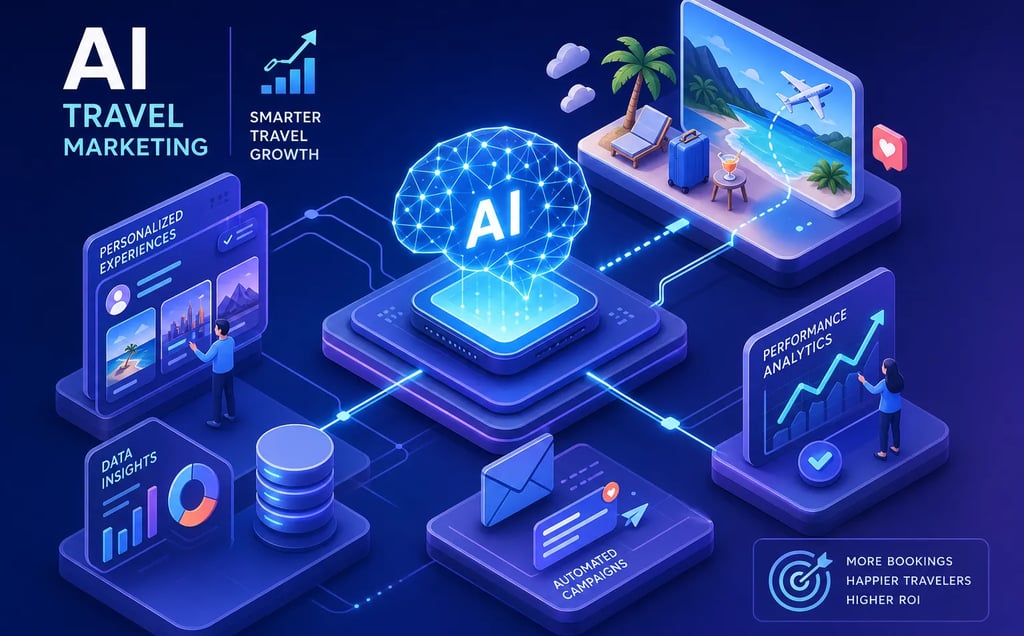
AI travel marketing is not a single product you buy and switch on. It sits across four practical pillars, and understanding the difference between them matters when you are deciding where to invest first. The first is personalisation: serving the right offer to the right traveller at the right moment, based on behaviour, history, and intent signals. The second is automation: running campaigns, follow-ups, and content workflows without manual effort at every step. The third is conversational AI, meaning chatbots and messaging tools that engage travellers around the clock. The fourth is data-driven optimisation, using real-time signals to continuously improve ad performance, email open rates, and booking conversion.
Each pillar delivers value independently. When you combine them, the impact compounds. A traveller who abandons a booking enquiry receives a personalised follow-up automatically, written in a tone that matches their browsing behaviour. A chatbot catches them on WhatsApp before they drift to an OTA. Every touchpoint is measured, attributed, and fed back into the model.
Why 2026 is the inflection point
Generative AI has moved from experimental to embedded. Tools that once required developer support now integrate directly with CRM platforms, email tools, and ad managers. The barrier to entry has dropped significantly as many vendors now offer no-code or pre-integrated solutions, which means smaller travel businesses can access AI-powered segmentation, dynamic content, and automated follow-up sequences without maintaining a dedicated in-house tech team, though some technical oversight remains valuable for complex integrations and data governance.
The competitive disadvantage for brands that have not yet moved is measurable. OTAs have been running AI-driven personalisation at scale for years. Independent hotels and tour operators that still rely on batch-and-blast emails and manual campaign scheduling are competing at a structural disadvantage. Accessible pricing bands for AI tools, which now start from around $50 to $500 per month for entry-level stacks and $500 to $3,000 or more for fuller deployments, mean the gap between enterprise and independent operators is narrowing.
How AI travel marketing powers personalisation and automation
AI moves well beyond broad demographic targeting. It builds behavioural segments based on booking intent, travel history, search patterns, and seasonal demand signals. Travel + Leisure Co. applied this approach through Simon AI and, according to company reporting, generated $350,000 in incremental revenue per year, doubled team productivity, and cut technology costs by 30%. That result came from personalisation applied at scale across their business operations, not from a single clever campaign.
The contrast with generic blast campaigns is stark. OTAs use micro-segmentation to match each visitor to an offer calibrated to their specific intent. When independent travel brands send the same message to their entire list, they are training their audience to ignore them while leaving revenue uncollected. AI-driven segmentation fixes that without requiring a data science team.
Automated workflows that run while your team sleeps
Automation handles the high-volume, repetitive tasks that drain marketing capacity: abandoned booking recovery sequences, pre-arrival upsell emails, post-trip loyalty re-engagement, and campaign scheduling. The value extends beyond speed. Well-built automated workflows significantly reduce missed follow-ups and eliminate the risk of sending the wrong segment an off-target offer, all while scaling without proportional headcount increases.
For small tour operators and boutique hotels competing against OTA marketing budgets, this matters considerably. A lean marketing team running AI-powered automation can cover the same touchpoints that a much larger operation would manage manually, provided the workflow is thoughtfully configured and the data feeding it is clean. The economics shift in your favour the moment the workflow is live.
The AI tools travel brands are actually using
ChatGPT and Google Gemini form the content engine layer of most AI travel marketing stacks. ChatGPT handles campaign ideation, destination copy, email drafts, and itinerary generation at pace. Pricing starts at free, with paid plans from $20 per month and Agent Mode available on Plus, Team, and Enterprise tiers (pricing correct as of mid-2026; check the OpenAI website for current rates). Google Gemini brings research depth and integration with Google Maps, Flights, Hotels, and Gmail, making it particularly useful for teams already operating inside the Google ecosystem. Both tools are only as useful as the prompts you put into them, which is the most commonly overlooked variable in AI travel marketing.
For conversational marketing, GuideGeek operates inside WhatsApp, Instagram, and Messenger with custom brand pricing, placing your travel brand directly in the channels where travellers are already having conversations. KAYAK Ask AI is free and connects to live inventory, making it a strong fit for conversion-oriented interactions. Mindtrip supports a research-to-booking workflow that keeps the traveller engaged from inspiration through to purchase.
For a practical roundup of market-ready options, see the best AI travel tools for 2026, which highlights tools suited to agencies, hotels, and tour operators. For a deep dive into how generative models are being applied in the travel sector, review insights on generative AI in travel.
What the Luxury Escapes result actually tells you
The Luxury Escapes chatbot generated $300,000 in three months at three times the website conversion rate. A well-implemented travel chatbot is a booking tool, not a customer service feature, and that distinction is what makes it worth prioritising in your AI travel marketing budget. Airlines have seen similar revenue impact from AI applied to pricing: Virgin Atlantic increased seating revenues by 10% through FLYR, and Lufthansa achieved a 5.2% revenue uplift via PROS, according to vendor case study reporting from both companies. AI in tourism marketing is not a niche experiment. It is active across the industry at every scale.
Prompts and templates you can use this week
Most travel marketers using AI tools write vague prompts and receive generic outputs. The variable that separates campaign-ready copy from generic filler is specificity. The framework that consistently produces usable results follows this structure: Role + Task + Audience + Offer/Context + Tone + Format + Constraints. Every element you leave out is a gap the model fills with a generic assumption.
Consider the difference between two approaches. A weak prompt reads: "Write me a travel email." A strong one reads: "You are a travel email copywriter. Write a welcome email for a boutique safari lodge targeting honeymoon couples who just downloaded our Best Safari Lodges guide. Tone: elegant and personal. Include a subject line, preview text, and body. Constraints: 140 words, one CTA, mention private game drives and all-inclusive stays." The second produces something you can send. The first produces something you have to rewrite entirely.
Ready-to-use prompt templates by asset type
Welcome email: You are a travel copywriter. Write a welcome email for [brand] to [audience] after they download [lead magnet]. Tone: [warm / premium / adventurous]. Include subject line, preview text, and body. Constraints: 120 to 180 words, one CTA.
Follow-up for unconverted leads: Write a follow-up email to families who requested details on a Disney World package but have not booked. Include a reminder about limited summer availability, a benefit of booking early, and a CTA to reserve a consultation. Under 130 words.
Search and social ad copy: Write 5 ad copy variations for a Costa Rica eco-lodge. Audience: couples aged 30 to 50 seeking nature-focused getaways. Highlight rainforest views, sustainability, and spa access. Tone: premium and calm. Output: headline, primary text, CTA.
Day-by-day itinerary: Write a 7-day itinerary for Japan targeting solo travellers interested in culture and food. Each day should have morning, afternoon, and evening sections. Tone: inspiring and practical. Each day in 2 to 4 sentences, easy to skim.
The master template for any asset type is: Role, Asset Type, Offer/Destination, Audience, Objective, Tone, Required Sections, Constraints, Output Format. Save it as a reusable reference for your team.
Connecting AI to your martech stack and measuring what it delivers
The typical integration architecture works in four steps: your PMS exports guest history into a central data layer; your CRS feeds search and booking intent into AI models; your CRM adds contact and lifecycle data; then the AI pushes segments and personalised content back into your email platform for activation. The systems talk to each other rather than operating in silos, and that data flow is what makes personalisation at scale possible.
Implementation timelines are realistic for businesses at any size. A simple pilot with one use case and one channel, such as abandoned booking recovery, takes two to six weeks if your CRM and email platform already have integrations and your data is reasonably clean. A cross-system integration across PMS, CRS, CRM, and email typically takes six to twelve weeks. Full orchestration with predictive models and governance takes three to six months. Start with one high-value use case and expand once you have a result to build on.
When planning integration, practical guidance on integrating AI into your martech stack can help you map connectors, data flows, and activation points so the AI outputs actually reach your email, ads, and in-destination communications.
The KPIs that tell you whether AI is working
Five core metrics will give you a clear picture. ROAS measures booking revenue generated per pound or dollar spent. CAC (or CPA) tells you whether AI is lowering the cost to acquire a traveller. Conversion rate shows whether AI-powered travel advertising is converting at a higher rate than generic campaigns. CLV reveals whether AI-retained customers are booking again. Engaged sessions indicate whether personalised landing pages are holding attention before the booking decision.
Use multi-touch attribution rather than last-click. Travel purchases involve long consideration windows spanning multiple touchpoints across channels. Last-click attribution will systematically undervalue your AI campaigns, leading to poor budget decisions. UTM parameters, ad platform pixels, call tracking, and booking platform data should all feed into an attribution model that reflects the full journey. For frameworks on how to measure the impact of AI on content performance and ROI, consult specialist guidance that aligns content metrics with commercial outcomes.
Why US travel brands are working with specialist partners
The tools exist. The prompts work. The integrations are achievable. The challenge for most small to mid-sized travel businesses is that configuring a stack covering AI personalisation, chatbot deployment, PMS and CRM data flows, multi-touch attribution, and ongoing campaign optimisation requires expertise that is rarely on the payroll. Hiring that expertise internally is expensive, and building it from scratch takes time that lean travel marketing teams simply do not have.
Generic AI tools built for e-commerce or retail do not account for the seasonal demand patterns, look-to-book windows, or OTA dynamics that define travel marketing specifically. A campaign strategy built without those variables will underperform regardless of how sophisticated the underlying technology is. That is the gap a specialist travel marketing partner is positioned to close.
Powerful Digital Marketing brings deep travel industry experience across tour operations, hospitality, and cruising, combined with purpose-built AI tools. US travel brands working with the agency access AI-driven social media strategy, smart chatbot implementation, SEO and PPC optimised for travel booking intent, and real-time competitor insights. The strategy is grounded in actual traveller psychology and seasonal demand patterns, not recycled templates from a generalist agency, which translates into faster implementation, lower acquisition costs, and campaigns that compete with OTA-level personalisation. Learn more about practical approaches in AI Travel Marketing: Tools, Tactics & Real ROI 2026.
Start with one campaign and build from there
AI travel marketing in 2026 is not a competitive advantage reserved for the largest brands. It is a practical toolkit that any travel business can deploy, whether that means running smarter email automation, building a booking-focused chatbot, or using generative AI to produce itinerary content at scale. The travel brands winning direct bookings right now are those that committed to one or two use cases, measured the results, and expanded deliberately from there.
If building and managing that stack independently is not realistic, working with a specialist partner like Powerful Digital Marketing: Why Brands Are Switching, one that understands both the AI and the travel industry, is the most direct route to measurable growth. Start with one high-value use case, track the KPIs that matter, and let the data guide where your AI travel marketing strategy goes next. If you have questions about how tooling, pricing, and timelines affect small travel businesses, see Common Questions About AI Marketing Tools for Travel Businesses for a practical FAQ.
ADDRESS
The Powerful Group Limited
124 City Road
London
United Kingdom
EC1V 2NX
WORKING HOURS
Monday - Friday 9:00 AM - 6:00 PM
Saturday - Sunday 8:00 AM - 12:00 PM
Want to Call? Ask our Powerful Bot for the Number