
PPC Campaigns for Travel Business: High-Converting Guide
Run high-converting PPC campaigns for travel businesses. Learn keyword research, ad copy, landing pages, conversion tracking, and seasonal budget strategies.
POWERFUL CLICKS - AFFORDABLE SEO AND PPC
Powerful Clicks
6/17/20267 min read
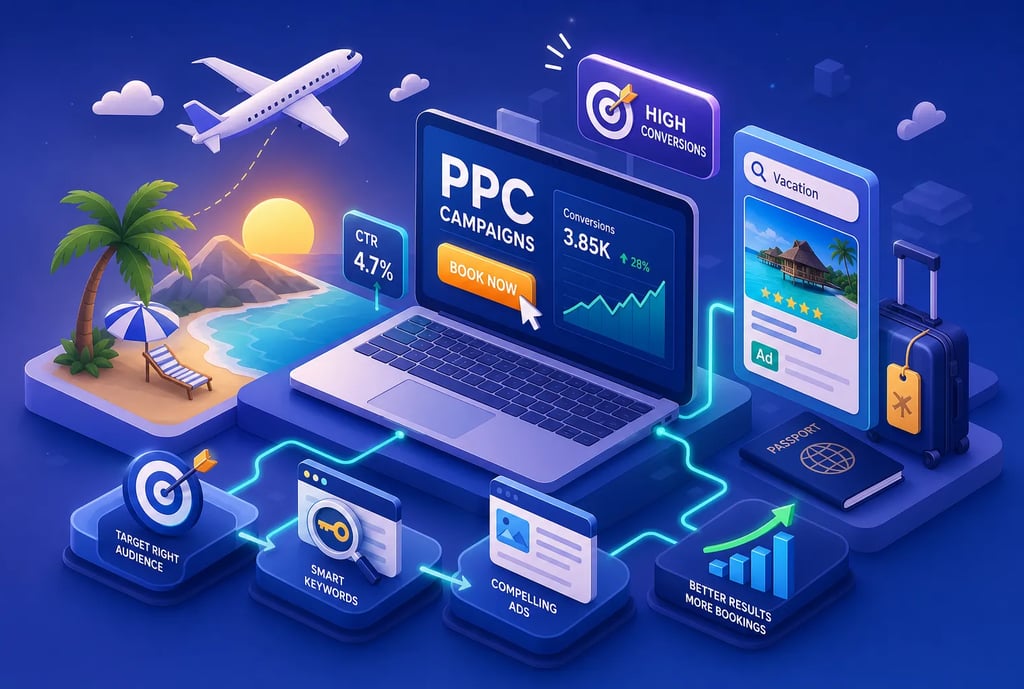
How to Run High-Converting PPC Campaigns for a Travel Business
Running profitable PPC campaigns in the travel sector is harder than it looks. Search budgets disappear quickly, booking journeys stretch across weeks and multiple devices, and the margin for error is narrow. This guide explains how to run high-converting PPC campaigns for a travel business, covering keyword research, ad copy, landing pages, conversion tracking, and seasonal budgeting, in the order that actually matters. At Powerful Digital Marketing, we manage PPC for hotels, tour operators, and cruise lines daily, and the same structural mistakes appear in the accounts we audit time and again. This guide exists to help you avoid them.
The good news is that the fundamentals are learnable and repeatable. Once you understand why most travel campaigns leak budget before a booking happens, every subsequent decision becomes clearer, and the path to a profitable account becomes a great deal more straightforward.
Why most travel PPC campaigns leak budget before a booking happens
Travel shoppers typically research across multiple sessions and devices before converting. A campaign built for single-session attribution will undercount performance and mis-allocate budget, because it cannot see the full picture of how a traveller actually behaves. The look-to-book window for holidays, tours, and cruises can span weeks or months, which demands a fundamentally different campaign structure than you would use in retail PPC.
Before setting performance targets, it helps to know where the industry actually sits. For 2026, the Travel and Hospitality benchmark for Google Search conversion rate sits between 3.5% and 5.4%, with some sources citing 5.75% for travel overall (WordStream Industry Benchmarks, 2026). On ROAS, the benchmarks break down by campaign type: Search Brand at approximately 4.00x, Search Non-Brand at 3.85x, and Performance Max at 2.79x (Google Ads internal benchmark data, 2026). These figures are a baseline, not a ceiling. Every step in this guide is designed to beat them by eliminating the structural waste that keeps most travel accounts underperforming.
How to run high-converting PPC campaigns for a travel business: keyword research
Not all travel keywords are equal, and treating them as if they are is one of the most common budget mistakes in travel accounts. The clearest framework divides keywords into three intent tiers: informational (travel tips, destination guides), commercial (best tour operators, cruise deals), and transactional (book safari Kenya, Maldives overwater villa booking). High-converting travel PPC campaigns prioritise the commercial and transactional tiers. Informational terms belong in upper-funnel audience-building, not in campaigns chasing direct bookings.
High-intent search terms
Concrete examples of high-intent terms include local queries such as "luxury travel agency near me" and long-tail transactional phrases such as "luxury honeymoon resorts Maldives" and "ski holidays Japan Hokkaido." These work because they combine a specific service or destination with clear purchase intent. The person searching "luxury travel agency near me" is not browsing for inspiration; they are ready to book.
Match types and negative keywords
For match types, use Exact match on your most specific high-intent terms, particularly local and service-specific queries, and Phrase match for controlled expansion around them. Build your negative keyword list before you spend a pound, not after. Filtering out informational and irrelevant traffic is one of the fastest ways to lower cost per acquisition in travel accounts.
Seasonal search volumes
Finally, do not run flat budgets year-round. Search volumes for specific destinations shift predictably across the calendar, and your campaigns should reflect those patterns. Running high-converting PPC for travel businesses means aligning spend with when your customers are actively searching, not when they are actually travelling.
Ad copy and landing pages for high-converting travel PPC campaigns
Effective travel ad copy starts with intent-matching at the headline level. Headline 1 targets the specific intent, whether that is a destination or a service type. Headline 2 addresses the key concern the searcher is carrying, such as price, availability, or exclusivity. Headline 3 delivers a direct call to value: "Book Direct and Save 15%" or "Reserve Your Dates Today." There is no need to label this as a framework; simply use it.
In tests, specific messaging typically outperforms generic travel copy. "Maldives overwater villas from £2,400" converts better than "luxury holidays at great prices" because it answers the searcher's actual question before they click. Once they do click, the headline they saw must match what greets them on the landing page. When it does not, bounce rates tend to rise and Quality Scores fall, outcomes that raise your CPC and push your ads lower in the auction. For practical inspiration on how small landing-page changes can increase bookings, read this guide on how to increase travel website bookings.
Ad extensions are where competitive travel advertisers gain ground without paying more per click. Sitelinks should point to specific destination or offer pages rather than generic sections of the site. Callouts carry trust signals: free cancellation, ATOL protected, no booking fees. Structured Snippets highlight destinations, accommodation types, or tour styles. Promotion extensions handle seasonal deals. Extensions expand your visible ad real estate at no extra cost, which is particularly valuable when competing in auctions where large OTAs hold significant share.
Landing pages built to close the booking
A high-converting travel landing page has one job: move the visitor from click to booking action. That means a single conversion goal per page, a strong benefit-led headline, the offer or price displayed prominently, and the primary CTA visible immediately without scrolling. Every element that distracts from that goal costs you bookings.
Trust signals are especially important in travel due to higher purchase values and perceived risk. Star ratings, TripAdvisor or Google review scores, guest photos, ATOL and ABTA logos, and urgency cues such as limited availability or a time-sensitive discount all serve to reduce that anxiety. Show pricing early. Hiding prices tends to send visitors back to Google to check competitors, and many of them will not return.
Travel searches skew heavily towards mobile (Google, Search Behaviour Report, 2025), so your booking form must work on a small screen with minimal cognitive load. Dates, number of guests, and an email address are usually enough for the first step. A mobile sticky CTA, a fixed "Check Availability" button that stays visible as the user scrolls, is a simple UX change that reliably lifts mobile conversion rates. Page speed is non-negotiable: destination image-heavy pages are the biggest performance bottleneck in travel, and a slow page means a lost booking. Compressed images, deferred loading, and a fast host are the minimum standard.
Conversion tracking that accounts for the full travel journey
The core tracking problem in travel is attribution across a long, multi-device path. A traveller may search on mobile, research on desktop, and book a week later, appearing as a new session each time if tracking is misconfigured, making the campaign look far less effective than it actually is. Solving this requires preserving the original click identifier across the entire booking journey.
The practical setup works as follows. Capture the GCLID when the user lands from a Google Ads click. Store it in a first-party cookie and in your backend booking record. Implement cross-domain measurement if your booking engine runs on a separate domain or subdomain, because without it, bookings appear as new sessions with no source attribution. Use a stable user identifier, such as a login or reservation ID, to stitch sessions across devices. For the confirmed booking event, send it server-side from the backend with the preserved GCLID, so the conversion is recorded even when the final session happened on a different device or browser. For technical detail on how to preserve ad click IDs with Google Tag Manager, that article is a helpful resource.
The key conversion events to track are: landing page view, booking start, form completion or enquiry submission, and confirmed booking with order value and currency. GA4 data-driven attribution with a longer conversion window is better suited to travel than last-click, because the booking journey frequently spans more than 30 days. For businesses with complex, long-cycle journeys, exporting GA4 data to BigQuery gives you the custom attribution analysis that standard reporting windows cannot provide. If you need a primer on how GA4 is changing travel marketing and practical steps to adjust, that write-up is worth reading.
Budget pacing and bid strategy across the booking season
Seasonality and lead time are two different signals, and both must shape your budget decisions. Seasonality tells you when people are searching. Lead time tells you how far in advance they book. A campaign promoting summer holidays needs significant budget in late winter and spring, not in July when most decisions are already made. Booking peaks and arrival peaks are not the same thing, and conflating them is an expensive mistake.
A practical seasonal pacing model moves through three phases. In the weeks before peak booking windows, front-load spend and increase bids on high-intent terms. As the travel date approaches and intent strengthens, push more aggressively on those terms. In shoulder periods, reduce acquisition spend while keeping remarketing campaigns funded, because returning visitors who have already shown interest remain among the most cost-efficient audiences in the account.
For Smart Bidding, wait until the account has sufficient conversion data, typically 30 to 50 conversions per month per campaign, in line with Google's own Smart Bidding guidance, before switching to a Target ROAS strategy. Set initial ROAS targets based on the 3.85x to 4.00x Search benchmarks and adjust from there as the account matures. Remarketing for travel is particularly effective at the late-decision stage, when travellers have visited the site, started a booking, and dropped off. These audiences carry the highest intent and the lowest cost per acquisition of any segment in the account.
Putting it all together: running high-converting travel PPC campaigns
The campaign logic follows five steps in sequence: start with high-intent keywords, write copy that matches the searcher's exact need, send clicks to a single-purpose landing page, track every step of the booking journey accurately, and pace budget around how travellers actually book rather than when they actually travel. Each step depends on the one before it, which is why fixing ad copy without first fixing keyword selection tends to produce modest results at best. For a more detailed playbook on structure and sequencing, see Travel PPC Advertising: Strategies to Drive Bookings.
Running high-converting PPC campaigns for a travel business rewards specificity and patience. The brands winning on Google Ads in this space align every element of their campaigns with how their customers think, search, and decide, planning spend around seasonal demand, leading with transparent pricing, and adjusting bid strategy as the booking window shifts. If you want to scale with proven methods, explore how to Boost Your Travel Business with Effective PPC Strategies and the practical advice in our Google Ads for Travel Businesses: Run Profitable Campaigns guide.
If you want to build this system with an AI-powered, travel-specialist team behind you, Powerful Digital Marketing offers exactly that kind of hands-on partnership. We combine deep travel industry experience with advanced AI tools to run PPC campaigns built around real traveller psychology and booking behaviour. Get in touch with our team to find out how we can build a campaign that turns your ad spend into confirmed bookings.
ADDRESS
The Powerful Group Limited
124 City Road
London
United Kingdom
EC1V 2NX
WORKING HOURS
Monday - Friday 9:00 AM - 6:00 PM
Saturday - Sunday 8:00 AM - 12:00 PM
Want to Call? Ask our Powerful Bot for the Number