Tour operators: Turn social media into bookings fast
Learn how tour operators turn Instagram, TikTok and Facebook posts into direct bookings. Get a practical framework for platforms, video, and UGC systems.
POWERFUL SOCIAL
Powerful Social
7/18/20267 min read
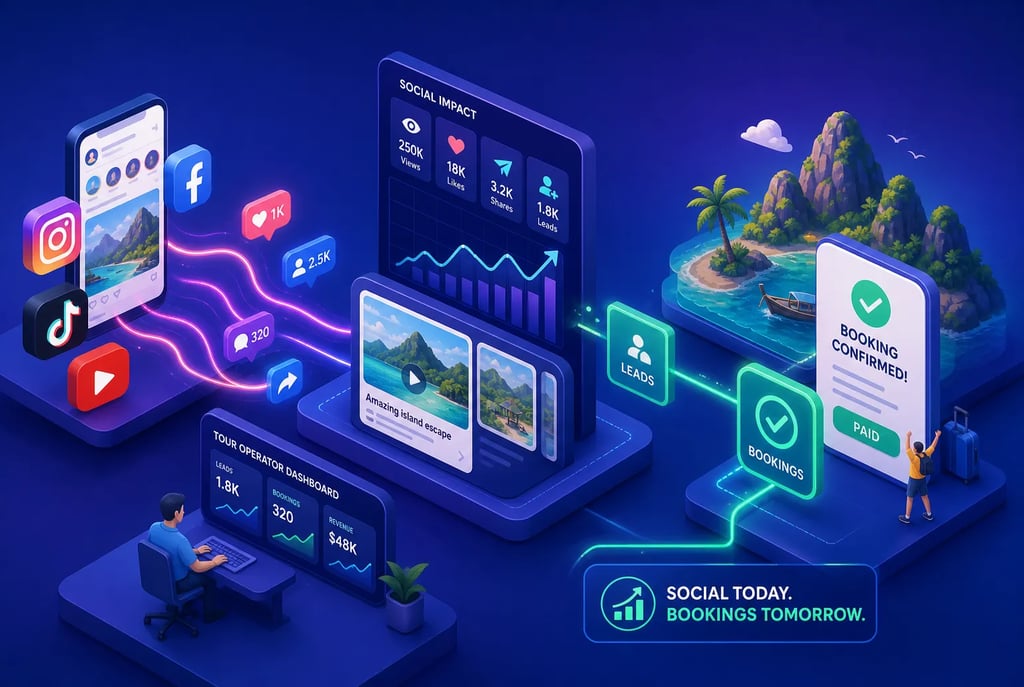
How tour operators turn social media into real bookings
Many tour operators share the same frustration. Their Instagram looks great. Their follower count is growing. Their posts get likes and the occasional comment. But the booking page? Quiet. The disconnect isn't the platform. It's the absence of a strategy that connects content to confirmed reservations. Industry data backs this up: according to tourism sector surveys, a significant majority of tourism companies report increased bookings from social media, yet many operators are still without a clear system covering what to post, when to post it, and what to do when someone actually shows interest.
The operators generating reliable revenue from social aren't the most creative ones; they're the most systematic ones. At Powerful Digital Marketing, we work with tour operators across the UK and beyond to build exactly this kind of system, one that combines AI-driven strategy with deep travel sector knowledge to turn social channels into a measurable source of direct bookings. What follows is the framework we use, broken into the decisions and tactics that matter most.
How a tour operator should use social media to get more bookings: start with the right platform
Not all platforms deliver equal results, and spreading effort thinly across every channel is one of the fastest routes to mediocre performance everywhere. Instagram drives the highest conversion rate among social platforms for travel content, with research from travel industry studies indicating that 44% of travellers visit a destination or make a purchase after seeing travel posts there. That booking intent, the mindset a user brings to the platform, matters more than raw follower numbers. Instagram's visual-first format, combined with Stories, Reels, a clickable bio link, and a shop-adjacent experience, makes it the natural starting point for operators building a direct-booking pipeline.
TikTok converts at around 42% and works particularly well for reaching younger, adventure-focused travellers who are still in the dreaming phase of planning. If your tours appeal to that demographic and you have the bandwidth to post consistently, TikTok is worth building alongside your Instagram presence. Facebook, at approximately 40%, remains the strongest platform for group travel, older demographics, and community-building through dedicated groups, but its organic reach has declined significantly over recent years. Use Facebook primarily for paid ads and community group activity rather than expecting organic posts to carry weight. Lead on Instagram, build TikTok if time and budget allow, and treat Facebook as an advertising and community tool rather than a primary content destination. This platform hierarchy is the foundation of any effective approach to tour marketing on Instagram and beyond.
The content formats that actually convert followers to buyers
Short-form video consistently outperforms static imagery in both reach and engagement because it shows the guest experience in motion, something a photograph simply cannot replicate. A 30-second clip of a guest's genuine reaction on a wildlife safari or white-water rafting run communicates excitement far more effectively than any caption. Research from video marketing studies suggests video content can increase conversions meaningfully, and the most important word in that observation is "authentic." A staff member revealing a hidden local spot or a guest sharing an unscripted reaction often outperforms a professionally filmed brand video because authenticity signals trust, and trust is what turns a browsing traveller into a paying one.
User-generated content is the most credible marketing asset your business can post. Travellers trust peer-created photos and testimonials considerably more than brand-produced content, some studies suggest the margin is as high as 88%, which means a guest's tagged photo of your tour carries more persuasive weight than your best professional shoot. Build a system around collecting it: brief guests at the end of every tour about your branded hashtag, make it easy for them to tag you, and always ask permission before reposting. The Solo Female Travelers community scaled to over £850,000 in annual revenue built almost entirely on community-generated content and word-of-mouth, with no paid advertising. That case study is not an outlier; it's proof that a disciplined UGC strategy can carry an entire organic growth model.
Stories are your daily touchpoint with an audience that typically has a longer consideration window before booking a tour. Use polls ("Would you rather: kayaking or hiking?") to drive engagement, countdown stickers to build anticipation before a tour departure, and behind-the-scenes footage to humanise the brand. These formats keep you visible in followers' minds during the consideration period between discovering your account and being ready to book.
Building a posting rhythm that sustains momentum
Consistency matters more than volume. A posting gap can hurt algorithmic reach and take time to recover from, reducing the visibility you've worked to build. For Instagram, three to five feed posts per week alongside daily Stories, as many as your capacity allows, is a realistic target for a small operator. In the early growth phase on TikTok, frequent posting significantly boosts discovery because the platform's algorithm rewards volume more aggressively than Instagram's. Facebook organic requires far less effort: two to three posts per week, with your real energy directed at group activity and paid campaigns instead.
The most practical way to maintain consistency is a two-week rolling content calendar structured around four content pillars. Inspiration covers destination visuals and dream-worthy moments. Education covers what guests can expect, packing tips, and local knowledge. Social proof covers guest testimonials, reviews, and UGC. Sales covers limited-availability alerts, booking link reminders, and seasonal promotions. Rotating through these pillars ensures conversion-focused posts appear regularly without making the account feel like a constant advertisement, a balance that keeps followers engaged long enough to become buyers.
Turning engagement into confirmed reservations
How a tour operator should use social media to get more bookings: winning the DM conversation
Social selling for tour companies is won or lost in the DMs. When a prospect enquires via direct message, the speed and clarity of your response is the primary conversion lever. A structured five-step workflow makes this repeatable:
Acknowledge and qualify, ask about travel dates, group size, and approximate budget.
Send a custom summary, share a relevant itinerary or tour outline tailored to their enquiry.
Include a direct booking link, one that supports both deposits and full payment.
Follow up automatically, send a reminder if there's no reply within 48, 72 hours, or per your typical sales cycle.
Confirm with documentation, send a full itinerary and voucher once payment is received.
Three response templates worth having ready: an initial enquiry reply that asks the qualifying questions (travel dates, group size, approximate budget); an offer delivery message that links to the itinerary and includes a clear booking link; and a follow-up message that briefly recaps the offer and adds a genuine urgency note. Mobile-optimised booking links are non-negotiable, virtually all social interaction happens on a phone, and a booking page that doesn't load cleanly on mobile will cost you reservations regardless of how strong the content above it was. For tactical steps to tighten each stage, see a practical guide on how to increase conversion rate throughout the booking journey.
Scarcity and urgency are legitimate and effective conversion tools when used honestly. Limited-spot callouts ("Only 4 places remaining on our 14 May departure"), countdown stickers in Stories, and genuine seasonal pricing windows all accelerate booking decisions. Pair these with real guest testimonials and star ratings to build trust alongside urgency. Pressure without credibility rarely converts, but credibility without urgency leaves bookings on the table.
Running paid social ads without wasting budget
UK Facebook and Instagram ad campaigns in travel and hospitality typically average a CPC of £0.43, £0.70, a CPM of £5, £15, and a CPA of £30, £60 for bookings. For tours with an average booking value of £150, £250, that puts ROAS at a very workable 3, 5x for well-optimised campaigns, and higher still for premium or luxury operators. These figures make paid social one of the most cost-efficient acquisition channels available, but only when campaigns are built around the right objectives. Run conversion campaigns tied to a booking page, not awareness campaigns optimised for page likes, which generate data but not revenue. This is the practical heart of social media advertising for tours: match your campaign objective to your business goal. For a deeper dive into practical ad tactics and bidding strategy, check our guide to PPC strategies for tour operators to win bookings in 2026.
Retargeting is where the real return lives. Cold traffic campaigns get visitors to your site; retargeting campaigns close the sale. Set up a pixel on your booking page and run retargeting ads to anyone who viewed a tour but didn't complete a reservation. A 30-day window for visitors who viewed specific destination pages balances relevance with sufficient audience volume for most operators.
Lookalike audiences, built from your existing customer data, let you reach new users who mirror your best bookers. These two audience types, retargeting and lookalike, typically deliver the highest ROAS of any paid social activity. Dynamic ads showing the exact tour a user previously browsed can significantly outperform generic creative. Build retargeting and lookalike campaigns first, then layer in broader awareness spend once the foundation is performing. For industry context on social media conversion rates for travel purchases, consult recent market benchmarks to set realistic KPI targets.
Measuring what's working and scaling with confidence
Vanity metrics are interesting but not actionable. Follower count and post likes tell you almost nothing about whether social media is generating revenue. The numbers that matter are: cost per booking or enquiry, click-through rate on booking link posts, DM enquiry volume, Stories completion rate, and Reels reach relative to follower count. Track these regularly, weekly where volume allows, or bi-weekly at minimum, so underperforming content gets cut before it wastes further budget. Most operators can manage this inside native platform analytics to begin with; as volume grows, a third-party reporting tool pays for itself in time saved and decisions improved. Combine this with an approach to affordable SEO & PPC for travel brands to make sure your organic and paid efforts are pulling in the same direction.
Managing content creation, community engagement, DM workflows, and paid ads simultaneously is a substantial commitment on top of the full-time work of running tours. Powerful Digital Marketing handles the entire social media management function for tour operators using AI-powered strategy, from content calendars and Reel production briefs to ad campaign optimisation and booking-funnel analysis. If you need tactical suggestions on how to use social platforms to convert more bookings, practical resources outline ways to use social media to boost your bookings across channels.
The operators winning on social have a system, not just a presence
The gap between a tour operator with a nice Instagram page and one generating consistent bookings from social media isn't creativity; it's structure. The operators seeing the biggest booking uplifts aren't the ones with the most followers. They're the ones with a clear platform focus, a consistent content rhythm, a repeatable DM process, and a measurement framework that tells them what to keep and what to cut. Third-party platforms and booking systems reinforce that outcome, see how social media boosts bookings in operational playbooks and distribution strategies.
If you want a plan built around exactly how a tour operator should use social media to get more bookings, specific to your tours, destinations, and audience, the team at Powerful Digital Marketing is ready to build it with you. Book a free strategy consultation and we'll show you precisely where your social media is leaving bookings on the table, and how to recover them.
ADDRESS
The Powerful Group Limited
124 City Road
London
United Kingdom
EC1V 2NX
WORKING HOURS
Monday - Friday 9:00 AM - 6:00 PM
Saturday - Sunday 8:00 AM - 12:00 PM
Want to Call? Ask our Powerful Bot for the Number