
AI Marketing for Travel Agencies: 30-Day Action Plan
Learn a practical 30-day AI marketing plan for travel agencies to boost bookings, prioritise use cases, shortlist tools, run a pilot and track KPIs.
TRAVEL MARKETING
Powerful Digital Marketing
7/17/20269 min read
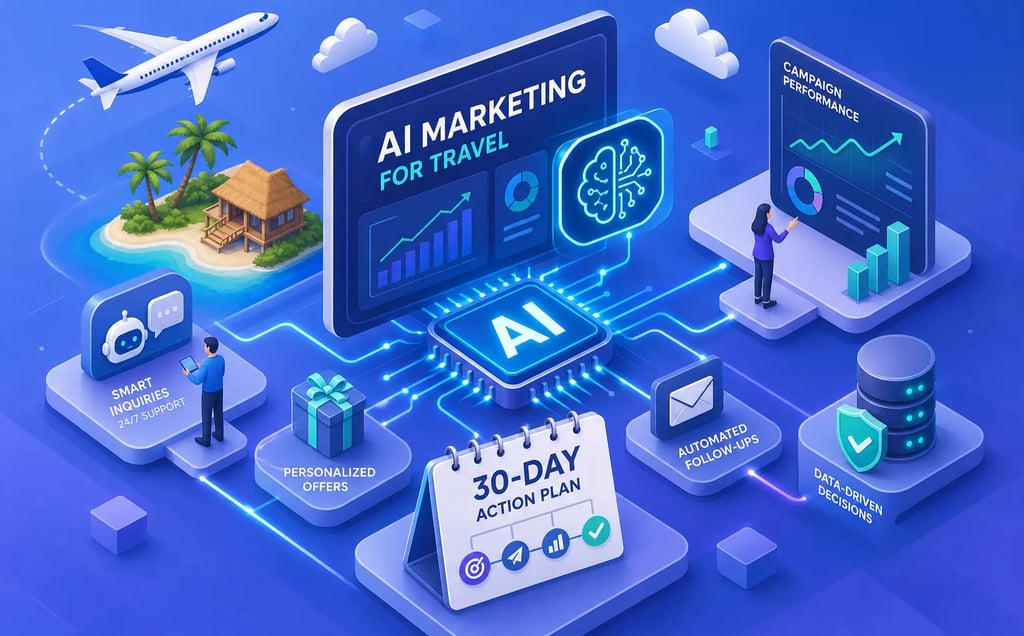
AI Marketing for Travel Agencies: A 30-Day Action Plan
Travellers in 2026 expect instant, personalised responses. Consider a browser who revisits a Maldives itinerary several times over two days and then moves on, not because they lost interest, but because the first agency that responded with something relevant got the booking. For any AI marketing travel agency strategy to win in this environment, timely personalisation is no longer optional. Agencies still relying on manual outreach, batch email blasts and reactive follow-up face a genuine competitive risk as rivals build AI into their marketing engines.
The opportunity is substantial and measurable. Agencies using AI-driven personalisation are reporting up to 30% higher conversion rates, and those deploying AI agents for lead capture are seeing 3 to 5 times better conversion on qualified enquiries. Specialist agencies built exclusively around AI marketing for travel agencies, including Powerful Digital Marketing, are demonstrating daily what is now achievable for boutique operators, tour companies, and independent agencies ready to compete differently.
By the end of this article, you will know which AI use cases to prioritise, which tools to shortlist, how to run a focused 30-day pilot, and exactly which KPIs prove that your investment is working.
What AI marketing is actually changing for travel agencies in 2026
The shift from broadcast marketing to intent-driven campaigns
Traditional travel marketing operates on a broadcast model: send the summer holiday email to the full list, post the destination reel, run the generic Google ad, and wait. AI-driven marketing works differently. It listens first. When a prospective traveller spends 20 minutes reading through a Japan itinerary page and returns the next morning to do the same, an AI system recognises that intent signal and triggers a personalised follow-up, not a generic newsletter, but a tailored message about a Japan departure that matches their browsing pattern.
This is the shift that defines 2026: marketing that responds to behaviour in real time rather than pushing scheduled content at a passive audience. The difference in conversion outcomes between these two approaches is no longer marginal. It is the gap between agencies that grow and agencies that plateau. For a deeper look at how AI is replacing one-size-fits-all tactics, read AI Travel Marketing: Outperforming Traditional Tactics.
Why 2026 is a turning point for travel agencies specifically
Several forces have converged to make this the year that AI marketing for travel agencies becomes accessible at every budget level. AI tools have dropped in cost to the point where SME agencies can access genuinely powerful platforms for well under £60 per month (note that many vendors price in USD, so confirm current GBP pricing directly with each provider). Traveller expectations for personalisation have risen sharply, shaped by consumer platforms that remember preferences and serve relevant content automatically. Google's AI Overviews are simultaneously reshaping how agencies get discovered online, rewarding structured, authoritative content over keyword-stuffed pages.
Agencies not investing in AI-driven travel marketing now are not standing still. They are falling behind competitors who started six months ago and are already building on those early gains. If you want a concise primer on what AI marketing means for travel businesses, see AI Travel Marketing: What It Is and Why It Matters 2026.
AI marketing for travel agencies: the use cases that move bookings fastest
AI chatbots and agents that capture leads around the clock
Modern AI agents go well beyond FAQ bots. They ask qualifying questions, recommend itineraries based on stated preferences, and capture contact details at 2am when no consultant is at their desk. The commercial case is already proven: Luxury Escapes deployed an AI travel messenger that achieved three times the conversion rate of their website and generated over $300,000 USD in sales revenue within three months. For agencies, the practical implication is clear: every hour your enquiry form sits unanswered is an hour a competitor's AI agent is responding. Industry overviews also highlight the broader shift to AI-enabled travel services, see research on AI in travel.
Agencies using AI agents for lead capture report up to 30% more bookings attributable to faster response times. The agent does not close every sale. It qualifies the lead, gathers the brief, and hands a warm, informed prospect to a human consultant who can focus on conversion rather than information gathering. There are practical examples of travel companies already deploying agents in market, review a selection of those in 5 travel companies already using AI agents.
Personalised itinerary generation as a front-end conversion tool
Giving a prospective traveller an instant, tailored two-week itinerary based on their stated budget, interests, and travel style dramatically reduces friction at the top of the funnel. Instead of asking them to fill in a contact form and wait 48 hours, you serve them something immediately useful. That immediate value exchange changes the dynamic of the enquiry from cold to warm before a consultant has spoken a word.
The conversion data supports this approach. Agencies using AI agents to generate personalised itinerary options before handing off to a human consultant report 3 to 5 times higher conversion rates on those enquiries compared to cold form submissions, a meaningful signal that AI-assisted itinerary tools justify their place at the top of the marketing funnel.
Generative content that scales without losing your brand voice
AI-assisted content creation covers destination copy, email campaigns, social captions, and Reels scripts produced in a fraction of the time it takes to write them manually. The key principle here is human-in-the-loop: AI generates the draft, your consultant adds authenticity, expertise, and brand tone before anything goes live. The workflow follows three steps: brief, generate, and edit. The editing stage is where your agency's personality and credibility come through.
This approach is not about replacing your content team. It is about removing the blank-page problem so that your team spends their time on craft and accuracy rather than producing first drafts from nothing.
AI marketing tools travel agencies are using in 2026
Purpose-built platforms for travel marketers
Several platforms are now built specifically around the challenges travel agencies face, itinerary creation time, after-hours lead loss, content volume, and multilingual traveller communication. These are worth considering on their own terms rather than as adaptations of generic e-commerce tooling.
Social Jet AI (priced at approximately $37 to $57 per month, confirm current GBP equivalent with the vendor) is built specifically for travel advisors and includes a content calendar, over 3,000 travel visuals, an AI content assistant, and email suite functionality.
Maya is a multilingual AI agent operating in more than 50 languages. Agencies using the platform have reported significant booking uplifts, though independent verification of headline figures is advisable before selecting it; enterprise pricing requires direct contact. For real-world examples of companies using AI agents like Maya, see the survey of travel companies already using AI agents.
mTrip is a white-label itinerary builder used by over 300 travel companies, combining AI-assisted itinerary creation with live trip management and duty-of-care alerts.
Blaze AI focuses on destination content and social posts and is noted by users as a cost-effective alternative to freelance content support, though that feedback is anecdotal and will vary by agency context.
For a practical selection guide and real ROI examples from travel marketing pilots, see our companion piece AI Travel Marketing: Tools, Tactics & Real ROI 2026.
General AI tools adapted for travel agency workflows
Tidio provides 24/7 AI chat for lead capture and can be trained on your specific FAQs and destination content. Brevo (formerly Sendinblue) offers email automation with AI subject line optimisation and send-time logic, which is particularly useful for agencies managing post-enquiry nurture sequences. Buffer and Later both offer AI-assisted social scheduling that removes the manual overhead of deciding what to post and when.
These tools are cost-effective entry points for agencies just starting out, but they require more setup to deliver travel-specific results. A DIY stack across five or six general tools often costs more in staff time and integration complexity than it saves, which is precisely where a specialist partner changes the equation.
When a specialist AI partner outperforms a DIY tool stack
What separates a travel-only AI marketing agency from a generic one
The core problem with general digital agencies applying broad strategies to travel brands is that their tools are not calibrated for traveller behaviour, seasonal booking cycles, or travel-specific search intent. An agency working across retail, hospitality, and professional services cannot develop the same depth of pattern recognition for look-to-book ratios, pre-departure nurture windows, or the search behaviour that distinguishes a dreamer from a ready-to-book traveller.
A travel-specialist AI partner delivers SEO and PPC strategies built around how travel searches actually work, AI-driven social content aligned to traveller micro-moments, and chatbot setups trained on itinerary and booking queries rather than generic customer service scripts. Agencies that make this switch typically see measurable campaign improvements within the first few months rather than after an extended learning period.
Why Powerful Digital Marketing is built differently for travel brands
Powerful Digital Marketing is an AI marketing agency built exclusively around the travel sector, spanning tour operators, boutique hotels, cruise brands, and OTAs. The approach combines AI automation with hands-on human strategy, which means travel brands get both the efficiency of technology and the nuance of genuine industry expertise, something a pure tech platform and a traditional generalist agency each struggle to replicate alone.
For agencies ready to modernise their marketing without building a DIY stack from scratch, exploring Powerful Digital Marketing's travel-specific services is a practical and time-efficient next step.
A practical 30-day implementation plan for your agency
Days 1 to 10: audit your workflows and choose your first AI use case
Before touching any tool, identify your single biggest marketing bottleneck. Is it the time it takes to draft itineraries? After-hours enquiries that go unanswered until the next morning? Social content volume that keeps falling behind schedule? Pick one. Trying to solve everything in 30 days guarantees you solve nothing properly.
Define a clear success metric before you start: "reduce itinerary drafting time by 50%" or "respond to every after-hours enquiry within 60 minutes." Also write down your brand voice in concrete terms, your tone, your vocabulary, what your agency never says, so AI outputs stay on-brand from day one without constant correction.
Days 11 to 20: run a focused pilot with one tool
Select one tool matched to the bottleneck you identified and run a time-bound pilot against the success criteria you defined. Use the input-generate-edit workflow: brief the AI with the specific context, generate the draft, then have a human consultant review for accuracy, tone, and genuine expertise before publishing or sending. This step is not optional. The review stage is where your agency's credibility is protected.
Train your team on this workflow during this phase. Staff need to understand clearly that AI provides the foundation, not the finished article. Agencies that skip this step end up publishing generic content that undermines rather than builds brand trust.
Days 21 to 30: measure results and plan the next phase
Confirm the pilot is live, being tracked, and producing data against your defined KPIs. If the chatbot pilot is running, check lead capture rates, response times, and how many of those leads converted to consultations. If it was a content pilot, check engagement rates against your pre-AI baseline.
If results hold, prepare your second use case for the 31 to 60 day phase. Adding one well-implemented AI capability per month compounds meaningfully: agencies that follow this disciplined approach typically see measurable ROI within three to six months of their first deployment.
KPIs to track and data privacy obligations to know
The metrics that prove AI marketing is working for your agency
Track these core KPIs by use case. For chatbots: lead capture rate and chatbot-to-consultation conversion rate. For personalised content and email: open rates and click-through rates compared to your pre-AI baseline. For itinerary generation: itinerary-to-booking conversion rate and average order value. For social AI: engagement rate per post and follower growth rate.
What does good look like after 60 to 90 days? Documented agency case studies point to benchmarks including 12% abandoned booking recovery, a 28% uplift in average order value from AI-assisted bundling, and a 35% reduction in cart abandonment, figures achieved by agencies that implement with clear KPIs from the outset. These are realistic targets rather than outliers, though results will vary by agency size and implementation quality.
UK GDPR essentials your agency must address before going live
UK GDPR requirements are non-negotiable before deploying any AI personalisation. You need explicit, affirmative consent before collecting data for AI-driven personalisation, not pre-ticked boxes, not implied consent from website use. Travellers must understand clearly how their data is being used, and you must collect only what is genuinely needed for the stated purpose. For sector-specific compliance advice, review practical guidance on how to comply with GDPR recommendations for the travel industry.
The 72-hour ICO breach reporting requirement applies to your AI deployments. AI chatbots can inadvertently expose customer data if access controls are not properly configured, and this is a documented risk rather than a theoretical one. Verify that any third-party AI vendor can demonstrate compliant data handling, including the ability to delete customer data on request. With the ICO's final guidance on automated decision-making and profiling expected in Summer 2026 under the Data (Use and Access) Act 2025, now is the right time to get your data governance in order rather than retrofit it later. For commentary on ICO expectations and AI governance, see the overview of ICO guidance on AI compliance and governance.
The agencies that move now will compound the advantage
AI marketing for travel agencies is not a future consideration. Agencies adopting it now are already seeing measurable gains in conversion rates, lead quality, and marketing efficiency. The tools exist, the case studies are documented, and the 30-day path from audit to live pilot is clear and achievable for agencies of any size.
Start by identifying one use case, then select the right tool or partner, run a disciplined 30-day pilot, and track the KPIs that matter. The agencies building AI into their marketing foundations now will hold a growing advantage as the technology matures and the gap between early adopters and late movers widens.
For agencies that want to skip the trial-and-error and work with a team that has built AI marketing strategies exclusively for travel brands, Powerful Digital Marketing is worth a conversation. The travel sector expertise, the AI infrastructure, and the strategic frameworks are already in place, ready to deploy for your agency from day one. Learn more in our practical guide AI Travel Marketing: Tools, Tactics & Real ROI 2026.
ADDRESS
The Powerful Group Limited
124 City Road
London
United Kingdom
EC1V 2NX
WORKING HOURS
Monday - Friday 9:00 AM - 6:00 PM
Saturday - Sunday 8:00 AM - 12:00 PM
Want to Call? Ask our Powerful Bot for the Number