
AI Marketing Tools for Travel Agencies — 2026 Shortlist
Practical AI marketing tools for travel agencies and DMCs. Get a curated 2026 shortlist matched to workflows, GDPR, budgets and a 90-day rollout.
AI IN TRAVEL
Powerful Digital Marketing
6/16/20269 min read
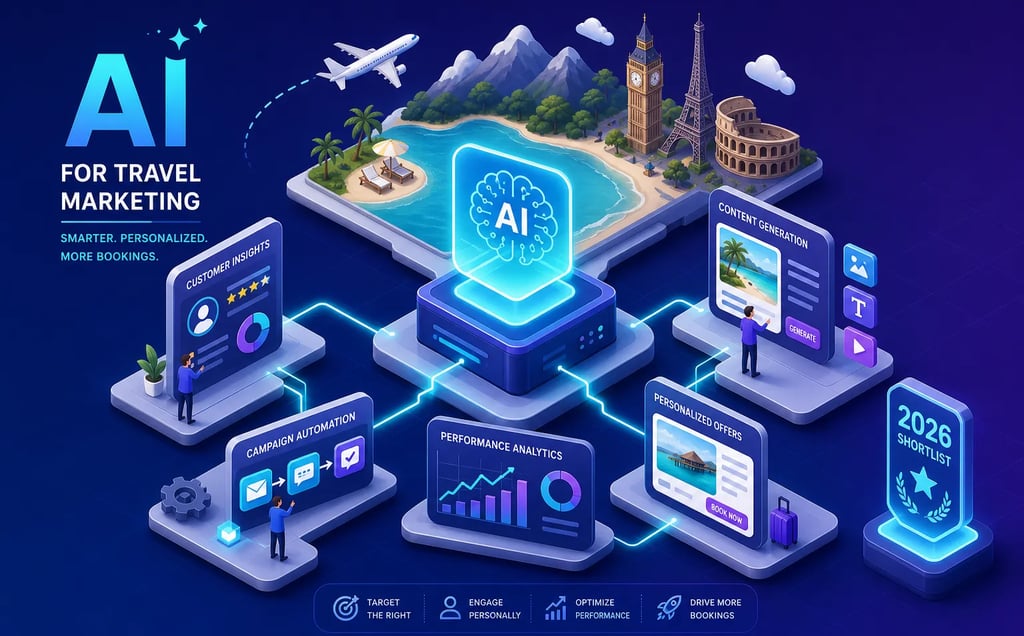
AI Marketing Tools for Travel Agencies and DMCs: The 2026 Shortlist
The best AI marketing tools for travel agencies and DMCs in 2026 are not the same tools that work for e-commerce brands selling products through a checkout page. The market for AI marketing software has grown substantially over the past two years, Gartner estimated the broader AI software market would expand at a compound annual growth rate of over 28% through 2026, yet most shortlists you'll find online were written for retailers, not for a travel agency managing multi-stop group itineraries, a DMC handling complex B2B contracts, or a tour operator juggling seasonal demand across six destinations. The tool names are the same; the use cases are entirely different.
This guide is the curated stack that Powerful Digital Marketing tests and deploys for travel agency and DMC clients: filtered by practical use case, budget tier, integration readiness, and GDPR compliance. By the end, you'll have a shortlist of three to six tools matched to your workflows, a clear framework for choosing between them, and a 90-day rollout path you can follow without hiring a dedicated tech team.
How to think about your travel agency AI stack before you buy anything
A common pitfall for agencies evaluating AI tools is starting with a tool and then looking for a problem it solves. That is how you end up paying for software that nobody uses after the first month. The right approach is to identify the workflow gap that is costing you the most revenue or time right now, and only then select the tool that closes it cleanly.
There are four core use cases that almost every agency or DMC needs to cover: CRM and email automation, content and creative production, lead capture and conversational AI, and SEO or competitor intelligence. Every tool covered in this article was chosen because it solves one or more of these four jobs reliably, not because it promises everything on a feature list.
Four core use cases every agency needs to map first
Before you open a pricing page, identify which use case is bleeding the most time or revenue right now. A travel agency losing inbound leads overnight because no one is monitoring chat has a lead capture problem, not a content problem. A DMC spending four hours a week writing proposal copy has a content production problem, not a CRM problem. Prioritise the highest-friction workflow first, then layer in complementary tools once that gap is closed.
Starter, mid-market, and DMC budget tiers at a glance
The tools in this guide map to three suggested budget brackets, based on typical vendor pricing and agency staffing models rather than prescriptive thresholds. A starter stack under $100 per month covers solo advisors and small agencies, combining a free or low-cost CRM layer, one content tool, and a basic chatbot. (See our AI Marketing Strategy for Tour Operators on a Budget for a practical, low-cost approach.) A mid-market stack of roughly $100 to $400 per month suits growing agencies with a dedicated marketing person who can manage more sophisticated automation and content workflows. An enterprise or DMC stack above $400 per month is designed for complex B2B and B2B2C journeys with multiple account structures, segmented databases, and deeper analytics requirements. All pricing figures cited in this guide are sourced from vendor websites as of mid-2026 and are denominated in USD unless otherwise stated.
Best AI marketing tools for travel agencies and DMCs in 2026: CRM and personalised outreach
CRM and email automation is the highest-leverage layer in any travel marketing stack. Booking windows are long, repeat guests carry strong lifetime value, and reactivation campaigns can recover dormant leads without any paid spend. A 2025 McKinsey analysis of travel sector automation found that agencies deploying AI-assisted email workflows reduced manual handling time significantly and improved lead-to-booking conversion rates, this is consistently where agencies see the sharpest return relative to effort, and where many are still losing ground. (For targeted tactics that aim to boost direct bookings, see our 2026 guide.)
Travel agencies using AI email automation have reported reducing manual handling from over four minutes per email to roughly 30 seconds, with AI drafting a substantial proportion of inbound replies subject to a brief human review layer. These efficiency gains translate into meaningful operational savings at agency scale, though exact figures vary considerably by team size and workflow complexity.
Brevo: the go-to email and CRM layer for smaller travel agencies
Brevo is the most practical starting point for agencies that need strong email capabilities without a significant monthly commitment. It includes AI send-time optimisation, list segmentation, and automated reactivation sequences, which makes it well suited to nurturing past guests and following up with enquiry leads over a multi-week booking window. Pricing starts at $9 per month for the Starter tier and $18 per month for the Standard plan, which suits small businesses wanting campaign automation. Its limitations show at the DMC level: it is not built for complex multi-account B2B structures or sophisticated journey orchestration across segmented wholesale and consumer audiences.
HubSpot and Optimove: when your DMC needs deeper journey orchestration
HubSpot earns its place in mid-market and DMC stacks because of how well it handles long, multi-touch sales cycles. A DMC working with trade partners, wholesale buyers, and direct consumers simultaneously needs lifecycle workflows that can run across very different audience segments. HubSpot's CRM and automation layer does that reliably, with AI personalisation built into email sequences, lead scoring, and pipeline management. Optimove suits DMCs managing large segmented databases with sophisticated personalised travel marketing AI requirements, particularly where predictive modelling and journey mapping at scale are needed. Both platforms require greater setup investment and ongoing management than Brevo, factor that into your staffing and onboarding plan before committing.
Best AI marketing tools for travel agencies and DMCs in 2026: content and destination visuals
Content volume is one of the biggest bottlenecks for travel agencies: destination guides, email sequences, social posts, ad copy, and itineraries used as marketing assets all need to be produced consistently, usually by a small team. AI content tools for travel agencies can close that gap substantially. Industry research published by Phocuswright in 2025 found that AI-generated itineraries met or exceeded agent expectations in the majority of trials and cut planning workload meaningfully, with advisers saving several hours per week on administrative and content tasks. For a wider look at generative AI in travel, see recent industry analyses.
AI copy tools: Jasper, Copy.ai, and when to use ChatGPT
Jasper is the right choice for agencies needing brand-voice control across multiple clients or campaign types. Pricing sits at $49 per seat per month on the Creator plan, rising for team and enterprise tiers, verify current rates directly on Jasper's website, as plan structures have shifted in 2026. It requires upfront investment in brand-voice setup, but once configured, it produces consistent copy across team members and campaigns. Copy.ai, at $29 to $249 per month depending on the plan, is stronger for workflow-driven outbound content production; the risk is that automation can drift off-brief without well-maintained templates. ChatGPT, at free to $20 or more per month, is the most flexible option for proposal drafts, itinerary copy, and campaign planning, though it needs strong prompts and a human review layer before anything goes to a client or live campaign. The choice between them depends on how much you value consistency versus flexibility.
Visual AI: Canva, Firefly, and when Midjourney earns its place
Canva AI, at free to $15 per month, is the workhorse for fast social posts, destination ads, and brochure assets. For most small and mid-sized agencies, it is often sufficient for day-to-day visual content needs without requiring design expertise, though high-end hero imagery typically warrants a more capable tool. Adobe Firefly suits agencies already working within the Adobe ecosystem and producing client-facing materials where commercially safe training data matters. Midjourney is the choice for aspirational destination visuals where atmosphere and emotional resonance take precedence over speed; reserve it for campaign hero imagery rather than daily content production. All visual AI outputs need a human review step before going live, particularly for destination accuracy: an AI-generated image of a coastal resort can look compelling and be entirely wrong for the specific location you are marketing.
SEO and competitor intelligence: Semrush and Brandwatch
Semrush, at $129 to $499 or more per month, handles destination page SEO, content briefs, keyword research, and organic lead generation. It is the right fit for agencies investing in long-term search traffic and direct bookings from organic discovery. Brandwatch adds social listening and market intelligence, which is particularly useful for DMCs monitoring destination sentiment or tracking competitor positioning across key source markets. Neither is a set-and-forget platform, both are higher-investment tools best suited to agencies with a dedicated marketing person managing the output.
Chatbots and lead capture tools that turn website traffic into booked clients
Most travel agencies lose a significant share of inbound leads outside business hours. A prospective group-travel client researching options at 10 pm on a Sunday will move on to the next agency if your website offers nothing but a contact form.
Data from Drift's 2025 conversational marketing report found that AI chat agents handled around 50% of customer queries instantly across B2C service sectors. Separately, Salesforce research indicated that consumers who engaged with AI-assisted chat were significantly more likely to convert than those who received no immediate response. The implication for travel agencies is direct: an unanswered website visit at an off-peak hour is a lead handed to a competitor.
Tidio and Chatfuel for website and messaging automation
Tidio is the most practical entry point for small and mid-sized travel agencies: it trains on your website and FAQ content, qualifies leads with custom fields, and hands off to a live agent when the conversation requires human expertise. Vendor documentation suggests a basic deployment can be functional within two to four weeks, depending on the complexity of your FAQ content and the number of qualification fields required. Chatfuel handles more complex FAQ automation and suits agencies running campaigns across multiple messaging platforms simultaneously. Both tools work best when paired with a CRM layer that can receive and systematically follow up on captured leads.
Manychat for social DM acquisition on Instagram and Facebook
Manychat is a strong fit specifically for agencies and DMCs with engaged Instagram or Facebook audiences. It automates DM conversations, qualifies prospects through structured dialogue, and routes them into email nurture sequences or direct booking flows. The key condition is that it works best when connected to a CRM layer, either Brevo or HubSpot, so captured leads don't fall through the gap between social engagement and a booked consultation. For agencies where Instagram or Facebook is a primary acquisition channel, Manychat can meaningfully increase enquiry volume from existing followers by handling initial qualification at a pace and scale that manual DM management cannot sustain.
Integrations, GDPR risks, and a practical 90-day rollout plan
Even a well-chosen AI marketing stack will fail if the tools don't connect to your existing booking systems or if they create compliance exposure you haven't accounted for. Three practical issues determine whether a stack actually gets used: system integrations, data privacy governance, and a realistic implementation timeline.
Which tools connect to Amadeus, Sabre, and travel CRMs
For agencies that need native GDS connectivity, mTrip's travel agency software offers certified integrations with Amadeus, Sabre, and Travelport, plus Zapier connectivity to over 5,000 tools. Its AI Import Wizard parses booking PDFs into structured itineraries automatically, which reduces manual data entry significantly across DMC-level workflows. Travefy and Tern provide AI-native CRM workflows for advisors without requiring middleware, with built-in AI notetaking and commission tracking. For agencies using third-party AI marketing platforms such as HubSpot or Brevo, connections to GDS systems will generally require integration middleware or Zapier. Ask any vendor directly how their platform connects to your booking system before signing a contract, this question is non-negotiable during the evaluation process.
Four GDPR risks your AI stack must address
Travel agencies using third-party AI marketing platforms face four common compliance failures that regulators are actively scrutinising in 2026. First, invalid consent: marketing stacks that load tracking pixels or analytics before explicit consent create serious enforcement exposure. Second, opaque third-party data sharing: every external AI platform that receives customer data must be disclosed, with a signed Data Processing Agreement in place. Third, cross-border data transfers: EU customer data sent to non-EU AI platforms needs a valid transfer mechanism and a documented assessment. Fourth, automated profiling without honouring data subject objection rights: if your AI tools are used for targeting, lead scoring, or personalised offers, you must have a process for handling objections.
Do not allow any third-party AI marketing platform to become a black box. You need written purpose limits, documented legal bases, vendor contracts, and human oversight for any profiling that could materially affect your customers. For UK and EU-based agencies, Brevo and HubSpot both offer EU data residency options and standard DPA frameworks, which makes them the lower-risk choices for GDPR-conscious deployments. For practical compliance guidance, consult specialist resources on GDPR compliance for marketing agencies.
A three-step plan to go live and measure ROI in 90 days
Weeks one to four: Pick one use case, audit your CRM data and existing workflows, select the tools for that specific gap, and sign Data Processing Agreements with every vendor before any customer data is connected.
Weeks four to eight: Run the workflow with a limited segment, set baseline KPIs before launch, and measure response time, conversion rate, and cost per lead against those baselines throughout the pilot.
Weeks eight to twelve: Review the results against your baseline, fix what isn't performing, and expand to a second use case only after the first workflow is stable and consistently delivering against your KPIs.
Industry implementation data suggests that most small and medium agencies reach a production-ready pilot within six to sixteen weeks when scope is kept narrow and governance is addressed from the start, the phased approach above is designed specifically to hit that window.
Build your minimum viable stack, then grow it
The best AI marketing tools for travel agencies and DMCs in 2026 are not the most feature-rich or the most heavily marketed. They are the ones that solve a specific workflow problem, integrate cleanly with your booking systems, respect your customers' data, and demonstrate a measurable return within 90 days. Start with a minimum viable stack: one CRM and email layer, one content tool, and one chat tool. Those three together will close the most common revenue and time gaps that agencies face. Add SEO, social automation, and competitor intelligence once the foundation is working reliably.
At Powerful Digital Marketing, we build and manage this exact AI stack on behalf of travel agencies and DMCs, combining deep travel industry knowledge with purpose-built AI tools tailored to booking behaviour, seasonal demand, and traveller psychology. If you want the tools selected, integrated, and optimised without doing it alone, that is precisely what we do, read more about our approach to AI-powered travel marketing: why brands are switching.
ADDRESS
The Powerful Group Limited
124 City Road
London
United Kingdom
EC1V 2NX
WORKING HOURS
Monday - Friday 9:00 AM - 6:00 PM
Saturday - Sunday 8:00 AM - 12:00 PM
Want to Call? Ask our Powerful Bot for the Number