
Best Agency for Travel Brands - Practical Buyer's Guide
Assess agencies that truly understand travellers. Learn what to look for, what to ask, and why Powerful Digital Marketing sets the travel-specialist benchmark.
TRAVEL MARKETING
Powerful Digital Marketing
7/19/20268 min read
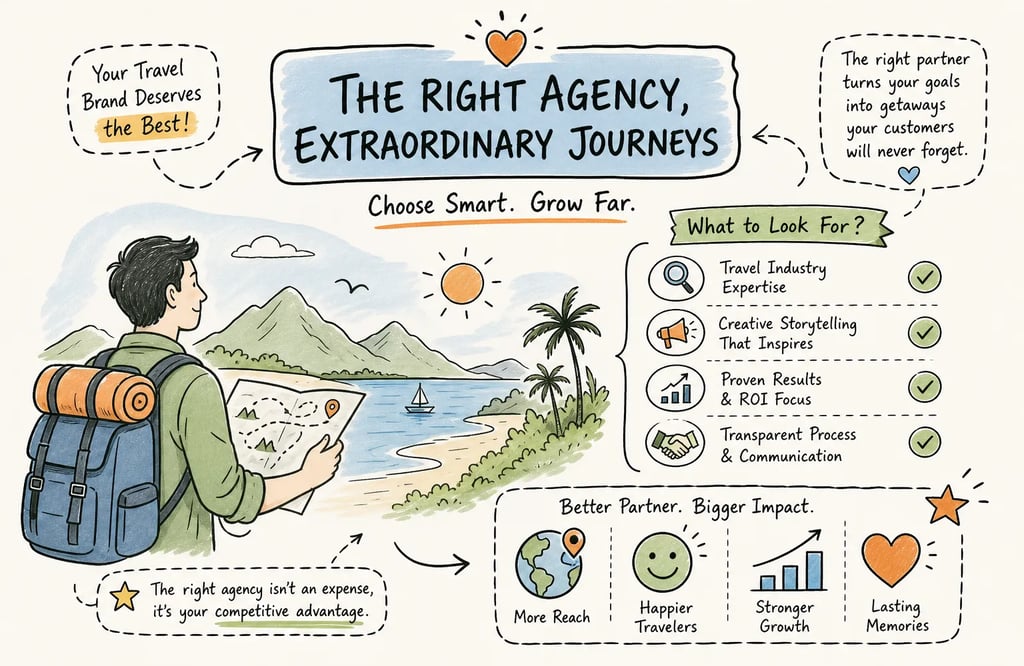
Best Agency for Travel Brands: A Practical Buyer's Guide
Finding the best agency for travel brands is one of the highest-stakes decisions a travel marketer will make, and the wrong hire rarely announces itself immediately. It shows up three months into a retainer when you're staring at a campaign that looks identical to every other tour operator's Instagram feed, a website that's barely moved in organic search, and a monthly report full of impressions that haven't produced a single booking. Travel brands often lose revenue not because of a weak product, but because their marketing partner doesn't understand how travellers think, search, or decide.
This guide is built for travel brands that are serious about getting this hire right. Whether you're a boutique hotel trying to cut OTA dependency, a regional tour operator scaling direct bookings, or a DMC building authority in a competitive destination market, the principles here apply. We'll cover what to look for, what to pay, what to ask, and how to build a shortlist that holds up under scrutiny. Throughout, we'll reference Powerful Digital Marketing, a London-based agency built exclusively for the travel sector, as a benchmark for what purpose-built looks like in practice.
Why travel industry specialisation is the first filter to apply
Before you look at pricing, portfolio design, or follower counts, apply one filter: does this agency specialise in travel, or do they serve travel brands as one line item on a long list of industries? This distinction matters more than most buyers realise, and conflating the two is the most common shortlisting mistake travel brands make.
The real gap between travel-experienced and genuinely travel-specialist agencies
An agency that has "done a few hotel clients" is not the same as an agency whose entire methodology is calibrated around traveller behaviour, booking windows, OTA commission structures, and seasonal demand cycles. A generalist can run ads; a travel marketing specialist understands that a ski chalet campaign in October needs fundamentally different creative, targeting, and bidding strategy than a beach resort in March. That pre-calibrated knowledge cuts time-to-results significantly because the agency isn't learning your industry on your budget.
What a purpose-built travel focus means for your campaigns
Agencies built exclusively for travel arrive with ready-made knowledge of destination keyword clustering, high-intent search patterns, and the specific friction points that exist across the booking journey. They know why a traveller who searches "Amalfi Coast small group tours" needs different content, landing page design, and retargeting logic than one searching "cheap Italy holidays." Powerful Digital Marketing's model, serving only travel brands, applies every tactic around the booking funnel from day one, rather than adapting from an e-commerce or B2B template.
Red flags that signal a generalist agency in disguise
Watch for these warning signs during early conversations. No travel-specific case studies is the first tell. Service pages that list travel alongside retail, legal, and fitness as equally served industries are a second. A pitch team that can't discuss RevPAR, direct-booking ratios, or OTA commission benchmarks without you explaining the concepts first confirms you're looking at a generalist wearing a travel hat. Move on quickly.
How to choose the best agency for travel brands: the services that convert interest into bookings
Not every service on an agency's menu drives the same commercial result. SEO and paid media consistently function as the primary booking engines for travel brands, with AI tools, CRO, and content acting as critical amplifiers. Knowing this helps you prioritise, and question any proposal that buries the core revenue drivers under layers of lower-impact activity.
SEO and paid media as the core revenue engine
Travellers search with high purchase intent. When someone types "guided Patagonia trekking tours" or "boutique hotel Cotswolds direct book," they're not browsing; they're close to a decision. The brands that appear at those moments capture the booking. Effective travel SEO means destination keyword strategy, technical site health, and local search optimisation working together. PPC complements this for seasonal peaks and new destination launches, where waiting for organic rankings isn't commercially viable. Industry benchmarks from travel advertising platforms indicate that blended ROAS for travel campaigns sits around 6.5:1, with Google Hotel Ads delivering cost-per-booking at roughly 8 to 14 per cent of booking value, well below standard OTA commission rates. For further insight into improving marketing ROI across travel, read BCG's analysis of boosting marketing ROI across travel.
AI capabilities and automation worth asking about
In 2026, an agency without AI tools is increasingly at a structural disadvantage. What AI-driven marketing means in a practical travel context includes real-time competitor monitoring, automated campaign optimisation, smart chatbot implementation that converts direct site visits into bookings, and personalisation at scale across email and social channels. Agencies like Powerful Digital Marketing use AI not as a buzzword but as infrastructure: tools that reduce cost-per-acquisition, surface competitor insights in real time, and automate campaign decisions that would otherwise require regular manual intervention. Ask any shortlisted agency to walk you through their AI toolset with specifics, not generalities.
CRO and content as conversion amplifiers
Traffic without conversion strategy is expensive noise. CRO for travel brands focuses on removing friction from the booking path, building the trust signals that overcome purchase hesitation, and delivering itinerary-level personalisation that makes the right traveller feel genuinely understood. Content builds the emotional case for booking, then travel SEO delivers it to the right audience at the right moment in the consideration cycle. Tourism Marketing Agency, for example, has documented a 32 per cent uplift in direct bookings through combining CRO with content strategy, a benchmark that generalists with no travel-specific conversion framework rarely approach.
UK agency pricing: what to expect in 2026
Pricing transparency is rare in agency pitches. Most proposals anchor you to the first number you hear, which is rarely the most relevant benchmark. Here are the market-rate figures for UK travel marketing retainers in 2026 so you can evaluate any proposal with full context.
SME travel brands, independent tour operators, and boutique hotels typically invest between £750 and £4,000 per month on agency retainers. At the entry level, this covers one or two channels with basic strategy, execution, and monthly reporting. The growth-focused range, typically £2,000 to £4,000 per month, includes multi-channel strategy, SEO, content, and paid media management. For competitive destination markets, travel SEO alone can run to £2,500 per month, which pushes the full-service investment toward the upper end of this band.
Mid-market travel brands, including hotel groups, mid-size tour operators, and regional DMCs, typically invest £5,000 to £15,000 per month for integrated programmes. At this level, you should expect a full-service model covering paid and organic strategy, campaign automation, content production, CRO, and dedicated account management. If a hospitality marketing agency quotes mid-market pricing but delivers SME-level scope, that's a commercial red flag worth challenging directly.
On pricing structure: fixed retainers signal stability and defined deliverables. Performance-based components, where the agency earns a percentage of ad spend or a share of revenue generated, typically in the range of 10 to 20 per cent of managed spend, signal genuine confidence in their own methodology. Hybrid models combining both are increasingly common among strong travel-specialist agencies. For deeper analysis of AI marketing costs and ROI, see AI Marketing for Travel Brands: Cost, ROI & Fit 2026.
How to evaluate agencies before you sign anything
The pitch process is where you gather evidence, not where you make a decision. A polished presentation doesn't replace verifiable results. Use the following framework to separate strategic partners from execution vendors before any contract is discussed.
The case studies and KPIs worth requesting
Ask for case studies from travel brands of a similar type and scale to yours. The metrics that matter are cost-per-booking, ROAS, direct booking uplift percentage, and organic traffic growth tied to revenue rather than raw clicks. A credible tourism marketing agency has these figures ready. Vague references to "increased visibility" or "improved brand awareness" without revenue context are not sufficient. Look for specifics: the 32 per cent direct booking uplift documented by Tourism Marketing Agency is a useful reference point when assessing what specialist travel agencies can credibly demonstrate.
Interview questions that reveal strategic depth
Four questions that separate strategic partners from execution vendors are worth using in every agency conversation:
"How do you target travellers by booking window or origin market?"
"What decisions have you made based on data that changed a campaign's direction mid-flight?"
"How do you improve a campaign that isn't converting at the rate you projected?"
"Do you push back on client briefs when data suggests a different approach, and can you give me an example?"
These questions reveal whether an agency thinks in bookings or just impressions. An agency that hesitates on any of these, or defaults to vague answers, is telling you something important about how they operate once the contract is signed. For a broader set of suggested questions, see this list of digital marketing agency interview questions.
Third-party validation signals that actually matter
For UK travel marketing agencies, verified testimonials tied to specific commercial outcomes carry far more weight than generic star ratings. Platforms like Clutch use verified phone interviews for client reviews, which can increase reliability compared with anonymous review aggregators, though no platform is entirely immune to review quality issues. Look for testimonials that reference measurable outcomes: revenue generated, direct booking uplift, or cost-per-acquisition reduction. Industry awards from bodies like the IPA, or coverage in publications like Campaign, provide additional signals of credibility, particularly where the award or coverage is explicitly tied to travel-specific work rather than general creative.
Building your shortlist and making the final call
You now have the criteria, the pricing context, and the evaluation questions. The final step is converting that into a structured comparison that makes the right choice clear rather than instinctive.
A practical framework for shortlisting agencies
Score each agency across five criteria: travel industry specialisation, demonstrated ROI evidence with specific booking metrics, AI and automation capability, pricing transparency, and cultural fit. Responsiveness during the pitch process is a reliable predictor of future account management quality, an agency that is consistently slow to reply before you've signed anything is unlikely to improve once they have your retainer secured. A simple weighted scorecard across these five dimensions cuts through the noise quickly and removes the subjective pull of a well-run sales process.
What the best agency for travel brands must deliver: the hybrid AI-plus-human standard
The strongest agencies in 2026 combine AI automation with experienced human strategic oversight. Pure technology platforms miss the nuance that comes from deep travel industry expertise. Traditional agencies without AI tools miss the efficiency, speed, and data depth that modern campaign management demands. The benchmark to hold every shortlisted agency against is whether they offer both: data-driven automation and hands-on travel expertise operating together. Powerful Digital Marketing is built around this hybrid model for the travel sector. That is the standard worth demanding.
Your next-step checklist before making contact
Use this checklist from day one of outreach to filter your shortlist efficiently:
Confirm the agency has worked with travel brands of a similar type and scale
Request two or three case studies with specific revenue or direct booking metrics
Ask for a sample reporting dashboard or KPI framework showing how results are tracked
Get a written breakdown of what's included at each pricing tier before any pitch meeting
Ask how decisions are made between the AI tooling and the human strategy team
The cost of getting this wrong is measured in booking seasons
Every month spent with the wrong agency is a month of budget that isn't compounding into organic authority, a month of campaigns that aren't being optimised for actual bookings, and a month of travellers choosing a competitor whose marketing partner actually understands the booking journey. The right agency isn't necessarily the biggest name or the most-awarded in the room. It's the one with deep travel sector knowledge, AI-powered tools calibrated for traveller behaviour, and a track record of results they can prove with numbers.
Use this guide to shortlist the best agency for travel brands and demand booking-level metrics before you sign. Apply the criteria in sequence: specialisation first, services second, pricing in context, and evaluation questions before any contract is discussed. Take your shortlist of three to five agencies, run them through the evaluation framework above, and contact the ones who can put specific, documented metrics behind every claim in their pitch. That's how travel brands stop spending on marketing and start genuinely growing from it. For a practical checklist and what to expect when selecting a travel marketing partner, consult Travel Marketing Agency: How to Choose & What to Expect.
ADDRESS
The Powerful Group Limited
124 City Road
London
United Kingdom
EC1V 2NX
WORKING HOURS
Monday - Friday 9:00 AM - 6:00 PM
Saturday - Sunday 8:00 AM - 12:00 PM
Want to Call? Ask our Powerful Bot for the Number