
Travel digital marketing agency - How to hire the right one
Avoid costly agency mismatches. Learn five criteria to evaluate and hire a travel digital marketing agency with sector expertise, AI tools and benchmarks.
AI NEWS
7/10/20268 min read

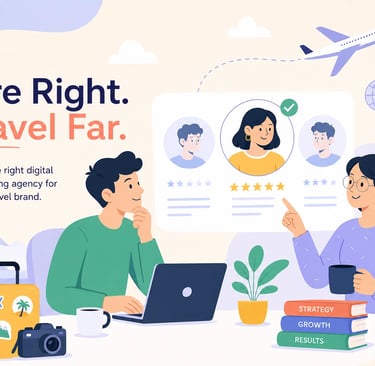
How to hire the right travel digital marketing agency
When travel brands fail to hire a travel digital marketing agency that truly understands their industry, the budget drain is real and ongoing. A generalist agency might know how to run a Meta campaign or build a backlink profile, but without a working knowledge of booking windows, seasonal demand curves, and how travellers move from inspiration to reservation, the result is traffic without transactions. You get impressions; you don't get guests.
This guide gives travel brand decision-makers a structured, practical framework for evaluating, briefing and hiring a travel digital marketing agency. Whether you're a boutique hotel trying to reduce OTA dependency, a tour operator competing against larger brands, or a DMC building visibility in a crowded market, the criteria here apply directly to your situation. The standard to measure every shortlisted agency against is one built exclusively for the travel sector, combining deep destination marketing knowledge with AI-powered capabilities, the model that Powerful Digital Marketing is designed around.
By the end, you'll have the criteria, the questions and the benchmarks to make the right hire with confidence, rather than discovering the mismatch three months and several thousand pounds into a contract.
Why hiring the wrong agency costs travel brands more than they realise
The real price of generalist marketing in a specialist industry
Misaligned agency strategy doesn't just produce disappointing results; it produces actively harmful ones. Poorly structured PPC campaigns burn through budget targeting travellers at the wrong stage of the booking journey. Content written without destination-specific search intent misses the queries that actually convert. SEO approaches borrowed from e-commerce or B2B ignore the research-to-reservation micro-moments that define how travellers actually behave online. In multiple documented cases, specialist travel SEO and PPC agencies have generated more qualified leads at a lower effective cost per acquisition precisely because their strategies are calibrated for travel from the start, not adapted from an unrelated industry.
The data illustrates this clearly. Examples from specialist travel campaigns include ROAS of 6x to 18x and year-on-year revenue uplifts of 63% to over 300% (see case studies cited in the Proven ROI section below). The gap between specialist and generalist performance isn't marketing hyperbole; it's the measurable outcome of category expertise applied correctly. The ongoing industry debate about a generalist or specialist agency is relevant here: specialisation often drives the contextual knowledge that produces those superior outcomes.
What "travel expertise" actually means in practice
Surface-level familiarity is not expertise. An agency that has "worked with one hotel before" is not a hospitality marketing agency. Genuine travel sector depth means understanding booking windows and how they compress or extend by destination type, seasonal demand curves that shift dramatically by market, look-to-book ratios, OTA dependency dynamics, and the specific stages of the traveller research journey where intervention produces results. Without this, even a technically competent agency will apply the wrong tactics at the wrong moments and misread the data when trying to explain why campaigns aren't converting.
How to hire a travel digital marketing agency: the five criteria that matter
Industry depth and AI capabilities working together
The strongest travel marketing agencies in 2026 combine deep sector knowledge with AI-powered tools for audience segmentation, real-time competitor analysis, campaign automation and personalisation across the booking funnel. Platforms such as Albert AI for campaign optimisation, Semrush's AI visibility features for competitor intelligence, and Optimove for CRM journey mapping are widely available. What separates a travel specialist from a generalist isn't access to these tools; it's the pre-calibrated strategies that make them effective for traveller behaviour specifically.
Powerful Digital Marketing operates on exactly this principle: every workflow, AI tool and campaign framework is designed around how travellers search and book, rather than adapted from a retail or B2B template. When evaluating any agency, ask specifically how their AI capabilities are configured for travel and destination marketing, not just which platforms they subscribe to. For a curated shortlist of recommended tools tailored to travel, see AI Marketing Tools for Travel Agencies, 2026 Shortlist. That question alone will reveal a great deal about the depth of their expertise.
Proven ROI: what good case studies actually show
Strong case studies from travel-specialist agencies quote specific, verifiable outcomes: ROAS figures, percentage increases in direct bookings, reductions in cost per lead, and organic keyword growth in destination-specific search terms. Documented results from credible travel campaigns, drawn from published case studies by specialist agencies including Inflow, AAMP and Propellic, include 18.73x ROAS for a shore excursions operator, 300% booking increases for tour operators, and 87% reductions in cost per lead for sports travel companies. If an agency presents case studies that reference vague "improvements in brand awareness" without supporting booking or revenue data, treat that as a significant gap. For a deeper look at how AI affects cost and ROI for travel brands, also consult AI Marketing for Travel Brands: Cost, ROI & Fit 2026.
Team structure and client-to-strategist ratios
A dedicated strategist should carry no more than five to ten active clients, a threshold supported by agency operations research on sustainable service delivery. Ratios higher than this signal service quality issues regardless of how compelling the agency's credentials appear during a pitch. Ask directly: how many clients does the strategist assigned to your account currently manage? If you want to go further, ask to speak with one of their existing clients about responsiveness and day-to-day account management. The answers will tell you more about what your experience will be than any testimonial on their website.
What to expect when you hire a travel digital marketing agency: questions and red flags
The seven questions every travel brand should ask before signing
These questions aren't formalities; they're filters. Ask each one and pay attention not just to the content of the answer but to how confidently and specifically it's delivered. A strong answer is detailed and references your specific context; a weak one pivots to generalities. For an expanded checklist of vetting questions, see the 10 most crucial questions to ask when vetting an ad agency.
Sector specialisation: What travel clients have you worked with, and can you show us measurable results from those engagements?
Strategy customisation: Is your approach adapted to our specific booking cycle, audience and seasonality, or do you apply a standard framework across clients?
Lead quality: How do you filter out low-value enquiries and ensure the traffic you generate is qualified for booking?
Digital asset ownership: If we end the contract, do we retain full ownership of our website, ad accounts, content and analytics data?
KPI reporting: Which specific metrics will you report on, and how frequently will we review performance together?
Budget flexibility: Can we adjust channel allocation based on results, or are we locked into a fixed spend distribution?
Exit terms: What are the notice period and termination conditions, and is there an exit clause in the contract?
Red flags that should disqualify an agency immediately
Any agency that guarantees specific booking numbers or ranking positions is either misleading you or doesn't understand how digital marketing works. No reputable agency can guarantee results; they can commit to process, transparency and targets. Equally, a one-size-fits-all approach applied without reference to your specific market, booking cycle or traveller persona signals that the agency will produce generic output regardless of the brief.
Other disqualifiers include the absence of a dedicated account contact, "dashboard only" service models where the client manages their own content, and any refusal to include an exit clause in the contract. A trustworthy agency welcomes these questions without deflecting. One that becomes defensive when asked about exit terms or asset ownership is communicating something important about how the relationship will go.
What the first 90 days with a new agency should look like
Onboarding milestones and the deliverables to expect
Onboarding for most travel brands takes two to four weeks, covering contract signing, access collection across analytics platforms, booking engines and ad accounts, and an initial kickoff to align on strategy and communication cadence. The first meaningful deliverable should arrive within 30 days: typically a technical site audit, a competitor keyword analysis, or the launch of an initial PPC campaign targeting specific travel search terms. By month two, the full strategy framework should be active and under review. Months four to six should include a formal 90-day performance review and a scaling plan for the channels producing results. To ensure you don't miss critical steps, use a client onboarding checklist for digital marketing agencies.
KPIs to agree on before the work begins
These metrics need to be agreed in writing before any campaign launches, not established after the first reporting cycle when convenient framing becomes tempting. The core KPIs for travel brands include: conversion rate from organic and paid traffic, cost per booking enquiry, ROAS on paid campaigns, growth in direct booking revenue versus OTA-sourced revenue, and keyword ranking improvements for destination-level search terms. For brands focused on longer-term growth, also track customer lifetime value and the LTV:CAC ratio, a healthy benchmark sits at 3:1 or above. If your agency cannot define these metrics clearly before work begins, that's a problem worth addressing before you sign anything. For a comprehensive reference of digital marketing KPIs, see this digital marketing KPIs, 100 metrics reference.
Understanding travel agency pricing and what your budget should deliver
Typical pricing structures for travel digital marketing services
Tiered monthly SEO packages for travel brands in the UK typically range from £1,249 per month for early-stage brands requiring technical SEO and content foundations, up to £2,449 per month for full AI-assisted, multi-channel programmes targeting competitive global markets. Full-service bundles covering SEO, PPC, content and social media management start at approximately £3,800 per month. Hourly rates across specialist travel agencies range from £40 to £150 depending on team size and depth of sector expertise. Influencer campaigns are generally project-priced from £2,000 upwards depending on reach and activation complexity. These figures reflect current UK market pricing compiled from specialist travel agency rate cards and industry surveys.
How to match your budget to realistic outcomes
A credible agency will tell you directly whether your budget is appropriate for your goals and what trade-offs exist if it isn't. If an agency agrees to deliver everything on your stated scope for a figure that doesn't hold up to scrutiny, that's not a bargain; it's a warning. A phased approach that prioritises high-ROI channels first is the mark of a strategist. Starting with paid search to generate immediate qualified traffic while building organic SEO authority in parallel is a sound sequencing model for most travel brands. Agencies that push for maximum scope from month one without a clear rationale are prioritising their revenue, not your results.
How to shortlist, brief and make your final decision when hiring a travel digital marketing agency
Building a briefing document that gets you better proposals
A well-structured briefing document filters out agencies that respond with generic proposals. Include your current marketing performance benchmarks, target traveller personas, key booking periods and seasonal peaks, your direct booking versus OTA ratio and where you want to get to, your budget range, your existing technology stack, and the KPIs the chosen agency will be held accountable to. Agencies that engage specifically with this context in their proposals are demonstrating the kind of strategic thinking you want managing your campaigns. Those that respond with a standard deck that could have been sent to anyone are showing you exactly how they'll treat your account.
Making the final call: what the right agency looks like
The right travel digital marketing agency asks more questions than it answers in the early stages. It demonstrates genuine understanding of your market, your travellers and your booking funnel before proposing a solution. It references your specific seasonality, your look-to-book challenges and your OTA dependency in ways that confirm it has actually absorbed your situation, not simply skimmed your brief. Powerful Digital Marketing is built on this model: a travel-exclusive agency combining AI-driven strategy with experienced human oversight, calibrated specifically for how travel brands grow. If you're evaluating agencies and want a benchmark for what genuine travel-sector expertise looks like in practice, it's a sensible starting point for comparison, see Travel Marketing Agency: How to Choose & What to Expect.
The decision framework in summary
Six filters separate the right travel digital marketing agency from an expensive mistake: specialisation depth, AI capability configured for travel and destination marketing, measurable ROI evidence from comparable clients, a sound onboarding structure with clear 30-day deliverables, transparent pricing with realistic outcome alignment, and contractual flexibility including a clean exit clause and full digital asset ownership on departure. Apply all six before committing to any agency, regardless of how impressive their pitch presentation is.
Use the briefing document approach to generate comparable proposals from your shortlisted agencies rather than evaluating pitch decks in isolation. Pitch decks are designed to persuade; structured briefs reveal whether a travel advertising agency can actually think strategically about your specific business, your booking windows and your competitive landscape.
Generic marketing built for a generic traveller who doesn't exist has a measurable cost, in wasted spend, lost direct bookings and OTA commissions that a better strategy would have avoided. Whether you open a discovery conversation with Powerful Digital Marketing or use this guide to pressure-test other contenders, the standard is clear: travel-specific expertise that connects directly to bookings and demonstrable revenue growth. For practical advice on onboarding and agency fit, also consider reviewing AI Marketing for Travel Brands: Cost, ROI & Fit 2026 as a companion read.
ADDRESS
The Powerful Group Limited
124 City Road
London
United Kingdom
EC1V 2NX
WORKING HOURS
Monday - Friday 9:00 AM - 6:00 PM
Saturday - Sunday 8:00 AM - 12:00 PM
Want to Call? Ask our Powerful Bot for the Number