

How to Lower Travel Marketing Costs Without Losing Bookings
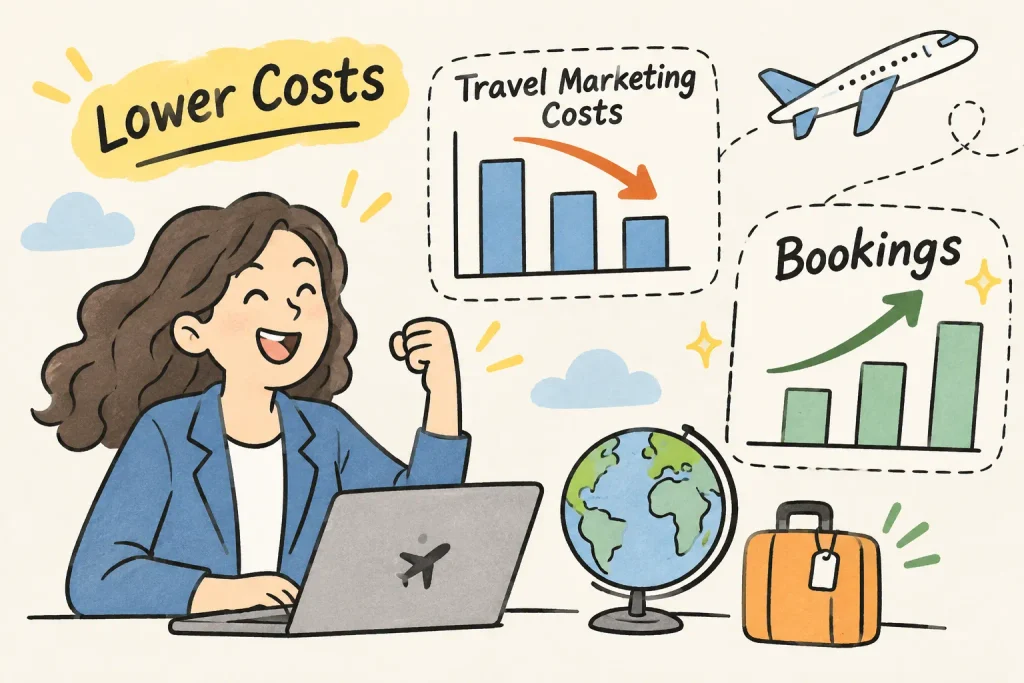
Expect savings in stages. The real test is cost per booking and profit, not a smaller invoice at the end of the month.
We’re Powerful Digital Marketing, a London-based agency that works only with travel brands, and our AI-plus-human approach shaped this playbook. Below you’ll find a step-by-step plan, benchmark ranges, a savings scorecard to check that bookings are safe, and a short illustrative example.
Key takeaways
- Measure profit first: Judge every channel on cost per booking and gross profit, not clicks or revenue.
- Cut waste before demand: Negative keywords, audience suppression and tracking fixes come before any budget cut.
- Build your own assets: Your email list and website are yours to keep, while organic search still depends on search engines. SEO and email take longer, but they can stop you paying twice for the same traveller.
- Change one lever at a time: Pause any cut where bookings or gross profit fall across a full booking cycle.
Where is your travel marketing budget actually leaking?
Work out your true cost per new customer and per booking
Customer acquisition cost (CAC) is your total sales and marketing costs divided by the number of first-time customers. Count ads, agency fees, marketing staff, software, commissions and content, not just ad spend.
If one customer makes several bookings, track two numbers. Customer CAC is the cost per new customer, and booking CPA is the marketing cost per booking. Mixing them hides which channels are really finding new travellers.
Measure profit, not just revenue
Marketing ROI works from incremental gross profit: booking revenue minus supplier costs, payment fees and variable service costs.
Then compare lifetime value with CAC. A campaign that looks weak on the first booking can still pay back through repeat trips. A lifetime value of around three times CAC is a common illustrative target, not a universal rule, so set your own threshold from your margins.
Spot the usual suspects in a quick budget-leak audit
Run this audit against your last quarter. Set aside a short, fixed block of time, as the aim is to find the obvious leaks rather than a perfect answer:
- Channels with no booking tracking
- Broad terms such as “holidays” instead of specific destinations and experiences, which pull in unwanted searches for a UK-focused campaign
- No negative keywords
- Ads shown to people who already booked
- Overspend at peak season
- OTA commissions paid on guests you could rebook directly
Track results by channel, destination, season and customer segment, and deduct cancellations and refunds, because a booking that cancels isn’t a saving.
How to lower travel marketing costs with SEO and direct channels
Why organic search pays back over time
Shifting spend to organic search can work, but not overnight. SEO builds an asset instead of renting traffic. Target specific searches such as “family activities in [destination]” or “best weekend tours near [city]”, and keep your Google Business Profile fully updated.
According to AtlasPerk, SEO can start reducing CAC for tour operators in roughly three to six months, though modestly at first, with a measurable improvement usually taking six to twelve months. These timelines are illustrative and vary by market, competition and starting point. Keep a trimmed paid baseline running while organic builds.
How do OTA commissions compare with direct booking costs?
OTAs usually cost more per reservation, but direct isn’t free. According to Cloudbeds, OTA commissions typically run 15-25% of booking value, sometimes 30% or more with premium placement. Hospitality Net puts direct booking at roughly 5-12% all-in for many established operations. Check each figure’s source and date before using it in your own planning, as the gap is not a guaranteed saving and depends on the actual costs you compare.
| Cost component | OTA | Direct booking |
|---|---|---|
| Acquisition cost | 15-25% of booking value, sometimes 30%+ (Cloudbeds) | Roughly 5-12% all-in for established operations (Hospitality Net) |
| Payment processing | Often bundled | About 2.9% + $0.30 per transaction (RateGain, quoted in US dollars; UK rates will differ, so check your own provider) |
| Marketing and technology | Usually included in the commission, though extra fees may apply | SEO, ads, email, booking engine and CRM costs |
| Customer data | Often limited, with weaker remarketing | Generally greater access to customer data and remarketing opportunities, subject to consent and data-protection rules |
The direct range is described as all-in, so check whether your own figure already includes payment processing to avoid counting it twice. In Operto’s example, an 18% commission on a $250 booking costs $45, against a modelled direct cost of $19 (both in US dollars). The caveat is that first-time guests aren’t automatically cheaper direct, and small or new properties may still need OTAs for visibility. Shift repeat and high-intent guests first.
Use email and retention to stop paying twice
Four lifecycle journeys are worth setting up: abandoned-booking, pre-departure, post-trip review requests and re-engagement. A welcome email is a useful addition too. According to AtlasPerk, the average rebooking interval for tour operators is about 312 days, so a win-back sequence around months nine to ten is a sensible test.
Offer low-cost direct perks such as flexible cancellation, a flexible departure date or a free add-on excursion instead of discounts. Add a modest referral reward, and past guests can become a cheaper acquisition channel.
How do you stop wasting money on PPC and paid social?
Fix tracking and attribution before touching budgets
Connect your ad platforms to the booking engine, CRM and phone sales. Use an attribution window that fits long travel research cycles, not just same-day conversions. Feed confirmed bookings, cancellations and margin back into bidding, so a cheap lead that never books stops earning the same value as a profitable reservation.
A 2026 benchmark from Digital Applied estimates 23% of travel PPC budget is wasted through poor targeting or fraud. Treat that as a reason to audit, not a promise. Your own search-term reports give the real figure.
Tighten targeting to lower travel marketing costs in paid media
Separate brand, destination and high-intent campaigns, each with its own budget and landing page. Add negative keywords for jobs, free, maps and weather. Suppress recent bookers from prospecting audiences, and use consented first-party audiences for exclusions and lookalikes.
Match channel to funnel stage. Use social for inspiration, search for active demand, and remarketing for browsers who didn’t book.
Control seasonal bidding and creative testing
Don’t max out spend at peak, when competitors inflate prices and some travellers would book anyway. Keep a smaller baseline and move incremental budget to shoulder periods.
Judge creative on cost per qualified enquiry and booking rate, not click-through rate, and audit placements for invalid traffic. The priority order is measurement, then irrelevant demand, then converted users, then targeting, creative and seasonality.
What can campaign automation save, and what does it look like in practice?
Which repetitive tasks should you automate first?
Start with bid and budget adjustments, search-term clean-up, audience exclusions, email journeys and reporting. A suitably configured setup can save staff time and monitor campaigns more often than a monthly review, though it won’t catch every problem. That matters in travel, where a leaking campaign can burn through a weekend of budget before anyone notices.
What this looks like in practice: a hypothetical tour operator
Imagine a mid-size tour operator with rising PPC costs, scattered tracking and heavy OTA reliance. This is a hypothetical example, not a client story, and it carries no results.
Software could handle booking-level bidding, automated search-term pruning, audience suppression and email triggers. The team would set travel-specific seasonality, make offer and creative decisions, and run budget reallocation reviews. The aim is a lower cost per booking, checked against gross profit.
Why the human layer still matters
AI handles speed and pattern-spotting. Experienced travel strategists decide where to cut and where to invest, and that judgement is what protects bookings. This hybrid model is what Powerful Digital Marketing is built on: faster optimisation from the technology, and decisions on where to cut from people who know booking cycles.
What savings should you realistically expect, and how do you know bookings are safe?
Benchmark timelines and cost comparisons by tactic
This table sets out where each saving shows up and the cost comparisons the research supports. It doesn’t give a savings percentage per tactic, because results vary by brand, season and starting point and no reliable range exists for every tactic. Timelines for the first four rows are unvalidated planning assumptions, not researched benchmarks.
| Tactic | Effort | Planning timeline (assumption) | Where the saving shows up |
|---|---|---|---|
| PPC clean-up and negative keywords | Low | Weeks | Lower wasted spend |
| Audience targeting and suppression | Low to medium | Weeks | Fewer paid reacquisitions |
| Campaign automation | Medium | Varies | Staff time, more frequent waste monitoring |
| Email and retention | Medium | Varies | Repeat bookings, lower CAC |
| SEO shift | High | Six months or more (AtlasPerk, illustrative) | Organic CAC against paid CAC |
| Direct versus OTA | Medium to high | Ongoing | The gap between Cloudbeds’ 15-25% OTA commissions and Hospitality Net’s 5-12% direct cost, which depends on your actual costs |
Build a simple savings scorecard
Track these monthly: CAC, cost per booking, conversion rate, average booking value, gross profit, return on marketing spend, repeat-booking rate and cancellation rate. Use one dashboard and one set of definitions.
The rule of thumb is to cut in stages and change one lever at a time. Pause any cut where bookings or gross profit drop for a full booking cycle.
Red flags that you’ve cut too deep
- Falling branded search: This may signal that awareness is thinning, though seasonality and other factors can also move it. If it persists, restore social and destination prospecting at a small baseline.
- Shrinking enquiry volume: Reopen the high-intent campaigns you trimmed first.
- Dropping remarketing pools: Rebuild audiences with consented first-party data and a modest retargeting budget.
- Rising OTA share: Strengthen direct perks and email, and check your booking path.
Conclusion: lower travel marketing costs by cutting waste, not demand
The sequence is simple. Measure profit, trim wasted PPC and paid social, shift demand to SEO and your own channels, automate repeat work, then check every result against bookings and gross profit. The aim is to lower travel marketing costs while cost per booking and profit move in the right direction.
Start this week by auditing your last quarter’s cost per booking, channel by channel. If you’d like to talk through your travel marketing, get in touch with Powerful Digital Marketing.
Frequently Asked Questions
What is the difference between customer acquisition cost and cost per booking?
Customer acquisition cost is your total sales and marketing costs divided by your number of first-time customers, while cost per booking measures marketing cost per booking. Track both if customers make several bookings, so you can see which channels bring in new travellers.
How long does SEO take to reduce travel marketing costs?
SEO can start reducing customer acquisition costs in roughly three to six months, with measurable improvement usually taking six to twelve months. These are illustrative timelines that vary by market, competition and starting point, so keep a trimmed paid baseline running while organic search builds.
Should we move all our bookings away from OTAs?
You do not need to move all your bookings away from OTAs, as small or new properties may still need them for visibility. Shift repeat and high-intent guests first, and compare your actual direct costs with OTA commissions before assuming a saving.
What should we do if bookings fall after a budget cut?
Pause the cut if bookings or gross profit fall across a full booking cycle. Change one lever at a time and use your scorecard to track cost per booking, gross profit and other measures each month.